WhatsApp Business Marketing in India: AI Automation Strategies for D2C Brands to Increase Sales in 2026
India is the world’s largest WhatsApp market, with over 500 million active users. That is not just a statistic it is the single most important marketing reality for every direct-to-consumer brand operating in this country. Your customers are on WhatsApp. They are chatting with family, sharing memes, making payments through UPI, and increasingly, discovering, evaluating, and buying products all within the same app.
The brands capturing that opportunity in 2026 are not doing it by manually messaging customers one at a time. They are building intelligent WhatsApp business marketing systems powered by AI automation that deliver personalised, timely, and conversion-optimised communication at scale. Whether you are a bootstrapped D2C brand in Bangalore or a Series-B funded ecommerce company in Mumbai, this guide gives you the exact strategies, tools, and frameworks to build a WhatsApp growth engine for your business.
Key Insight: WhatsApp messages in India achieve open rates above 90% — compared to 20-25% for email. For D2C brands competing in a crowded paid media landscape, no other channel offers this level of direct customer attention.
Why WhatsApp Business Marketing Is the #1 Channel for Indian D2C Brands in 2026
The Indian digital commerce landscape has a unique characteristic that makes WhatsApp marketing different here than anywhere else in the world: trust travels through WhatsApp. When an Indian consumer receives a WhatsApp message from a business particularly one with a verified green tick it carries credibility that no Instagram ad or email campaign can replicate. It arrives in the same space where they communicate with the people they trust most.
The numbers that make the case
500M+ WhatsApp users in India | 90%+ message open rate | 3x higher conversions vs email for Indian D2C brands
For Indian WhatsApp marketing for D2C brands, the channel advantage is amplified by three structural trends unique to the 2026 Indian market:
- Rising customer acquisition costs on Meta and Google: CPMs have increased significantly post-ATT. D2C brands that built over-reliance on paid social are now looking for owned channels. WhatsApp is the most powerful owned channel available in India.
- UPI and WhatsApp Pay integration: The convergence of messaging and payment within a single app creates a frictionless purchase journey that no other channel in India currently replicates.
- Tier 2 and Tier 3 city penetration: WhatsApp is the primary digital communication channel for hundreds of millions of Indians outside the top metros. For D2C brands expanding beyond urban India, whatsapp marketing india is not optional it is the primary route to these customers.
Understanding the WhatsApp Business Ecosystem in India
Before building your WhatsApp business marketing strategy, it is essential to understand the three distinct layers of the WhatsApp Business ecosystem because your choice of which layer to operate in determines everything that is possible.
Layer 1: WhatsApp Business App (Free)
The free WhatsApp Business app supports basic marketing functionality: automated away messages, quick replies, a product catalogue, and a business profile. It works from a single device and handles one conversation at a time. For very early-stage businesses handling fewer than 50 customer conversations per day, this is a viable starting point.
The limitation is absolute: no bulk messaging, no AI automation, no multi-agent inbox, no CRM integration, no analytics beyond basic read receipts. The free app is not a whatsapp marketing strategy it is a customer service tool with limited marketing capability.
Layer 2: WhatsApp Business API
The WhatsApp Business API is the foundation of every serious WhatsApp business marketing operation in India. It unlocks bulk messaging to opted-in contacts, full AI chatbot integration, CRM connectivity, multi-agent team inbox management, broadcast campaigns to unlimited contacts, detailed analytics, and template message approval.
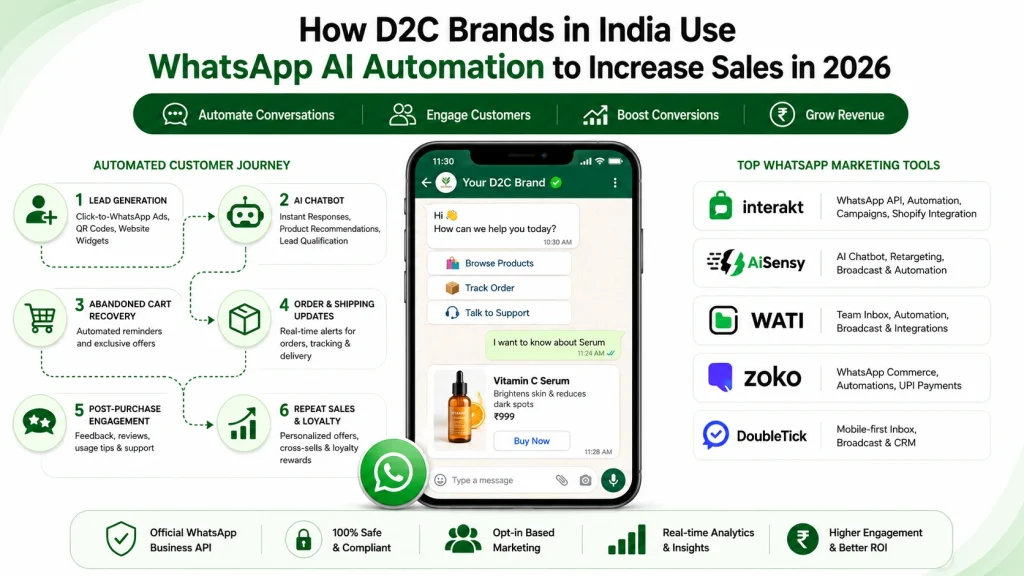
Accessing the API requires a verified Business Manager account with Meta and integration via an official WhatsApp Business Solution Provider (BSP). Fortunately, India has a mature ecosystem of API platforms including Interakt, WATI, AiSensy, and Zoko — that handle API access and provide user-friendly interfaces for managing WhatsApp marketing automation without requiring technical development expertise.
Layer 3: AI-Powered Automation on Top of the API
The third layer and the one delivering the greatest competitive advantage to Indian D2C brands in 2026 is whatsapp ai automation built on top of the API. AI-powered chatbots handle customer enquiries, qualify leads, recommend products, process orders, and manage post-purchase support all within WhatsApp, all without human intervention for routine interactions.
This is the combination that transforms WhatsApp business marketing from a communication tool into a revenue-generating system: the reach and intimacy of WhatsApp, the scalability of API infrastructure, and the intelligence of AI automation working together.
AI Automation Strategies That Drive D2C Sales on WhatsApp
The following strategies represent the highest-impact applications of whatsapp ai automation for Indian D2C brands in 2026. Each is designed to be implementable with the commercial BSP platforms available in the Indian market, without requiring custom development.
Strategy 1: AI-Powered Product Discovery Chatbot
For D2C brands with multi-SKU catalogues, helping customers find the right product is one of the most significant conversion barriers. Customers who cannot quickly identify what they need either abandon the journey or contact support creating cost and delay.
An AI product discovery chatbot embedded in your WhatsApp business marketing flow solves this elegantly. A customer messages your WhatsApp number triggered by a QR code on packaging, a link in an Instagram bio, or a click-to-WhatsApp ad and the AI chatbot initiates a guided conversation:
- ‘What are you looking for today skincare, haircare, or body care?’
- Based on the response: ‘What is your primary concern dryness, acne, anti-ageing, or brightening?’
- Product recommendation with product image, price, key benefits, and a direct purchase link or WhatsApp Pay option.
This conversational commerce approach consistently outperforms static product catalogue browsing for Indian consumers particularly in Tier 2 and Tier 3 cities where navigating a full website on a mid-range smartphone creates friction. The AI handles the discovery process in a format that feels natural and familiar.
Strategy 2: WhatsApp Lead Generation Funnels for D2C
Effective whatsapp lead generation for Indian D2C brands requires a clear opt-in strategy every contact in your WhatsApp marketing list must have explicitly agreed to receive messages from your business. The most effective opt-in triggers in the Indian D2C context include:
- Click-to-WhatsApp ads on Meta: Running Facebook and Instagram ads with a ‘Send Message on WhatsApp’ CTA captures high-intent leads directly into your WhatsApp flow. These contacts enter your whatsapp ai automation sequence immediately, while interest is at its peak.
- QR codes on packaging and retail: A QR code on product packaging linking to WhatsApp — with a pre-filled message like ‘I want to know more about my order’ builds your opted-in list from your existing customer base passively and persistently.
- Website WhatsApp widget: A floating WhatsApp icon on your website, particularly on product pages and the checkout page, captures visitors who prefer conversational commerce to form-filling.
- WhatsApp-exclusive offers: Promoting a WhatsApp-only discount or early access offer on your social channels drives opt-ins from your warmest existing audience followers who already have brand affinity.
Once a lead enters your WhatsApp flow, your whatsapp lead generation system should immediately begin qualification: capturing their name, location, and primary interest through a short AI-guided conversation that feels helpful rather than interrogative.
Strategy 3: Abandoned Cart Recovery on WhatsApp
Cart abandonment rates in Indian ecommerce average 60-80%. For D2C brands running Shopify, WooCommerce, or custom storefronts, integrating WhatsApp abandoned cart recovery is one of the fastest ROI improvements available.
The sequence works as follows: when a customer with a known WhatsApp number adds items to cart but does not complete purchase, a WhatsApp marketing automation trigger fires within 30-60 minutes, sending a personalised message referencing the specific products left in cart, along with a direct purchase link. A second message at 24 hours can introduce a limited-time offer a small discount or free shipping for customers who still haven’t purchased.
Real Impact: Indian D2C brands using WhatsApp abandoned cart recovery report 15-25% cart recovery rates — significantly higher than email recovery (5-8%) — because WhatsApp messages are seen, and they arrive in a channel where the customer is actively engaged.
Strategy 4: Post-Purchase Engagement and Upsell Flows
The post-purchase window is the highest-value, most underused segment of the whatsapp marketing strategy for Indian D2C brands. A customer who just bought from you is at peak brand satisfaction and most receptive to both support and upsell communication.
A structured post-purchase WhatsApp flow for D2C brands covers:
- Order confirmation message (immediate): Confirms order details, expected delivery date, and customer support contact building trust and reducing ‘where is my order’ support queries.
- Dispatch notification (on shipment): Sends tracking link directly in WhatsApp the single most requested post-purchase communication in Indian ecommerce.
- Usage tips and onboarding (Day 2-3 after delivery): Shares product usage content that improves the customer experience and reduces returns particularly valuable for personal care, supplements, and electronics.
- Review request (Day 5-7 after delivery): A personalised, conversational review request on WhatsApp achieves significantly higher response rates than email review requests in the Indian market.
- Cross-sell recommendation (Day 10-14): An AI-personalised product recommendation based on the initial purchase ‘Customers who bought X often love Y’ delivered at the moment the customer is experiencing the value of their first purchase.
Strategy 5: WhatsApp Broadcast Campaigns with AI Segmentation
Broadcast messaging sending a single message to your entire opted-in WhatsApp list is one of the most powerful tools in WhatsApp business marketing. But undifferentiated broadcasts are increasingly ineffective as Indian consumers receive more marketing messages on WhatsApp. The brands outperforming in 2026 are using whatsapp ai automation to segment their lists before broadcasting ensuring each recipient receives a message that is relevant to their purchase history, engagement level, and preference profile.
Effective segmentation dimensions for Indian D2C broadcast campaigns:
- Purchase recency: New customers (last 30 days), active customers (31-90 days), lapsing customers (91-180 days), and churned customers (180+ days) should all receive different messages.
- Product category affinity: A customer who has only ever bought skincare products should not receive a broadcast about your new haircare range without a bridge message connecting the categories.
- City and regional relevance: Festival promotions, local offer relevance, and language preferences all vary significantly across India. AI segmentation enables personalisation at the regional level critical for whatsapp marketing india at scale.
- Engagement score: High-engagement customers (who consistently open and respond) can receive direct promotional messages. Low-engagement contacts should first receive value-add content to rebuild interest before receiving promotional broadcasts.
Strategy 6: AI Chatbot for 24/7 Customer Support and Sales
Indian D2C customers expect fast responses and not just during business hours. A well-trained whatsapp ai automation chatbot handles the full range of customer queries around the clock, without adding to your support team’s headcount.
The core query categories a D2C WhatsApp chatbot should handle in India:
- Order status and tracking enquiries (typically 40-50% of all support queries)
- Return and exchange requests initiating the process conversationally, reducing ticket volume
- Product information and specification questions for pre-purchase customers
- Payment issues particularly UPI payment failures, which are common in the Indian market
- Size, fit, or usage guidance for physical products
- Escalation to a human agent for complex or sensitive queries, with seamless handoff
A well-deployed AI support chatbot for Indian D2C brands typically deflects 60-70% of routine enquiries reducing support costs while improving customer response times from hours to seconds. This directly supports whatsapp lead generation outcomes, because fast, helpful responses during the purchase consideration phase significantly increase conversion rates.
Top WhatsApp Marketing Tools for Indian D2C Brands in 2026
The Indian market is fortunate to have a mature and growing ecosystem of whatsapp marketing tools purpose-built for the domestic context many offering WhatsApp Business API access, regional language support, UPI integration, and pricing appropriate for Indian business scale. Here is an honest evaluation of the leading platforms.
Interakt
Arguably the most popular whatsapp marketing tools platform among Indian D2C brands, Interakt offers a clean combination of WhatsApp API access, broadcast messaging, automation flows, team inbox, and Shopify integration. Its pricing is structured for Indian SME budgets, starting at entry-level tiers that make WhatsApp marketing automation accessible even for early-stage brands. The Shopify integration is particularly strong — enabling automated triggers for cart abandonment, order updates, and shipping notifications without custom development.
- Best for: Shopify-based D2C brands at the growth stage looking for fast implementation and clean UX.
- Standout feature: One-click Shopify sync and pre-built D2C automation templates.
AiSensy
AiSensy is one of the most AI-forward whatsapp marketing tools in the Indian market, with strong chatbot builder capabilities, retargeting features, and a live chat inbox that supports multi-agent teams. Its retargeting functionality — allowing D2C brands to re-message contacts who clicked a previous broadcast but did not convert is a differentiating feature for performance-focused whatsapp marketing strategy execution.
- Best for: D2C brands that prioritise chatbot sophistication and broadcast retargeting.
- Standout feature: WhatsApp retargeting campaigns re-engaging contacts based on previous message interaction behaviour.
WATI (WhatsApp Team Inbox)
WATI is a globally popular platform with strong adoption among Indian businesses. Its no-code chatbot builder, broadcast scheduling, keyword auto-reply, and team inbox management make it a reliable choice for D2C brands with growing customer support volumes. WATI’s integration library covers most major Indian ecommerce and CRM platforms.
- Best for: Brands with larger support teams needing robust multi-agent inbox management alongside WhatsApp marketing automation.
- Standout feature: Team inbox management with agent assignment, SLA tracking, and conversation tagging.
Zoko
Zoko is purpose-built for ecommerce WhatsApp commerce enabling D2C brands to run the complete purchase journey inside WhatsApp, from product discovery through checkout and payment. Its native integration with Shopify and support for WhatsApp Pay and UPI makes it the strongest choice for brands pursuing full conversational commerce within the app.
- Best for: D2C brands wanting to close sales entirely within WhatsApp, without redirecting customers to a website.
- Standout feature: WhatsApp-native checkout with UPI payment support the most India-relevant feature in any whatsapp marketing tools platform.
DoubleTick
A newer entrant built specifically for the Indian D2C market, DoubleTick offers a mobile-first team inbox, broadcast messaging, and CRM-lite contact management all optimised for managing whatsapp marketing india operations from a smartphone. Particularly popular with founder-led brands and small teams where mobile-first management is a practical requirement.
Building a High-Converting WhatsApp Marketing Strategy for D2C India
Having the right tools is only part of the equation. A structured whatsapp marketing strategy determines how those tools are deployed and whether your WhatsApp channel becomes a genuine revenue driver or an underutilised communication add-on.
Step 1: Get your Green Tick verification
The WhatsApp Green Tick the verified business badge displayed next to your business name is the single most important trust signal in WhatsApp business marketing for the Indian market. Indian consumers are understandably cautious about business messages on WhatsApp due to fraud incidents. A Green Tick verified account immediately communicates legitimacy and significantly improves message open rates and response rates.
Green Tick verification requires an active WhatsApp Business API account, a verified Meta Business Manager, and Meta’s approval of your brand’s eligibility. Most established D2C brands with a functional website, social media presence, and business registration can qualify. Work with your BSP to initiate the application as a priority step.
Step 2: Design your opt-in architecture
Your whatsapp lead generation architecture should have multiple entry points across your website, social media, packaging, and paid ads each feeding into a centralised opted-in contact database. Map every opt-in source and design the initial AI conversation that greets new contacts based on where they came from.
A customer who opted in via a ‘Skincare Quiz’ Instagram ad should receive a different opening WhatsApp message than a customer who scanned a QR code from your product packaging. Context-aware onboarding dramatically improves the relevance of subsequent WhatsApp marketing automation and reduces early opt-outs.
Step 3: Build your core automation flows first
Before investing time in broadcast campaigns, build the five foundational automation flows that run continuously in the background and generate consistent ROI:
- Welcome and qualification flow (all new opt-ins)
- Abandoned cart recovery flow (ecommerce integration required)
- Post-purchase engagement and review flow (delivery trigger)
- Re-engagement flow (for contacts dormant 60+ days)
- AI support chatbot (always-on query handling)
These five flows alone, well-executed, typically deliver 20-35% of a D2C brand’s total WhatsApp revenue running entirely on automation without requiring ongoing campaign management.
Step 4: Layer in broadcast campaigns
Once your foundational flows are live and performing, introduce regular broadcast campaigns festival promotions, product launches, flash sales, loyalty rewards to your segmented contact list. Indian festivals (Diwali, Holi, Eid, Pongal, Navratri) represent the highest-value broadcast opportunities in the whatsapp marketing india calendar. Plan your campaign content calendar around these peaks and start building audience segments at least four to six weeks before each major festival.
Step 5: Monitor, test, and optimise
Your whatsapp marketing strategy should be treated as a living system, not a one-time setup. Review your key metrics weekly: broadcast open rates, chatbot deflection rates, campaign conversion rates, and opt-out rates. A rising opt-out rate is the earliest warning signal that message frequency or relevance is deteriorating — address it before it compounds.
A/B test message templates regularly particularly for high-volume automation flows like cart recovery and post-purchase sequences. Small improvements in these always-on flows compound significantly over time, making systematic testing one of the highest-leverage activities in WhatsApp business marketing programme management.
WhatsApp Marketing Compliance for Indian D2C Brands
Compliance is not a bureaucratic afterthought in WhatsApp marketing for D2C brands it is a business continuity issue. Account suspension can eliminate your entire WhatsApp marketing channel overnight. Here are the non-negotiable compliance principles for the Indian market.
- Always obtain explicit opt-in consent: Every contact must have explicitly agreed to receive WhatsApp marketing messages from your business. Pre-ticked boxes and implied consent do not meet WhatsApp’s standards.
- Use Meta-approved message templates for outbound messaging: Any message sent outside the 24-hour customer service window must use a pre-approved template. Your BSP will guide you through the template submission and approval process, which typically takes 24-72 hours.
- Provide a clear and easy opt-out mechanism: Every broadcast message should include a simple opt-out instruction — ‘Reply STOP to unsubscribe’ is the standard. Process opt-outs immediately and remove opted-out contacts from all future sends.
- Respect frequency guidelines: WhatsApp has not published specific frequency limits, but the algorithm monitors spam reports. Keep marketing broadcasts to a maximum of two to three per week for active contacts, and less for re-engagement sequences.
- Never purchase contact lists: Cold messaging purchased lists is a direct violation of WhatsApp’s business policy and will result in account suspension. Build your list exclusively through legitimate opt-in mechanisms.
Measuring WhatsApp Marketing ROI for Indian D2C Brands
The WhatsApp business marketing channel is highly measurable when properly configured. These are the key performance metrics every Indian D2C brand should track across their WhatsApp programme.
- Message delivery rate: Target above 95% persistent delivery failures indicate contact list quality issues or number validity problems.
- Open and read rate: WhatsApp read receipts provide accurate engagement data. Healthy broadcast open rates for well-segmented Indian D2C audiences should be above 60%.
- Click-through rate (CTR): Percentage of message recipients who tap your product link, catalogue link, or CTA button. Top-performing whatsapp marketing strategy campaigns in India achieve CTRs of 15-30% vastly superior to email.
- Chatbot deflection rate: The percentage of inbound queries resolved by your whatsapp ai automation chatbot without human escalation. Target 60-75% for a well-trained D2C chatbot.
- Campaign conversion rate: Percentage of broadcast recipients who complete a purchase within 24-48 hours of receiving the message. Track this per campaign type abandoned cart, festival promotion, restock alert to identify your highest-performing message categories.
- Revenue attributed to WhatsApp: With Shopify or WooCommerce integration, most BSP platforms can attribute revenue directly to WhatsApp touchpoints. This is the metric that justifies investment in whatsapp marketing tools and demonstrates channel ROI to stakeholders.
- Opt-out rate: Track weekly. Industry benchmark for well-managed D2C WhatsApp lists in India is below 1% per broadcast. Above 2% signals a relevance or frequency problem that needs immediate attention.
Final Thoughts: Building Your WhatsApp Growth Engine for 2026
The opportunity in WhatsApp business marketing for Indian D2C brands is enormous and still relatively early. The majority of D2C brands in India are either not using WhatsApp at a meaningful scale, or using it without the automation and AI infrastructure needed to turn it into a consistent revenue driver. That gap is your competitive window.
The brands that will dominate whatsapp marketing india in 2026 and beyond are the ones building their opted-in subscriber lists now, investing in the right whatsapp marketing tools, designing intelligent WhatsApp marketing automation flows that serve customers at every stage of the buying journey, and treating the channel with the same strategic seriousness they give to paid media.
The 500 million WhatsApp users in India are not just a reach opportunity. They are a relationship opportunity. A well-executed whatsapp marketing strategy does not just send messages it builds the kind of direct, personalised brand relationship that creates loyal customers, high repeat purchase rates, and word-of-mouth growth that no ad budget can buy.
Start with your foundations: get the API access, build your opt-in channels, set up your five core automation flows, and invest in an whatsapp ai automation chatbot that represents your brand well. Everything else the broadcast campaigns, the retargeting, the festival promotions, the advanced segmentation builds on top of that foundation. The brands that lay it carefully in 2026 will reap compound growth from it for years.