Table of Contents
ToggleAI Lead Generation: The WhatsApp CRM Integration Framework
Introduction
Generating high-quality leads at scale is one of the biggest challenges facing B2B sales and marketing teams today. Traditional outreach methods cold emails, static forms, and manual follow-ups are losing effectiveness as buyer expectations rise. This is where ai lead generation is reshaping the game. By combining intelligent automation with conversational channels, businesses can qualify prospects in real time, reduce manual workload, and engage buyers where they already spend time.
WhatsApp has emerged as one of the most powerful channels in this ecosystem. With over 3 billion monthly active users globally as of 2025 (source: TechRT / Meta), it is the world’s most widely used messaging platform. When paired with a CRM via whatsapp crm integration, it becomes a direct, data-driven pipeline for capturing and converting leads at a speed and intimacy that email and display ads simply cannot match.
Why AI Lead Generation Is Changing B2B Sales
The shift toward ai lead generation is not a trend it is a structural change in how B2B pipelines are built. According to research aggregated by The Starr Conspiracy (sourced from Salesforce, HubSpot, Forrester, and McKinsey, 2024), B2B companies using AI-powered lead generation report an average 73% increase in qualified leads within six months, a 56% reduction in unqualified leads passed to sales, and a 31% reduction in average sales cycle length.
McKinsey’s 2024 B2B research further notes that companies leveraging AI for sales are experiencing faster responses to inbound leads, with ai marketing automation tools delivering a 2.1x improvement in response times compared to manual processes. These gains come from AI’s ability to score leads instantly, personalize messaging at scale, and trigger follow-up sequences without human delay.
The Case for WhatsApp as a Lead Generation Channel
WhatsApp is no longer just a personal messaging app. Over 200 million businesses use WhatsApp Business monthly as of 2025 (TechRT). The platform achieves a 98% message open rate for business communications, and messages are read by approximately 80% of recipients within five minutes of delivery figures that email open rates cannot approach (source: JestyCRM / Infobip Messaging Trends).
For whatsapp lead generation, these engagement metrics translate directly into faster pipeline movement. Businesses can run click-to-WhatsApp ads via Meta platforms, capture leads through QR codes at events, and deploy AI chatbots to qualify prospects automatically all before a human sales rep enters the conversation.
Key WhatsApp Business Facts (2025)
- Over 175 million people message a business on WhatsApp every day (Meta / Will Cathcart, Head of WhatsApp)
- WhatsApp messages achieve up to 98% open rates for business communications (Infobip Messaging Trends 2026)
- In 2023, WhatsApp chatbots saved businesses over 2.5 billion hours by handling repetitive queries (TimelinesAI, citing industry data)
- Nissan’s verified WhatsApp Business channel with CRM integration and AI chatbot delivered a 138% increase in leads (Infobip case study, 2025)
WhatsApp CRM Integration: How It Works
A whatsapp crm integration connects WhatsApp Business API conversations directly into your CRM system, creating a unified, real-time record of every prospect interaction. When a lead sends a WhatsApp message whether through a click-to-chat ad, a QR code, or a direct link the integration can automatically create a new lead record, route the conversation to the right sales rep, and trigger a pre-defined follow-up sequence.
Core Capabilities of a WhatsApp CRM Integration
- Automatic Lead Capture: Inbound WhatsApp conversations are instantly logged as lead or contact records in the CRM, eliminating manual data entry.
- Intelligent Routing: Chats are directed to the correct sales rep, account manager, or queue using automation rules reducing response delays.
- Full Conversation History: Every WhatsApp interaction is stored against the relevant CRM record, giving sales teams complete context without switching platforms.
- Automated Follow-Up Sequences: Triggered workflows can send scheduled WhatsApp messages, reminders, and nurture content based on lead stage or behavior.
- Compliance Management: Opt-in tracking, consent records, and GDPR-compliant messaging ensure all outreach meets regulatory standards.
This framework forms the foundation for whatsapp marketing automation where human-guided outreach is replaced or augmented by AI-driven sequences that respond to prospect behavior in real time.
Salesforce WhatsApp Integration Enterprise-Grade Lead Management
For enterprise teams, salesforce whatsapp integration is the most robust way to deploy WhatsApp as a lead generation and nurturing channel. Salesforce launched its Unified Conversations for WhatsApp feature in April 2024, bringing WhatsApp messaging directly into Marketing Cloud, Sales Cloud, and Service Cloud (source: Salesforce official press release, April 2024).
With salesforce whatsapp integration, Marketing Cloud’s Journey Builder allows teams to build multi-step, personalized WhatsApp journeys. Sales Cloud enables reps to send and receive WhatsApp messages directly from lead and contact records. Einstein GPT-powered replies, available in Service Cloud, deliver intelligent, context-aware responses using data from Salesforce Data Cloud making every interaction faster and more relevant.
Use Cases for Salesforce WhatsApp Lead Generation
- Capture leads from WhatsApp click-to-chat ads and auto-create Salesforce lead records via Workflow automation
- Trigger WhatsApp follow-up messages after a lead opens an email or visits a pricing page (behavior-based automation)
- Use Pardot engagement scoring combined with WhatsApp outreach for highly targeted sales sequences
- Sync AI-generated call summaries back to Salesforce records, keeping CRM data accurate without manual updates
B2B Marketing Segmentation for WhatsApp Campaigns
Effective b2b marketing segmentation is what separates high-performing WhatsApp campaigns from generic blasts that damage sender reputation. Rather than broadcasting the same message to every contact, segmented whatsapp marketing automation delivers personalized content based on firmographic data, behavioral signals, and CRM lifecycle stage.
Segmentation Criteria for B2B WhatsApp Outreach
- Industry and Vertical: Tailor messaging to industry-specific pain points and use cases.
- Lead Score and Intent: Use AI scoring from your CRM to prioritize high-intent leads for immediate WhatsApp outreach.
- Funnel Stage: Deliver awareness content to cold leads, case studies to warm leads, and demo invitations to hot leads.
- Engagement History: Suppress or re-engage contacts based on previous WhatsApp open and response rates.
- Account Size: Differentiate messaging for SMBs versus enterprise accounts, adjusting tone, offer, and call to action accordingly.
According to the McKinsey B2B Pulse Survey (April 2024, n=3,942 B2B decision-makers), AI-powered lead management is among the top priorities for B2B commercial leaders in industries handling large numbers of leads. Precise b2b marketing segmentation, combined with ai lead generation tools, enables teams to act on intent signals before competitors do.
Building Your AI-Powered WhatsApp Lead Generation Framework
Bringing these components together into a cohesive ai lead generation framework requires a structured approach. Below is a phased implementation model:
Phase 1 Foundation
- Set up WhatsApp Business API with an official Meta Business Solution Provider
- Connect WhatsApp to your CRM (HubSpot, Salesforce, or Zoho) via a native or third-party integration
- Define opt-in flows and ensure GDPR/TCPA-compliant consent collection
Phase 2 Automation and AI
- Deploy AI chatbots to qualify inbound leads using predefined criteria (budget, authority, need, timeline)
- Build whatsapp marketing automation sequences for lead nurturing, appointment booking, and demo reminders
- Implement b2b marketing segmentation rules within your CRM to route leads into the correct WhatsApp journeys
Phase 3 Optimization
- Monitor open rates, response rates, and lead-to-opportunity conversion rates per WhatsApp campaign segment
- A/B test message templates, send times, and CTA formats to continuously improve performance
- Use AI analytics to identify drop-off points and refine qualification questions in chatbot flows
Teams that execute this framework systematically are positioned to benefit from the full potential of whatsapp crm integration and ai marketing automation working in concert.
Frequently Asked Questions
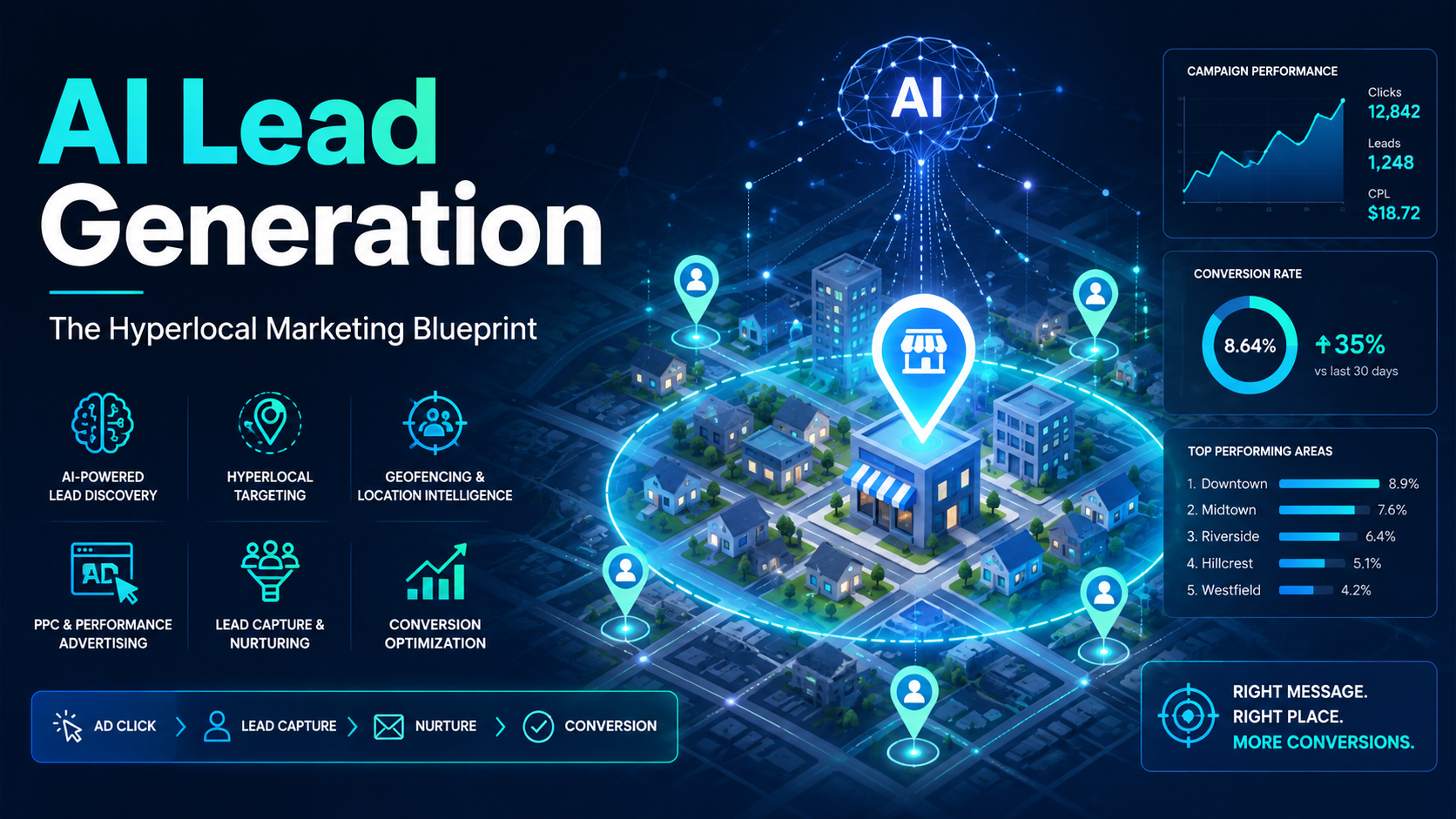
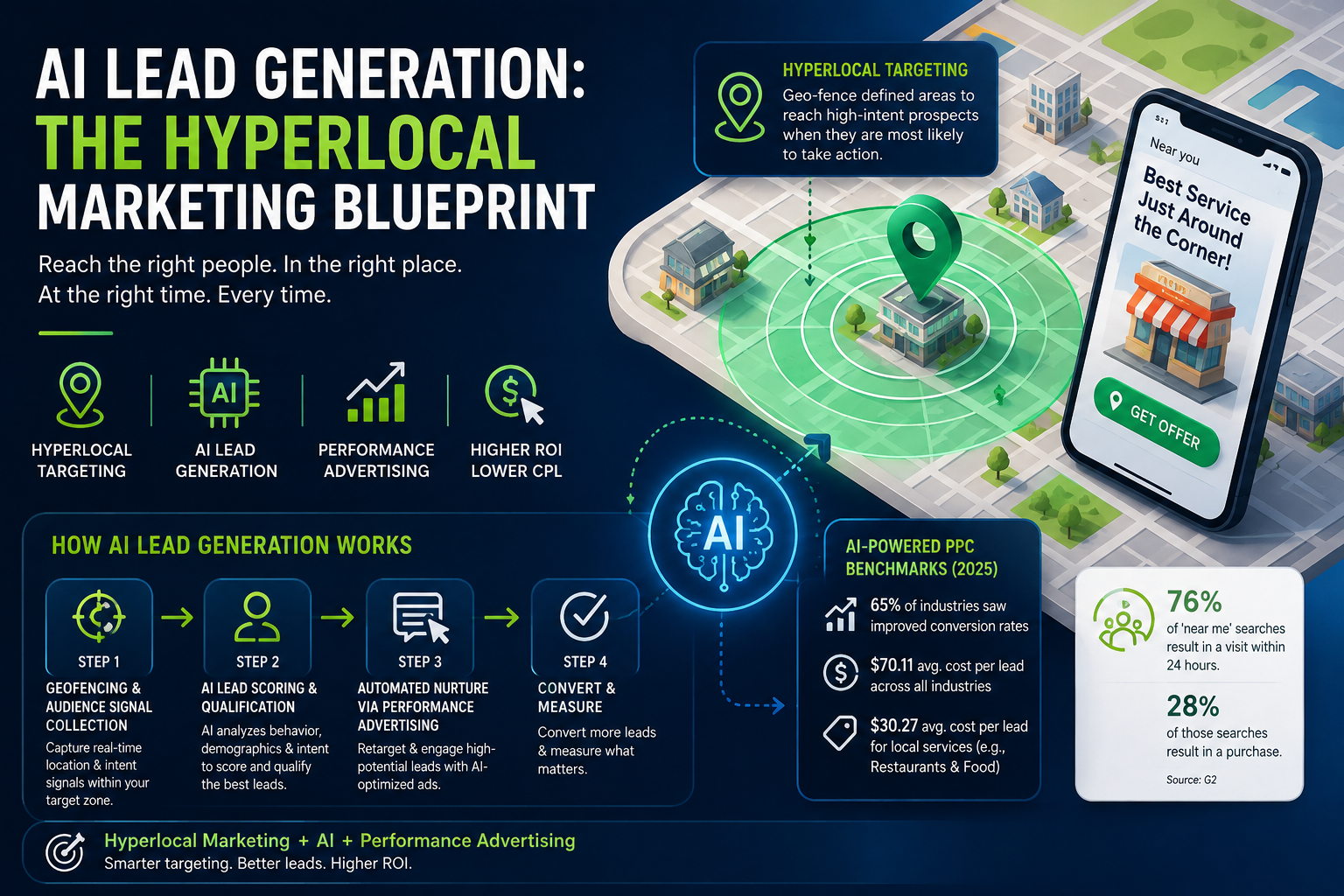
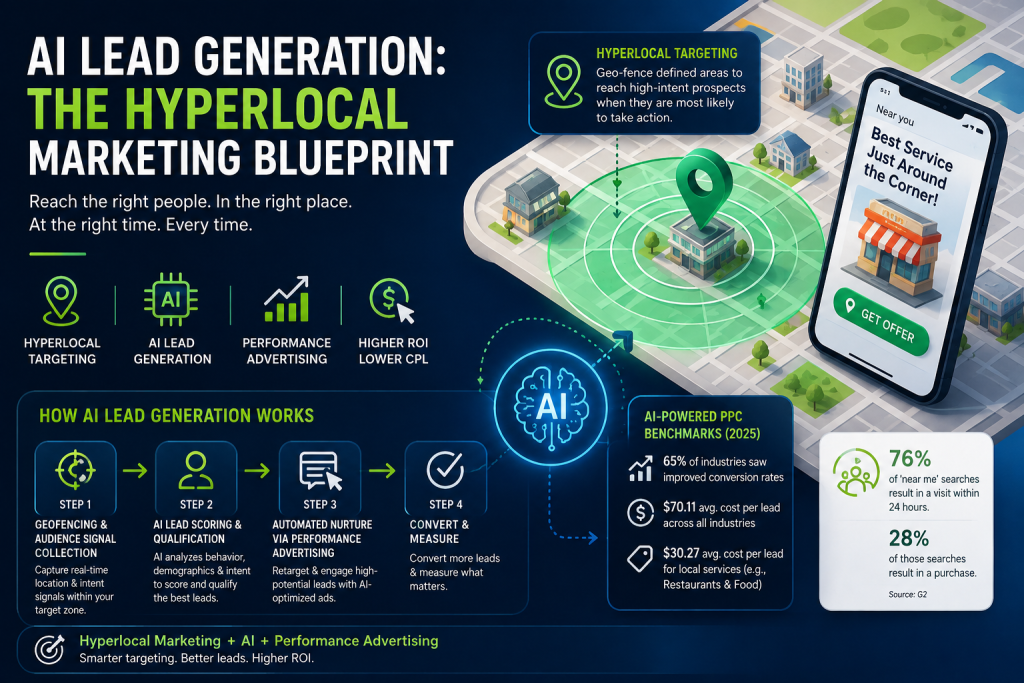
AI lead generation uses machine learning to automatically identify, score, and engage prospects based on behavioural, demographic, and location data. For local businesses, it reduces manual prospecting time, improves lead quality, and ensures performance advertising budgets are allocated toward prospects most likely to convert within a specific area.
Standard local marketing targets a broad city or region. Hyperlocal marketing narrows the focus to a neighbourhood, a street radius, or even a specific venue using geofencing and real-time location signals to serve ads only to prospects within that defined zone. This precision reduces wasted impressions and increases relevance for high-intent buyers nearby.
Performance advertising provides the measurable, outcome-based framework that makes hyperlocal advertising accountable. Paying per click, lead, or conversion means every spend is tied to a specific action. When AI is layered on top, bid strategies self-optimise around conversion probability, ensuring the performance advertising model continuously improves without manual adjustment.
Geofencing establishes a virtual boundary around a physical location. When a mobile device enters that boundary, it triggers an ad, push notification, or SMS. In hyperlocal advertising, geofencing has become a widely adopted tactic because it enables businesses to reach nearby consumers with highly relevant messaging based on physical location. This precision targeting makes hyperlocal marketing campaigns more efficient by focusing spend only on audiences in a defined geographic zone.
AI scoring models evaluate inbound leads against conversion history, CRM data, and real-time engagement signals to filter out low-quality prospects before they reach a sales team. Forrester’s 2024 AI Lead Management research found that AI-enabled qualification delivered a 56% reduction in unqualified leads passed to sales, freeing sales capacity for high-probability opportunities.
The strongest platforms for hyperlocal advertising with AI include Google Ads (Local Campaigns, Performance Max, Local Services Ads), Meta Ads (radius targeting with AI-driven audience expansion), and programmatic DSPs with geofencing capability. For AI lead generation specifically, adding an AI chatbot or lead qualification tool to landing pages connected back to the CRM completes the conversion loop.
AI marketing automation handles the follow-up after a hyperlocal marketing ad captures an initial lead interaction. Automated sequences email, SMS, or WhatsApp deliver the right message at the right stage of the buying journey. When these tools are synced with CRM data from hyperlocal marketing campaigns, every follow-up is informed by the prospect’s location history and engagement score.
The most important metrics for AI lead generation in a hyperlocal marketing context are cost per qualified lead, lead-to-appointment conversion rate, return on ad spend (ROAS), AI chatbot qualification rate, and geofence entry-to-click rate. For performance advertising, supplementing these with incrementality testing ensures you are measuring genuine marketing lift, not just organic demand.