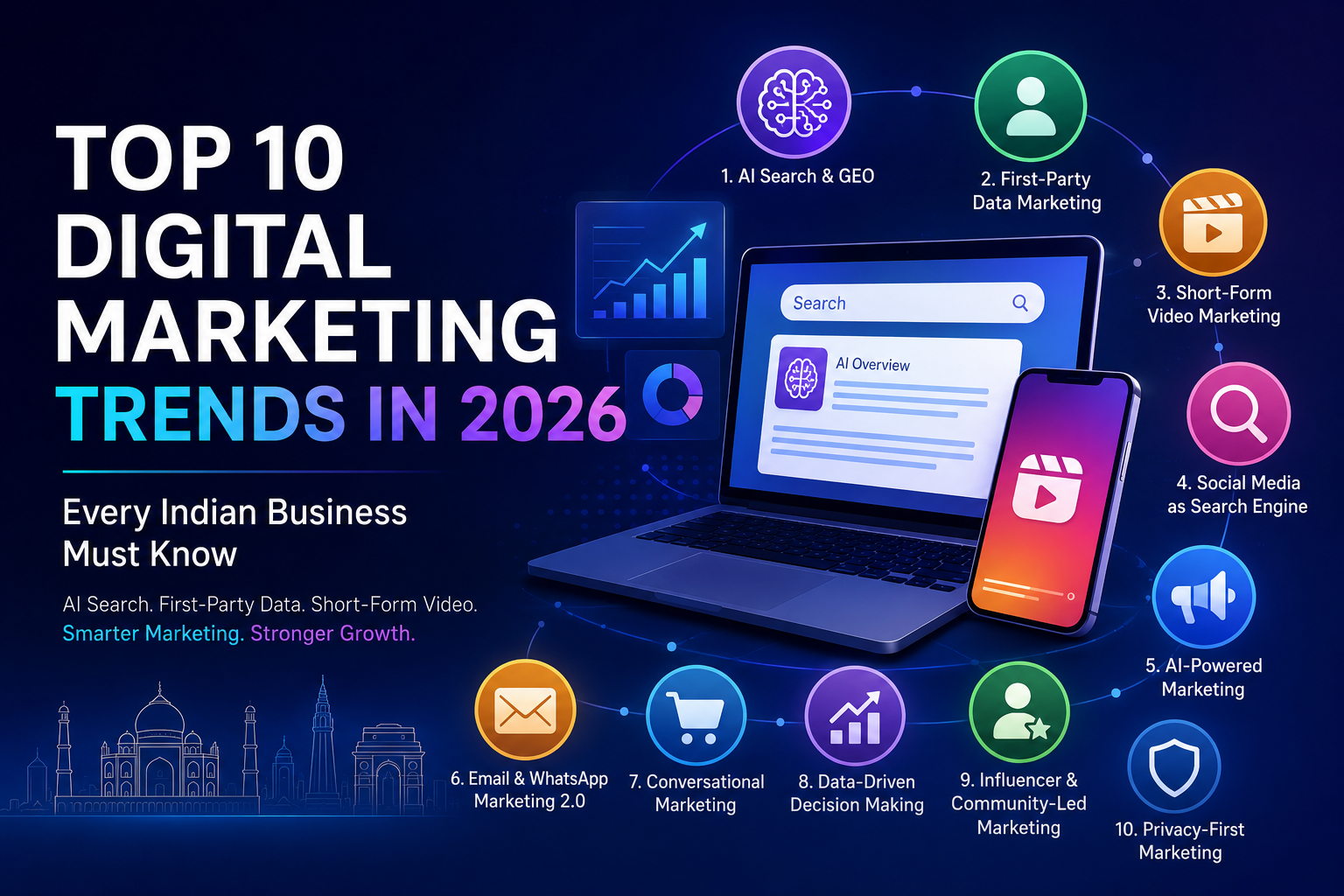
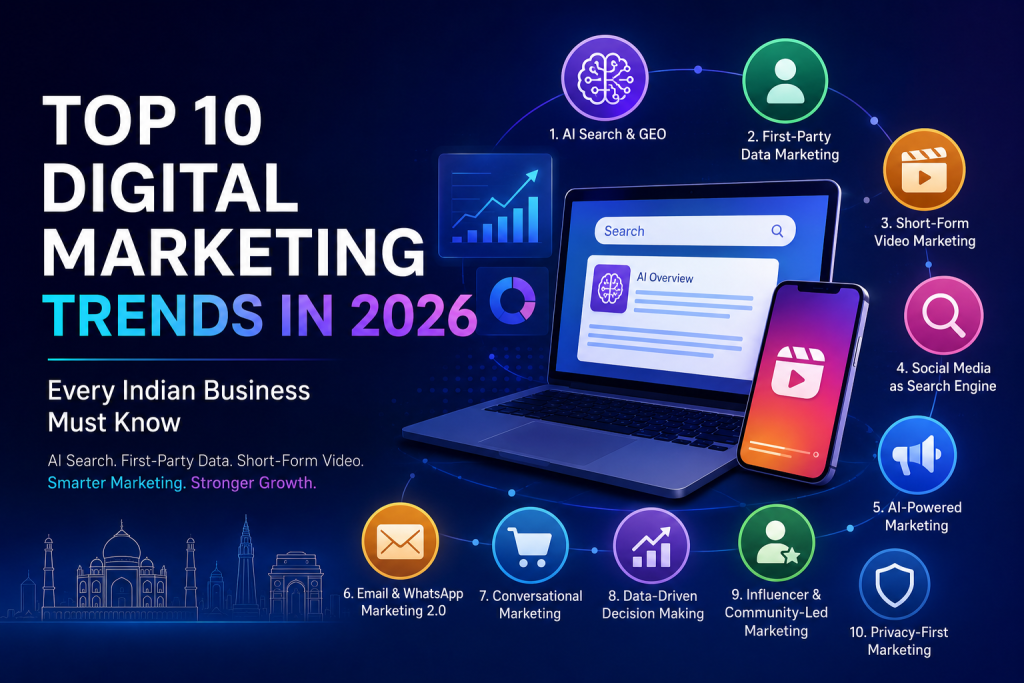
Top 10 Digital Marketing Trends in 2026 Every Indian Business Must Know
Digital marketing in India is not the same as it was even two years ago. Search is changing. Buyer behavior is shifting. AI is rewriting how people find information and how brands reach their customers.
In 2026, businesses that stay ahead of the curve will generate more leads, build stronger brands, and convert better. Those that don’t adapt will find themselves invisible on search, outpaced on social media, and outperformed by competitors who moved faster.
“The brands winning in 2026 aren’t guessing. They’re building their next 12 months around what’s actually changing in digital marketing.”
This blog breaks down the top 10 trends shaping Indian digital marketing right now and what you can do about each one.
Why Digital Marketing Trends Matter for Indian Businesses in 2026
“India’s digital audience has never been larger or more scattered. With over 900 million internet users spread across Google, YouTube, Instagram, WhatsApp, and now AI platforms like ChatGPT and Perplexity, the question isn’t whether your buyers are online. It’s whether you’re showing up where they’re actually looking.”
A few realities every Indian marketer needs to sit with:
- Google’s AI Overviews are changing which websites get clicked
- Consumers are doing more research before buying across multiple platforms
- Third-party cookie tracking is being phased out, forcing brands to build their own data
- Short-form video is not a trend anymore; it is a default content format
- The cost of digital advertising is rising, making lead quality matter more than lead volume
These shifts affect every business, D2C brands, B2B companies, service providers, real estate firms, edtech platforms, healthcare brands, and everything in between.
The businesses that will win in 2026 are those building smart, integrated, data-backed marketing systems. Here is what those systems look like.
Top 10 Digital Marketing Trends in 2026
1. AI Search and Generative Engine Optimization (GEO)
When someone types a question into Google, they increasingly get an AI-generated answer at the top of the page before any links. This is Google’s AI Overview. A similar thing happens on ChatGPT, Perplexity, and Gemini. These AI answer engines pull from trusted sources and summarise information directly.
GEO, or Generative Engine Optimization, is the practice of making your content structured, credible, and authoritative enough to be referenced by these AI systems.
Why it matters in 2026: Studies show that AI Overviews now appear for a significant portion of search queries, and users often don’t scroll past them. If your brand isn’t visible in AI-generated answers, you’re losing top-of-funnel traffic.
How Indian businesses can use it:
- Write content that directly answers the questions your buyers are asking
- Use structured data (schema markup) on your website
- Build topic authority through blogs, FAQs, and detailed guides
- Get mentioned on credible third-party platforms, media sites, industry directories, and review platforms
2. First-Party Data Marketing
First-party data is information you collect directly from your audience through your own website forms, CRM system, email list, WhatsApp contacts, webinar registrations, and purchase history.
As third-party cookies are phased out and privacy regulations tighten, this data becomes the foundation of your marketing.
Why it matters in 2026: Platforms like Google are reducing reliance on third-party tracking. Brands that have built their own data assets will target better, personalize smarter, and waste less ad spend.
How Indian businesses can use it:
- Set up lead capture forms on your website and landing pages
- Use gated content reports, templates, and calculators to collect emails
- Run WhatsApp opt-in campaigns for high-intent audiences
- Use a CRM to segment and nurture contacts based on their behavior
3. Short-Form Video Marketing
Reels, Shorts, and short videos on LinkedIn are now the most consumed content format across platforms. Brands that show up in short video formats with educational content, product explainers, founder stories, and client results get more reach and more trust.
Why it matters in 2026: Instagram Reels average significantly higher organic reach than static posts. YouTube Shorts is growing faster than long-form YouTube in India. LinkedIn video is outperforming text posts in B2B reach.
How Indian businesses can use it:
- Create 30–60 second videos answering your audience’s top questions
- Film founder or team videos that show the human side of your brand
- Repurpose long blog content into short video scripts
- Use product demo reels to drive direct inquiry
4. Social Media as a Search Engine
A large and growing share of users, especially Gen Z and millennials, now start their product or service research on social platforms rather than Google. They search on Instagram for restaurant recommendations. They go to YouTube to learn how a product works. They check Reddit for real user opinions before buying.
Why it matters in 2026: Your social media presence is now part of your search presence. Brands that don’t show up on Instagram, YouTube, or LinkedIn for relevant searches are invisible to a whole segment of their market.
How Indian businesses can use it:
- Optimize your Instagram bio, reel captions, and highlights with keywords your buyers search for
- Create YouTube content that answers pre-purchase questions in your category
- Be active on LinkedIn for B2B discovery
- Monitor Reddit and Quora to understand what your audience is asking and create content that answers it
5. AI-Powered Personalization
AI tools now allow marketers to personalize at scale — customizing email subject lines, ad creatives, landing page content, product recommendations, and follow-up messages based on individual user behavior.
Why it matters in 2026: Consumers expect relevance. Generic campaigns produce generic results. Personalized marketing consistently produces higher open rates, better click-through rates, and improved conversion.
How Indian businesses can use it:
- Use AI email tools to send different messages to different segments based on where they are in the funnel
- Run dynamic ad creatives that adjust messaging by audience type
- Set up personalized landing pages for different traffic sources
- Use product recommendation engines if you run an e-commerce brand
6. Human-Led Content and Brand Trust
As AI-generated content floods the internet, search engines and users are placing more value on genuine human expertise, real experience, and original opinions. Google’s EEAT guidelines (Experience, Expertise, Authority, Trust) are more relevant than ever.
Why it matters in 2026: Content that is generic, surface-level, and clearly AI-written is getting deprioritized. Content backed by real expertise, case studies, and original data is getting more visibility and credibility.
How Indian businesses can use it:
- Publish founder-led content, opinions, lessons learned, and perspectives
- Share client case studies and real results (with numbers, not vague claims)
- Get reviews on Google, G2, Clutch, or Justdial, wherever your buyers look
- Work with subject matter experts to create original research or insights
7. Marketing Automation and AI Agents
Marketing automation is not new, but AI agents are taking it further. Today, AI can handle lead follow-up sequences, CRM data entry, campaign reporting, content scheduling, customer support queries, and more without constant human involvement.
Why it matters in 2026: Small and mid-sized Indian businesses often lack dedicated teams for every marketing function. Automation fills those gaps, ensuring leads don’t fall through the cracks and campaigns stay consistent.
How Indian businesses can use it:
- Automate lead nurture sequences using email and WhatsApp
- Use AI-powered chatbots on your website to qualify visitors
- Set up CRM automation to assign and follow up on leads automatically
- Use reporting dashboards that pull data from all channels in one place
8. Performance Marketing Focused on Lead Quality
Many businesses track digital marketing success through impressions, clicks, and cost per lead (CPL). In 2026, smart brands are shifting focus to lead quality tracking, how many leads become sales-qualified, how many convert into customers, and what the actual revenue per campaign looks like.
Why it matters in 2026: Low-quality leads waste sales team time and inflate marketing budgets with poor returns. Performance marketing needs to connect to real business outcomes.
How Indian businesses can use it:
- Define what a “qualified lead” looks like for your business and share that with your agency or marketing team
- Track Customer Acquisition Cost (CAC), conversion rates by source, and Return on Ad Spend (ROAS)
- Use CRM data to identify which campaigns produce leads that actually close
- Feed closed-deal data back into ad platforms to improve targeting
9. Omnichannel Marketing
Omnichannel marketing means your SEO, paid ads, email, WhatsApp, social media, landing pages, and remarketing all work together as a connected system, not as separate, siloed campaigns.
Why it matters in 2026: Today’s Indian buyer interacts with a brand across multiple touchpoints before making a decision. They might find you on Instagram, visit your website, leave, see a retargeting ad, then fill a form after receiving an email. If these channels aren’t connected, you can’t understand or influence that journey effectively.
How Indian businesses can use it:
- Map your customer journey from awareness to conversion across all channels
- Use remarketing to re-engage website visitors on Google, Meta, and YouTube
- Align content themes across SEO, social, and email so your messaging is consistent
- Set up UTM tracking so you know exactly which channel drives results
10. Video Commerce and Social Commerce
Social commerce is the ability to discover and purchase products directly through social platforms without leaving the app. Video commerce takes this further: influencer videos, live product demos, and shoppable content drive purchase decisions in the feed itself.
Why it matters in 2026: Instagram, YouTube, and even WhatsApp are evolving into buying environments. The line between content and commerce is blurring, and Indian consumers, especially in tier-2 and tier-3 cities, are responding.
How Indian businesses can use it:
- Set up Instagram Shopping if you sell physical products
- Partner with micro-influencers for authentic product review videos
- Run live demo sessions on Instagram or YouTube to showcase how your product works
- Use user-generated content (UGC) and customer reviews in video format to build social proof
Conclusion
2026 is not the year to keep doing what worked in 2022. The digital landscape has changed. AI search, first-party data, short-form video, lead quality over quantity, and omnichannel integration are no longer advanced strategies. They are the baseline for any business that wants to stay competitive.
The brands that adapt early to the digital marketing trends in 2026 will build a stronger foundation, earn more trust, and generate better returns from every rupee they spend on marketing.
Start with one or two trends that matter most to your business right now. Build from there. And if you’d like expert guidance on what to prioritize and how to execute, Trilliant Digital is ready to be your strategic partner.
FAQs
The top digital marketing trends in 2026 include AI search and GEO, first-party data marketing, short-form video, social media as a search engine, AI-powered personalization, human-led content, marketing automation, lead quality-focused performance marketing, omnichannel marketing, and social commerce. Each trend reflects a shift in how buyers discover, research, and decide, and how brands need to show up to meet them.
GEO stands for Generative Engine Optimization. It refers to the practice of optimizing your content so it can be cited or referenced by AI-powered search platforms like Google AI Overviews, ChatGPT, Perplexity, and Gemini. Unlike traditional SEO, which focuses on ranking in search results, GEO focuses on making your content authoritative and structured enough to appear inside AI-generated answers.
Yes, SEO remains critical in 2026 but it has evolved. Traditional keyword ranking still matters, but brands now also need to optimize for AI search, structured data, topic authority, and EEAT signals. SEO in 2026 is broader and more content-driven than before, but it is far from obsolete. Businesses that invest in strong SEO are also better positioned for GEO visibility.
First-party data the information you collect directly from your customers through your own channels, is becoming the most valuable marketing asset a business can own. As third-party cookie tracking is phased out and privacy regulations tighten globally and in India, brands with rich first-party data can target more accurately, personalize better, and reduce wasted ad spend. Building this data now puts you ahead.
AI is changing digital marketing in multiple ways: it is reshaping how search results are presented, enabling personalization at scale, powering marketing automation, improving ad targeting, and assisting with content creation. For Indian businesses, the most immediate impact is in search, where AI Overviews and answer engines are changing which brands get visibility, and in automation, where AI agents can handle tasks that once required full-time team members.
There is no single answer it depends on your business type and current maturity. However, AI search and GEO is important for any business that relies on organic search traffic. First-party data is critical for brands running paid ads. Short-form video is essential for B2C brands with a visual product or service. For B2B companies, lead quality and marketing automation tend to deliver the most immediate ROI.
Small businesses don’t need to implement every trend at once. Start with what matters most for your audience: build a basic first-party data system using a CRM and email capture, create a consistent short-form video presence on one platform, and ensure your website content answers the real questions your buyers are asking. Even small, consistent steps toward these trends will put you ahead of competitors who aren’t moving at all.
Trilliant Digital helps businesses across India with SEO, performance marketing, social media marketing, content strategy, website optimization, marketing automation, and lead generation. Whether you need a full-funnel strategy or support in a specific area, their team works closely with business owners and marketing managers to build strategies that are practical, data-backed, and aligned with real business goals. You can learn more at trilliantdigital.com.
Lorem ipsum dolor sit amet, consectetur adipiscing elit. Ut elit tellus, luctus nec ullamcorper mattis, pulvinar dapibus leo.