Table of Contents
ToggleProgrammatic SEO for FinTech: The Ultimate SaaS SEO Strategy
Introduction
FinTech is one of the most competitive organic search landscapes in existence. With thousands of SaaS platforms, neobanks, payment tools, and embedded finance products competing for the same buyer keywords, ranking on page one takes more than a few blog posts. That is exactly where programmatic SEO changes the game.
This guide explains what is programmatic SEO, why it is purpose-built for FinTech SaaS, and how to build a scalable SaaS SEO engine that drives qualified signups not just traffic.
What Is Programmatic SEO And Why FinTech Needs It
What is programmatic SEO? It is the practice of using templates and structured data to generate hundreds or thousands of targeted landing pages at scale, each designed to rank for a specific long-tail keyword or query variation. Instead of writing each page manually, programmatic SEO automates the production of unique, search-intent-matched pages across a defined keyword matrix.
For FinTech companies, this model is particularly powerful. The sector produces an enormous volume of comparison, integration, and use-case queries “best payment API for SaaS”, “embedded lending for e-commerce”, “open banking vs BaaS” that no manual content team can address at the speed the market moves. Programmatic SEO answers every variation systematically, capturing high-intent traffic that competitors leave unclaimed.
The opportunity is significant. According to click-vision.com’s SaaS SEO analysis, organic search drives approximately 53% of total SaaS website visits according to recent 2025 benchmarks, making it the most cost-efficient growth channel available to B2B SaaS companies.
The Embedded Finance Content Opportunity
No vertical better illustrates programmatic SEO’s potential than embedded finance. According to Mordor Intelligence (Feb 2026), the global embedded finance market is projected to grow from $155.96 billion in 2026 to $454.48 billion by 2031, at a CAGR of 23.84%. This explosive growth is creating an equally large search demand and most of that demand is not yet captured by authoritative content.
For FinTech SaaS companies building in payments, lending, insurance, or banking-as-a-service, programmatic SEO can systematically address thousands of embedded finance query variations product comparisons, regulatory explainers, integration guides building topical authority faster than any editorial calendar allows.
SEO Automation The Engine Behind Scale
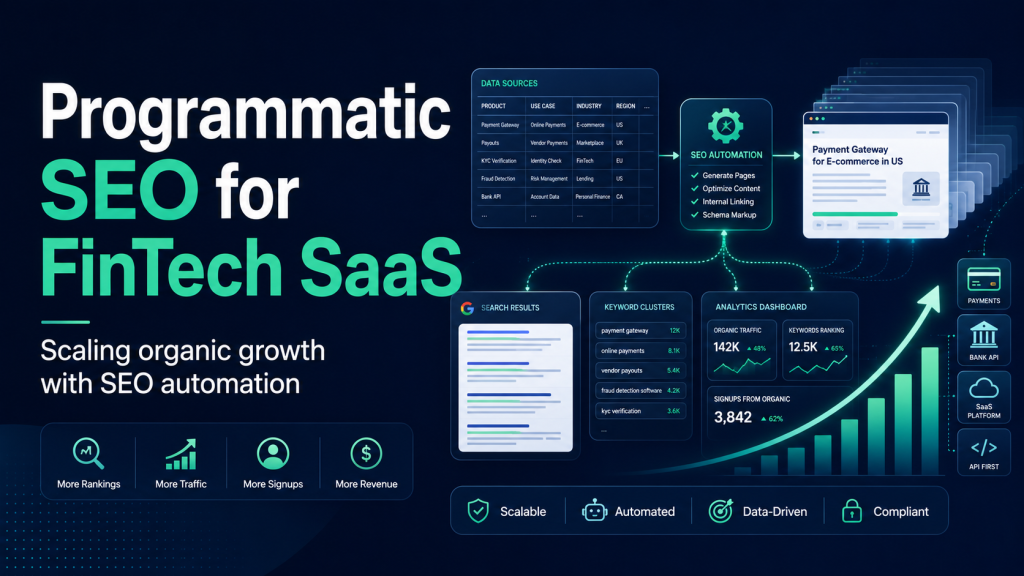
SEO automation is what separates programmatic SEO from traditional content marketing. Rather than producing pages one at a time, SEO automation tools generate, publish, and optimize pages based on a structured data source a spreadsheet, database, or API feed combined with a reusable content template.
Core Components of a FinTech SEO Automation Stack
- Keyword matrix: A structured database of head terms × modifiers (e.g., “payment API” × “for SaaS” / “for marketplaces” / “for e-commerce”)
- Content templates: Reusable page structures with dynamic variables injected per keyword cluster
- CMS integration: Automated publishing via Webflow, WordPress, or a headless CMS connected to your data layer
- Internal linking: Automated cross-linking between programmatic pages to distribute authority and improve crawlability
- Schema markup: Automated structured data injection for FAQPage, Product, and HowTo schemas critical for FinTech YMYL compliance
A real-world example of SEO automation at scale: Zapier’s programmatic SEO approach generates over 50,000 integration pages that collectively attract millions of monthly organic visitors all built from a template applied to structured integration data (source: averi.ai programmatic SEO guide).
Building a SaaS SEO Strategy Around Programmatic Content
A strong SaaS SEO strategy uses programmatic SEO for scale and editorial content for authority both working together inside a unified SaaS marketing strategy.
Phase 1 Keyword Architecture
Map your FinTech product to every search intent variation your ICP uses. For a SaaS marketing strategy in payments, this might include: comparison queries (“Stripe vs Adyen for SaaS”), use-case queries (“recurring billing software for subscriptions”), and integration queries (“connect Plaid to Salesforce”). Each cluster becomes a programmatic SEO template.
Phase 2 Content Automation at Scale
Content automation transforms your keyword matrix into live pages. The process involves: building a master data sheet with all variables, designing a template that satisfies search intent for the cluster, and using your CMS automation layer to publish, index, and internally link every generated page. According to Omnius’s programmatic SEO case study, this approach drove 220.65% organic traffic growth in Q1 2025 (last year) for a SaaS client, with signups increasing from 67 to 2,100 per month.
Phase 3 Quality Control and E-E-A-T
FinTech content falls under Google’s YMYL (Your Money or Your Life) guidelines, meaning quality signals matter more here than in most verticals. Every programmatic page must include: a clear, unique value statement; author attribution with FinTech credentials; accurate, cited data; and schema markup that signals expertise. Content automation must not sacrifice these signals for volume.
Measuring Programmatic SEO Success in FinTech SaaS
A SaaS marketing strategy built on programmatic SEO should be measured against pipeline outcomes, not just traffic. Key metrics include:
- Organic signups per month: The primary SaaS SEO growth metric qualified users entering the product funnel from organic search
- Pages indexed vs. pages ranking: Monitors whether SEO automation output is being crawled and promoted by Google
- Cost per organic lead vs. paid: According to First Page Sage, organic channel CAC averages $205 versus $341 for paid a 39.9% saving
- Topical authority score: Tracked via Semrush or Ahrefs to confirm programmatic SEO is building domain depth in FinTech keywords
- AI citation rate: Increasingly important whether your programmatic SEO pages are cited in ChatGPT, Perplexity, or Google AI Overviews
Frequently Asked Questions (FAQs)
Q1. What is programmatic SEO and how does it work for FinTech?
Programmatic SEO is a strategy that uses data templates to generate large numbers of targeted landing pages automatically. For FinTech, it works by mapping product categories, integrations, comparisons, and use cases to keyword clusters, then automating page creation and publishing via a CMS. The result is topical coverage at a scale no manual content team can achieve.
Q2. What is programmatic SEO’s main advantage over traditional content marketing?
Understanding what is programmatic SEO compared to traditional content marketing comes down to velocity. Traditional content produces one well-crafted page at a time. Programmatic SEO produces hundreds or thousands of targeted pages from a single template, capturing long-tail traffic across an entire keyword universe simultaneously.
Q3. How does embedded finance create programmatic SEO opportunities?
Embedded finance is growing at a CAGR of 23.84% through 2031 (Mordor Intelligence), generating thousands of new search queries as buyers research BaaS providers, payment APIs, and lending integrations. Programmatic SEO lets FinTech SaaS companies systematically capture every variation of those queries product comparisons, use-case guides, regulatory explainers before competitors do.
Q4. What SEO automation tools are recommended for FinTech SaaS?
SEO automation for FinTech typically involves Ahrefs or Semrush for keyword research and clustering, Google Sheets or Airtable as the data source, a headless CMS (Contentful, Webflow, or WordPress with WP All Import) for automated publishing, and schema markup tools for YMYL-compliant structured data. The no-code stack typically runs $200–$500 per month for a single marketer to operate.
Q5. Is programmatic SEO safe after Google’s Helpful Content Updates?
Programmatic SEO is safe when each page provides genuine, unique value to the searcher. Google’s Helpful Content Updates penalise thin, duplicate, or low-value content not scale itself. FinTech SaaS companies that enrich each programmatic page with accurate data, expert authorship, and clear user intent will build durable rankings. Pages that recycle generic content across thousands of URLs are the ones at risk.
Q6. How does programmatic SEO fit into a SaaS marketing strategy?
Programmatic SEO is most effective as part of a broader SaaS marketing strategy that also includes editorial thought leadership, product-led content, and link-building. In FinTech, programmatic SEO handles the long-tail volume (integration pages, comparison pages, use-case pages) while editorial content targets high-authority head terms. Together, they build organic growth that compounds over time.
Q7. What SaaS SEO metrics should FinTech companies prioritize?
SaaS SEO metrics for FinTech should prioritize pipeline impact over vanity metrics. The most important signals are organic signups, cost per organic lead, keyword ranking coverage across your programmatic clusters, and increasingly AI citation rate across LLM-powered search tools. According to First Page Sage, SaaS SEO delivers a 702% ROI for B2B SaaS companies, making it the highest-return marketing channel available.
Q8. How long does it take for programmatic SEO to show results?
In competitive FinTech verticals, programmatic SEO typically begins generating measurable organic traffic within 3–6 months of a well-structured launch. Omnius’s case study documented 220.65% organic traffic growth within a single quarter after deployment. Results depend on the quality of the keyword matrix, content uniqueness, technical SEO health, and the site’s existing domain authority.
Q9. What is content automation and how does it support programmatic SEO?
Content automation is the process of using templates, data feeds, and publishing workflows to create content at scale without manual writing for every page. In programmatic SEO, content automation is the production layer it takes a validated keyword matrix and data source, applies a quality template, and publishes pages automatically. For FinTech SaaS, it enables coverage of thousands of query variations across payments, lending, and embedded finance without proportionally scaling headcount.
Q10. How does programmatic SEO support embedded finance product marketing?
Programmatic SEO is one of the most effective channels for embedded finance product marketing because it mirrors how buyers actually search. A buyer evaluating embedded finance solutions typically searches across dozens of specific queries before making a shortlist. Programmatic SEO ensures your product appears at every relevant touchpoint comparison pages, integration guides, use-case landing pages building familiarity and trust before the buyer ever visits your homepage.