Table of Contents
ToggleLocal SEO Automation: Retail Geographic Targeting Guide
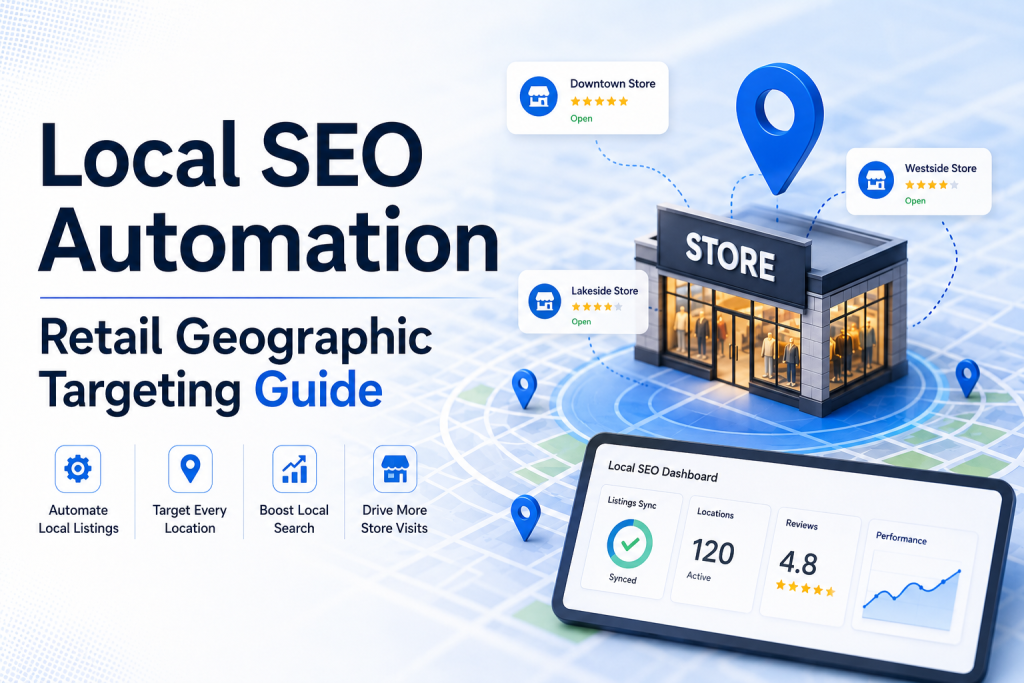
Walk into any retail marketing meeting today and you’ll hear the same question: how do we get found by shoppers near every store without a manual update for every location? That is precisely the gap local SEO automation closes. For multi-location chains, combining SEO automation with geographic targeting is no longer optional it is how serious retail brands win the “near me” moment at scale.
Why Local SEO Matters More Than Ever for Retail
According to BrightLocal’s Consumer Search Behavior research, 80% of US consumers search online for local businesses every week, and 32% do so every single day. That volume makes local search one of the most active discovery channels in retail, outpacing social media for purchase-intent searches.
The stakes are equally clear on the conversion side. Data from OnTheMap’s verified local SEO statistics show that 78% of local mobile searches result in an offline purchase within 24 hours. For a brick-and-mortar retailer, that single statistic reframes local search from a marketing tactic into a direct revenue channel.
What Is Local SEO Automation?
Local SEO automation uses software and connected workflows to manage the repetitive tasks that local SEO demands updating local listings, pushing business-hours changes, syncing store data across directories, and monitoring reviews across every store location from a single dashboard. Instead of a coordinator logging into ten platforms manually, one update propagates everywhere automatically.
For a boutique with two locations, manual management is fine. For a chain with fifty or two hundred stores, SEO automation is the only way to stay accurate and competitive without an unmanageable headcount.
The Core Tasks Automation Handles
A typical SEO automation stack covers: publishing and syncing local listings across search engines and directories, monitoring for duplicate or outdated entries, distributing updates to store hours, phone numbers, and services, routing new reviews for timely responses, and reporting local search performance by location. Taken together, these remove the manual bottlenecks that cause most retail chains to fall behind on accuracy.
Geographic Targeting: Making Every Store Locally Relevant
Geographic targeting is the practice of tailoring search visibility and content to specific areas rather than treating an entire customer base as one audience. A shopper in one city sees content, offers, and search results tied to the store nearest them. This matters because search engines are inherently location-aware the same query returns different results depending on where the searcher is standing.
Google’s own documentation confirms that local results are ranked primarily on relevance, distance, and prominence. Geographic targeting directly influences all three: location-specific pages improve relevance, verified store addresses define distance, and locally earned reviews build prominence.
What Geographic Targeting Looks Like in Practice
In practical terms, geographic targeting means each store has a dedicated location page with locally relevant keywords, that promotional campaigns are segmented by region rather than broadcast nationally, and that store locators surface the nearest location rather than defaulting to a brand homepage. Each of these layers sends clearer geographic signals to search engines and to shoppers alike.
How Retail Technology Enables Scalable Local SEO
Modern retail technology platforms connect a brand’s internal data store hours, inventory status, service offerings to every public-facing listing. When a store changes its holiday hours in the internal system, that change flows automatically to Google, Apple Maps, Bing, and major directories without anyone logging in manually. This kind of real-time sync is what makes accurate local listings achievable across hundreds of locations.
The best retail technology stacks also include monitoring: regular scans that catch inconsistencies, flag duplicates, and alert teams before a wrong phone number or outdated address quietly drains foot traffic from a specific store.
Local Listings: The Foundation Everything Else Rests On
Local listings map profiles, directory citations, and search engine business entries are the trust layer beneath every other local SEO effort. Search engines use the consistency of a store’s name, address, and phone number across platforms as a credibility signal. Inconsistencies, even minor ones, introduce doubt that can suppress visibility even when a store’s content and reviews are strong.
Automating local listings starts with a single source of truth: one system where store data lives and from which every other platform pulls. Updates made once propagate everywhere, removing the risk of a holiday-hours change sitting unsynced on a high-authority directory during a brand’s busiest week.
Connecting Local Marketing to Automation
Local SEO automation handles the structural side of visibility; local marketing gives it a reason to convert. Region-specific promotions, community-focused content, and geographically segmented campaigns all amplify the visibility that automated SEO creates. A well-optimized listing brings shoppers to a store’s profile a timely, locally relevant offer is often what gets them through the door.
The most effective retail brands treat local marketing and local search as one interconnected system rather than separate departments. Locally relevant content also tends to earn more engagement and local backlinks, which feeds back into stronger prominence signals and better rankings over time.
A Practical Framework for Getting Started
Bringing all of this together works best with a clear sequence. Begin with an audit of every location’s current local search presence listing accuracy, review volume, and whether a location page exists. Next, centralize listings management into one platform so updates only need to happen once. Then layer in geographic targeting through location-specific content and regionally segmented campaigns. Finally, establish regular reporting at the store level so performance gaps surface early and the entire system improves continuously rather than sitting static after launch.
Common Mistakes to Avoid
Treating SEO automation as a one-time setup is the most frequent misstep tools go stale, listings drift out of sync, and the same problems automation was meant to prevent quietly return. Over-templating location pages is a close second: pages built from a single copy-paste template with only the city name swapped rarely earn strong local rankings because they offer no genuine local relevance. The data automation generates also needs regular review; ignoring location-level reports means early warning signs go unseen until they’ve already impacted rankings.
Frequently Asked Questions
What is local SEO automation?
It is the use of software and connected workflows to manage local SEO tasks updating local listings, syncing store data, and monitoring reviews across many locations from one dashboard, so accuracy scales without proportional manual effort.
How does geographic targeting help local search rankings?
It creates location-specific relevance signals. Dedicated location pages, regional content, and accurate store data together tell search engines exactly which geographic areas a store serves, which directly influences relevance and prominence two of Google’s three core local ranking factors.
Why do inaccurate local listings hurt rankings?
Search engines treat listing consistency as a trust signal. When a store’s name, address, or phone number varies across platforms, it introduces doubt about the business’s legitimacy, which can suppress local search visibility even when content and reviews are strong.
At what scale does SEO automation make sense for retailers?
Most brands feel the strain of manual local SEO somewhere between ten and twenty locations. At that point, the time cost of manual updates typically outweighs the cost of an automation platform, making it a practical business decision rather than a luxury.
How do local marketing campaigns connect to local SEO automation?
Automation handles structural visibility accurate listings, consistent data. Local marketing provides the content and offers that convert that visibility into foot traffic. Together they function as a single system: automation ensures shoppers can find the store; local marketing gives them a reason to visit.
How should retail brands measure the ROI of local SEO automation?
Track location-level metrics: listing accuracy rates, local search visibility per store, review volume and sentiment, location page traffic, and, where measurable, foot traffic. Store-level data reveals which locations are gaining and which need additional local marketing attention.