Table of Contents
ToggleDynamic Personalization: How AI Tailors Landing Pages for High-Value Enterprise Traffic
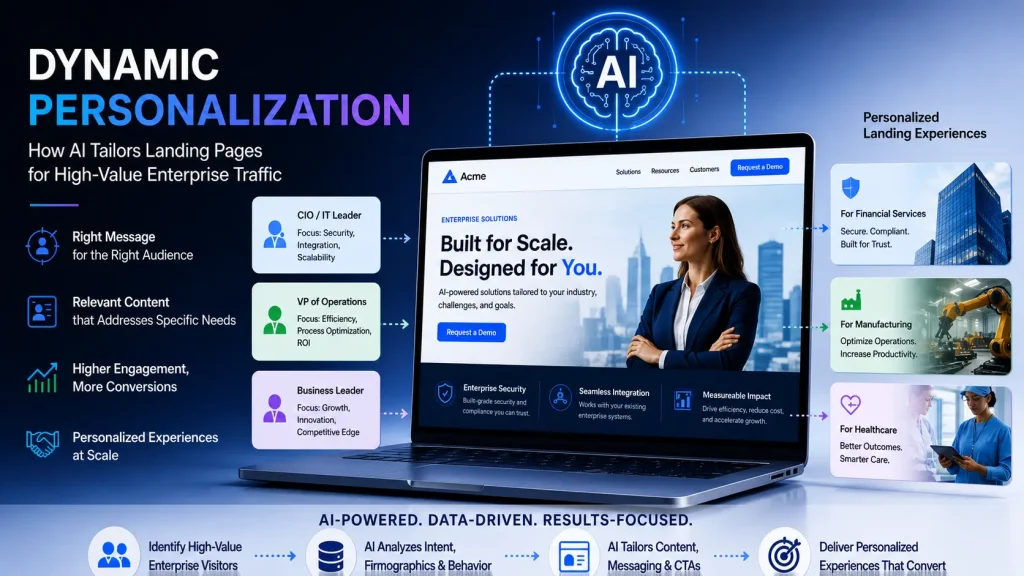
Enterprise buyers do not behave like casual website visitors. They arrive with more context, more intent, and much more specific expectations. A generic landing page can easily miss the mark, especially when the visitor represents a high-value account with multiple decision-makers involved.
That is where landing page personalization is becoming more important. AI now makes it possible to adjust content, messaging, and offers based on who is visiting, what they care about, and where they are in the buying journey. For enterprise businesses, this can make a meaningful difference in engagement and conversions.
This article looks at how AI is reshaping landing page personalization, why it matters for enterprise traffic, and how teams can use it in a practical way.
Why Enterprise Traffic Needs a Different Approach
Enterprise traffic is usually more complex than standard website traffic. A single visit may come from a procurement lead, a technical evaluator, a senior executive, or a department manager. Each of these people wants different information.
A one-size-fits-all landing page often fails because:
- It speaks too broadly
- It does not match the visitor’s role
- It does not address account-specific needs
- It lacks enough relevance to move the visitor forward
Personalized experiences help solve this problem by showing the right message to the right visitor at the right time.
What AI Brings to Landing Page Personalization
AI gives marketers a smarter way to adapt landing pages in real time. Instead of building one static page for everyone, teams can use data and behavioral signals to tailor what visitors see.
This is especially useful for dynamic landing pages, where content changes based on factors such as:
- Company size
- Industry
- Source of traffic
- Visitor role
- Previous site behavior
- Campaign type
- Account tier
With AI, personalization becomes more scalable. Marketers no longer need to build dozens of manual versions for every segment. Instead, AI can help decide which content blocks, headlines, proof points, or CTAs should appear for each visitor.
How Landing Page Personalization Works
At a practical level, landing page personalization uses visitor data to shape the page experience. The system may rely on first-party data, CRM data, behavioral data, or intent signals to decide what to show.
For example:
- A visitor from a healthcare company may see healthcare-specific messaging
- A returning visitor may see a stronger demo CTA
- A decision-maker may see ROI-focused content
- A technical user may see product details or integration information
This does not just make the page feel more relevant. It also helps reduce friction by answering the questions that matter most to that specific visitor.
Why AI Website Personalization Matters for Enterprise Marketing
AI website personalization is useful because enterprise buyers rarely move in straight lines. They research across channels, revisit pages multiple times, and compare vendors carefully before making a decision.
AI can help by:
- Identifying intent signals
- Predicting what content a visitor may need next
- Adjusting page layout based on engagement patterns
- Helping teams prioritize high-value accounts
For enterprise marketing teams, this creates a more responsive website experience. Instead of treating all traffic the same, the site becomes a more active part of the sales process.
The Role of Landing Page Personalization Tools
Many teams want personalization but struggle with the operational side. That is where landing page personalization tools come in. These tools make it easier to build, test, and manage dynamic experiences without rebuilding pages from scratch every time.
Common capabilities include:
- Audience segmentation
- Rule-based or AI-driven content variation
- A/B testing
- CRM and marketing automation integration
- Account-level targeting
- Analytics and performance tracking
The right tool should help teams personalize without creating unnecessary complexity. It should support both marketers and sales teams while keeping the visitor experience smooth.
Product Page Personalization and Enterprise Conversions
While landing pages often get the most attention, product page personalization also plays an important role in enterprise buying journeys. Enterprise visitors often move from campaign pages to product pages as they research features, pricing, integrations, and implementation details.
Personalized product pages can help by:
- Highlighting industry-specific use cases
- Showing relevant integrations
- Surfacing case studies from similar companies
- Adjusting messaging by buyer role
- Emphasizing the features that matter most to that account
When landing pages and product pages work together, the experience becomes more coherent and more persuasive.
Benefits of Dynamic Personalization for High-Value Accounts
AI-powered personalization offers several clear benefits for enterprise traffic:
- Better Relevance
Visitors see messaging that reflects their business context, which makes the page more useful.
- Higher Engagement
When content feels more relevant, visitors are more likely to stay on the page and explore further.
- Stronger Conversion Rates
Personalized CTAs and supporting content can improve demo requests, contact form submissions, and other key actions.
- Better Sales Alignment
Marketing can deliver warmer, more informed leads to sales by tailoring the experience before the first conversation.
- Smarter Use of Traffic
Enterprise traffic is expensive to acquire. Personalization helps get more value from each visit.
AI vs Without AI in Landing Page Personalization
To understand the real impact of AI-driven landing page personalization, it helps to compare it with the traditional (non-AI) approach.
Without AI (Traditional Personalization)
In a non-AI setup, personalization is usually manual or rule-based. This typically means:
- Marketers create fixed landing page variants for each segment
- Rules are manually defined (e.g., “if industry = healthcare, show this page”)
- Limited number of variations due to operational effort
- Updates require developer or marketing effort
- Testing is slower and less flexible
Limitations:
- Scalability becomes difficult as segments increase
- Hard to personalize at account or individual level
- Content often becomes outdated quickly
- Optimization cycles are slow
With AI (Dynamic Personalization)
AI-based personalization continuously adapts landing pages using real-time data and behavioral signals. This enables:
- Dynamic content changes based on visitor intent
- Real-time adjustment of headlines, CTAs, and proof points
- Account-level personalization (ABM-ready experiences)
- Automated decision-making across multiple variables
- Continuous learning and optimization
Advantages:
- Highly scalable across thousands of accounts
- More precise targeting for enterprise visitors
- Faster optimization based on performance data
- Better alignment with buyer intent and journey stage
Key Difference at a Glance
Aspect | Without AI | With AI |
Personalization Type | Manual / Rule-based | Dynamic / Real-time |
Scalability | Limited | High |
Optimization Speed | Slow | Continuous |
Data Usage | Basic segmentation | Behavioral + intent- based signals |
Enterprise Fit | Moderate | Strong |
How to Start Using Landing Page Personalization
If you are just getting started, the best approach is to begin with a few high-impact use cases rather than trying to personalize everything at once.
Step 1: Identify High-Value Segments
Focus on the industries, account tiers, or buyer roles that matter most.
Step 2: Map Visitor Intent
Understand what each segment is likely trying to accomplish when they land on your site.
Step 3: Personalize Key Page Elements
Start with headlines, proof points, CTAs, testimonials, and images.
Step 4: Test and Measure
Track how different experiences affect bounce rate, engagement, and conversions.
Step 5: Expand Gradually
Once the first use cases perform well, extend personalization to more pages and more segments.
Best Practices for a More Human Experience
AI can improve efficiency, but the goal should still be a natural, human-feeling experience. Good personalization should feel helpful, not intrusive.
A few best practices:
- Keep the messaging clear and simple
- Avoid over-personalizing based on weak signals
- Use data responsibly
- Make sure the page still feels cohesive
- Focus on relevance, not novelty
The most effective landing page personalization does not try to impress visitors with technical complexity. It simply helps them find what matters faster.
Final Thoughts
AI is making landing page personalization more practical for enterprise marketers. With the right strategy, businesses can create dynamic landing pages that speak more directly to high-value traffic, support better engagement, and improve conversion outcomes.
Whether you are using landing page personalization tools, improving product page personalization, or building a broader AI website personalization strategy, the goal is the same: deliver a more relevant experience for every visitor.
For enterprise brands, that relevance can make the difference between a missed opportunity and a qualified conversation.