Table of Contents
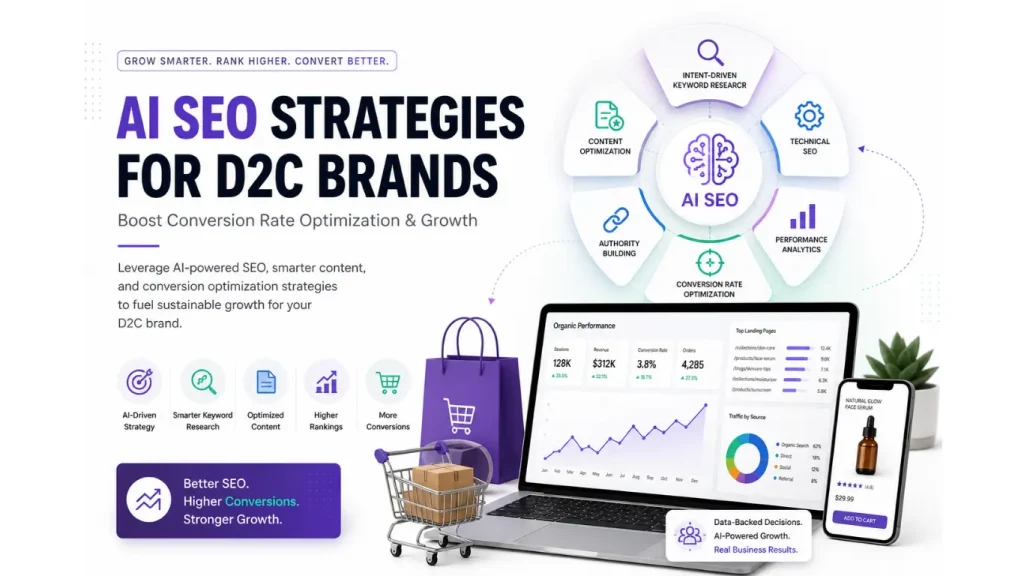
ToggleAI SEO Strategies for D2C Brands: Boost Conversion Rate Optimization & Growth
Let’s be honest traditional SEO alone is no longer enough for D2C brands trying to win visibility on Google. With intense competition from marketplaces, fast-growing startups, and every D2C SEO agency targeting the same audience, ranking is just the starting point. What truly drives growth today is how effectively you turn that traffic into customers. This is where AI SEO changes the game. By combining AI SEO strategies with data-driven D2C SEO and conversion rate optimization, brands can attract high-intent users, personalize their journey, and improve conversions at scale.
This guide is for founders, marketing leads, and growth teams at D2C brands who want practical, grounded strategies not just hype. We’ll walk through how AI SEO works in a D2C context, which tactics move the needle on conversions, and when it makes sense to bring in a D2C SEO agency to accelerate growth.
Why D2C Brands Need AI SEO Now
Direct-to-consumer brands have a unique problem. Unlike retailers with massive product catalogues or SaaS companies with one clear offering, D2C brands often live in that middle ground niche enough to have a loyal audience, but broad enough to face intense search competition.
The old approach was straightforward: pick your target keywords, write blog content, build some backlinks, and wait. That still works but it’s slow, and it doesn’t account for how dramatically search behavior has shifted. Shoppers ask questions in full sentences. They compare products conversationally. They arrive at your site with much higher intent, but also higher expectations.
AI SEO meets that shift. It lets D2C brands move faster on content, get smarter about intent, personalise landing pages dynamically, and most importantly connect SEO directly to conversion rate optimization outcomes rather than just rankings.
What AI SEO Actually Means for D2C
AI SEO isn’t about replacing your content team with robots or gaming Google’s algorithm. At its core, it means using machine learning and AI-powered tools to make better decisions, faster decisions about what to write, how to structure pages, which audiences to target, and where conversion leaks are hiding on your site.
For D2C brands specifically, AI SEO sits at the intersection of three disciplines:
Pillar 1: Intent-driven content
AI tools can analyse thousands of search queries to map real buyer intent not just what people search, but what stage of the funnel they’re in. This helps D2C brands create content that converts, not just content that ranks.
Pillar 2: Technical optimisation at scale
AI can audit large product catalogues for thin content, duplicate pages, or slow load times issues that quietly kill both rankings and conversions. This is especially valuable for D2C brands with growing SKU libraries.
Pillar 3: Personalisation & CRO
AI-powered personalisation lets you show different landing page variations to different audience segments adjusting headlines, social proof, or CTAs based on traffic source, location, or behaviour. This bridges D2C SEO and conversion rate optimization seamlessly.
6 AI SEO Strategies That Actually Drive D2C Growth
1. Build topical authority, not just keyword lists
Google’s algorithm has grown sophisticated enough to reward depth over breadth. Rather than chasing individual keywords, AI SEO tools can help you map entire topic clusters relevant to your product and identify which sub-topics your competitors have missed.
For a D2C skincare brand, this might mean building a comprehensive content hub around skin barrier health AI tools like Surfer SEO, MarketMuse, or Clearscope analyse competitor content and surface the semantic depth you need to establish authority.
2. Use AI for search intent segmentation
Not all searchers are equal. AI SEO strategies can classify your target queries by intent informational, commercial, transactional — and help you match the right content format and CTA to each stage. This directly improves the quality of your organic traffic, not just the quantity.
3. Automate product page optimisation at scale
One of the most underrated opportunities in D2C SEO is the product page itself. AI writing tools used thoughtfully, with a human editor in the loop — can generate unique, keyword-rich product descriptions at scale, pulling in semantic keywords and answering common buyer questions inline.
4. Leverage AI for link-building outreach
Backlinks remain one of the strongest ranking signals. AI tools can identify high-relevance link prospects, personalise outreach emails at scale, and predict which link opportunities are most likely to convert essential for any D2C SEO agency or in-house SEO team.
5. Implement AI-driven internal linking
Internal links distribute page authority, improve crawlability, and guide users deeper into your site all of which support both D2C SEO and conversion rate optimization. AI can audit your site and recommend internal linking opportunities you’d never find manually.
6. Use predictive analytics to anticipate search trends
AI-powered trend forecasting tools can identify rising search topics in your niche before they hit peak volume a significant first-mover advantage and one of the most powerful D2C growth strategies available today.
AI SEO and Conversion Rate Optimization: A Natural Partnership
Here’s something many D2C brands miss: D2C SEO and conversion rate optimization aren’t separate disciplines. They’re two sides of the same coin. Driving more organic traffic to a landing page that converts at 1% is far less valuable than improving that conversion rate to 3% first.
AI makes the connection between them practical. Here’s how the two reinforce each other:
AI heatmaps & session recording Tools like Hotjar and Microsoft Clarity use AI to surface patterns in how organic visitors interact with your pages where they drop off, what they click, where trust signals are missing.
Dynamic landing pages AI personalisation platforms can serve different landing page variations based on the keyword a visitor used to find you.
AI-powered A/B testing AI-powered multivariate testing adapts faster, letting D2C brands with moderate traffic still extract meaningful conversion rate optimization insights from organic visitors.
The brands seeing the most D2C growth strategies pay off treat conversion rate optimization as an SEO outcome metric not a separate project.
When to Work with a D2C SEO Agency
There’s a point in every D2C brand’s growth journey where in-house bandwidth becomes the bottleneck. A specialised D2C SEO agency brings three things an in-house generalist can’t always deliver: dedicated focus, a tested framework for your category, and access to AI SEO tools and data sets that are expensive to build independently.
When evaluating a D2C SEO agency, look for these signals:
Revenue-first reporting A good agency ties work to organic revenue and customer acquisition cost not just ranking reports.
Holistic D2C understanding The best agencies understand how SEO intersects with your retention loop, subscription model, and paid media spend.
AI tools with human oversight Any agency claiming to fully automate your content with AI should raise flags. The best use AI SEO to accelerate research and drafting but keep editorial quality control firmly in human hands.
Measuring What Actually Matters in D2C Growth Strategies
Defining the right success metrics is what separates D2C brands that treat D2C SEO as a cost centre from those that treat it as a growth engine.
Organic Revenue: The truest measure of SEO value for D2C brands.
Organic CVR: Conversion rate from organic traffic not just traffic volume.
Content ROI: Revenue attributed per content piece or cluster.
CAC (Organic): Customer acquisition cost via organic channel vs paid.
One practical approach: use GA4 segments to isolate organic traffic and build a monthly dashboard tracking organic sessions, organic revenue, and organic CVR side by side. When all three grow together, your AI SEO strategy is working.
Conclusion
AI SEO isn’t a magic wand. It won’t rescue a brand with a weak product or a confusing value proposition. But for D2C brands with genuine product-market fit, it is the most powerful lever for compounding organic growth because it makes every part of the SEO process smarter, faster, and more connected to actual business outcomes.
Start with intent. Map your buyer’s journey before you write a single word. Use AI SEO strategies to find the gaps your competitors have missed. And always measure conversions not just clicks.
Whether you’re building your AI SEO strategy in-house or partnering with a D2C SEO agency, the brands that win in organic search over the next three years will be the ones that treat it as a growth discipline not just a marketing checkbox.
Frequently asked Questions
AI SEO refers to using artificial intelligence and machine learning tools to improve search engine optimization strategies. For D2C brands, AI SEO helps identify customer intent, automate content creation, optimize product pages, and improve conversion rate optimization—leading to higher organic revenue.
Some of the best AI SEO tools for D2C brands include Surfer SEO, MarketMuse, Clearscope, Frase, and SEMrush. These tools help with keyword research, content optimization, internal linking, and technical SEO audits, making them essential for ecommerce SEO optimization strategies.
AI SEO strategies improve conversion rate optimization by aligning content with user intent, personalizing landing pages, and analyzing user behavior. AI-driven CRO tools like heatmaps and session recordings help identify friction points and improve ecommerce conversion rates.
AI SEO is not a replacement but an evolution of traditional SEO. It enhances traditional methods by using data-driven insights, automation, and predictive analytics, making it more effective for ecommerce and D2C growth strategies.
A D2C SEO agency helps implement AI SEO strategies by providing expertise, advanced tools, and scalable frameworks. They focus on driving organic revenue, improving customer acquisition cost (CAC), and aligning SEO with overall D2C growth strategies.
You can improve ecommerce conversion rate using AI by:
- Personalizing landing pages
- Using AI-driven A/B testing
- Optimizing product descriptions
- Analyzing user behavior with AI tools
- Implementing smart CTAs based on intent
Yes, AI SEO services can be highly valuable for small D2C brands. They help maximize limited resources, automate repetitive tasks, and provide data-driven insights that improve both SEO performance and ecommerce conversion optimization strategies.