Table of Contents
ToggleAI Lead Generation: The Hyperlocal Marketing Blueprint
Introduction
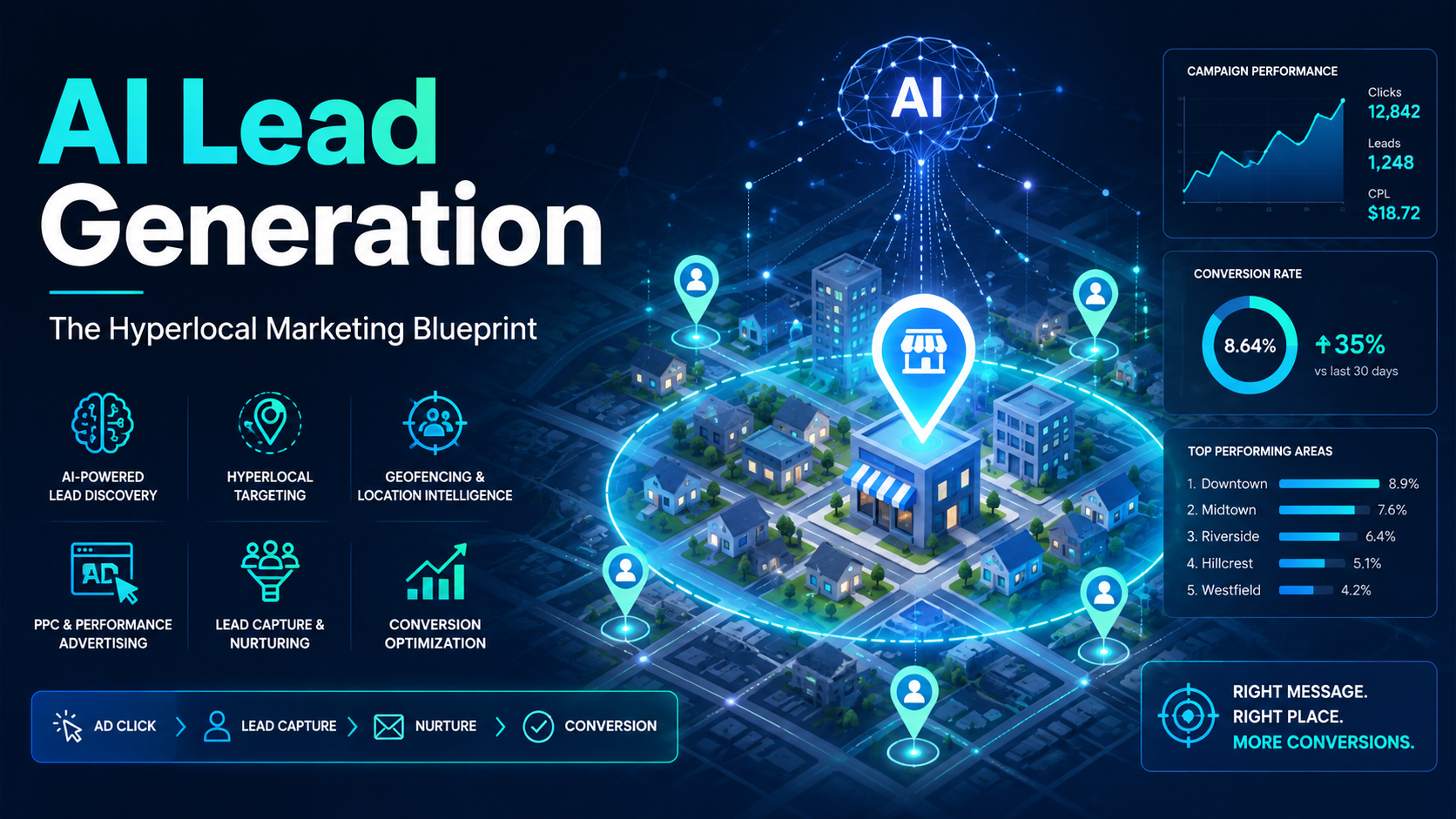
The promise of digital advertising has always been reaching the right person at the right time. AI lead generation is finally delivering on that promise not just at scale, but with street-level precision that was unimaginable a few years ago. When you combine artificial intelligence with hyperlocal marketing, the result is a system that identifies high-intent prospects in a defined geography, delivers hyper-relevant ads, and converts them into leads faster than any traditional funnel.
This blueprint breaks down exactly how AI lead generation strategies work within a hyperlocal advertising framework and how performance advertising and pay per click marketing tools power each stage of the process.
Why Hyperlocal Marketing Is the Ideal Channel for AI Lead Generation
Most lead generation strategies cast a wide net and hope for the best. Hyperlocal marketing inverts that model. Instead of broad audience targeting, it focuses on a specific neighbourhood, street radius, or geofenced zone and layers in AI to qualify, score, and engage the most promising prospects automatically.
Location-based marketing continues to gain traction among retailers, while consumers increasingly show a willingness to share location data in exchange for personalised offers the opt-in consent that makes compliant hyperlocal marketing viable.
For AI lead generation, this opt-in behaviour is critical. AI models trained on location intent signals, search history, and CRM data can prioritise leads within a geofence who are statistically most likely to convert reducing wasted ad spend before a campaign even launches.
Performance Advertising The Engine Behind Hyperlocal AI Campaigns
Performance advertising is the foundational model that makes hyperlocal advertising measurable. You pay for outcomes clicks, leads, appointments rather than impressions. When AI optimises bidding, targeting, and creative for performance advertising campaigns in real time, the ROI potential multiplies significantly.
AI-Powered PPC Benchmarks (2025)
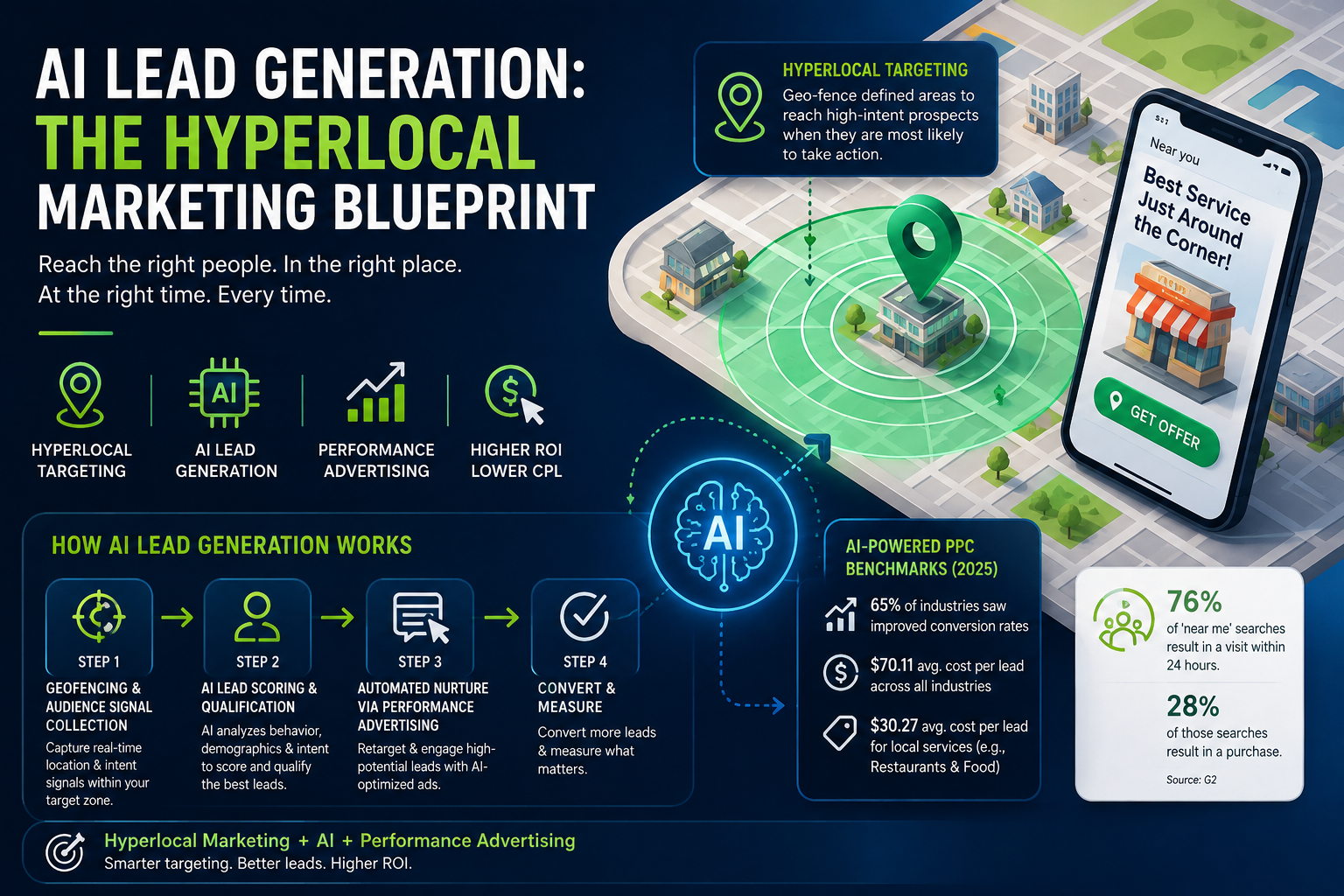
According to WordStream’s 2025 Google Ads Benchmark Report (based on 16,446 U.S. campaigns, April 2024–March 2025), 65% of industries saw improved conversion rates in 2025 despite rising costs-per-click. The average cost per lead in Google Ads stood at $70.11 across all industries, with local service categories such as Restaurants & Food averaging as low as $30.27 per lead.
For local businesses, pay per click marketing within a defined radius combined with AI Smart Bidding means budget is allocated precisely where conversion probability is highest, rather than spread evenly across a broad geography.
How AI Lead Generation Works in a Hyperlocal Context
Building a working AI lead generation system for hyperlocal marketing requires connecting several components. Here is how a well-structured system operates:
Step 1 Geofencing and Audience Signal Collection
Define your target zone a neighbourhood, a competitor’s premises, or an event venue and activate geofencing via platforms such as Google Ads Local Campaigns, Meta Ads with location targeting, or programmatic DSPs. According to G2’s hyperlocal marketing analysis, 76% of people who conduct a ‘near me’ search on their smartphone visit a business within 24 hours, and 28% of those searches result in a purchase. Hyperlocal advertising puts your brand in front of that high-intent audience at the precise moment of decision.
Step 2 AI Lead Scoring and Qualification
Once a prospect interacts with a hyperlocal advertising touchpoint clicking an ad, submitting a form, or engaging with a chatbot AI scoring models evaluate the lead against firmographic, behavioural, and demographic criteria. Forrester’s 2024 AI Lead Management research found that AI-enabled qualification delivered a 56% reduction in unqualified leads passed to sales versus manual processes.
Step 3 Automated Nurture via Performance Advertising
Qualified leads who do not convert immediately are re-entered into a performance advertising retargeting sequence. AI adjusts bid values, ad creative, and messaging cadence based on the prospect’s engagement score and funnel position. This closed-loop approach ensures every dollar of pay per click marketing spend is directed toward leads with the highest predicted conversion probability.
Building a Hyperlocal AI Lead Generation Blueprint Step by Step
Phase 1 Market & Zone Definition
- Map your target geography: define primary, secondary, and competitor-adjacent zones
- Research ‘near me’ and local-intent keyword demand using Google Keyword Planner
- Identify peak footfall windows and seasonal demand patterns for your zone
Phase 2 Campaign Architecture
- Pay per click marketing campaigns: Google Search with radius targeting + Local Services Ads for high-intent queries
- Performance advertising retargeting: Meta Custom Audiences geofenced to your zone, serving dynamic ads to prior website visitors and lookalike segments
- Hyperlocal advertising display: programmatic placements on local news, weather, and community apps within your defined radius
Phase 3 AI Integration
- Enable Smart Bidding (Target CPA or Target ROAS) on all pay per click marketing campaigns provide sufficient conversion data for Smart Bidding algorithms to optimise effectively
- AI lead generation chatbot: deploy on landing pages to qualify inbound leads in real time, collecting name, intent, and location before human handoff
- Connect ad platforms to CRM via API to pass lead quality signals back to bidding algorithms closing the optimisation loop
Phase 4 Measurement
- Primary KPIs: cost per qualified lead, lead-to-appointment conversion rate, return on ad spend (ROAS)
- Secondary KPIs: geofence entry-to-click rate, AI chatbot qualification rate, average sales cycle length
- Run geo-holdout incrementality tests quarterly to verify that hyperlocal marketing spend is generating true lift, not capturing organic demand
Real-World Evidence for AI-Driven Hyperlocal Performance
The case for combining AI lead generation with hyperlocal advertising is not theoretical. Brands using Google’s AI-powered advertising solutions have reported stronger customer acquisition and improved campaign efficiency by allowing machine learning models to identify high-intent audiences automatically.
These gains come from AI’s ability to discover high-converting search queries and physical location patterns that manual campaign managers miss a key advantage for performance advertising at the local level.
Frequently Asked Questions (FAQs)
Q1. What is AI lead generation and why does it matter for local businesses?
AI lead generation uses machine learning to automatically identify, score, and engage prospects based on behavioural, demographic, and location data. For local businesses, it reduces manual prospecting time, improves lead quality, and ensures performance advertising budgets are allocated toward prospects most likely to convert within a specific area.
Q2. How does hyperlocal marketing differ from standard local marketing?
Standard local marketing targets a broad city or region. Hyperlocal marketing narrows the focus to a neighbourhood, a street radius, or even a specific venue using geofencing and real-time location signals to serve ads only to prospects within that defined zone. This precision reduces wasted impressions and increases relevance for high-intent buyers nearby.
Q3. What role does performance advertising play in a hyperlocal AI strategy?
Performance advertising provides the measurable, outcome-based framework that makes hyperlocal advertising accountable. Paying per click, lead, or conversion means every spend is tied to a specific action. When AI is layered on top, bid strategies self-optimise around conversion probability, ensuring the performance advertising model continuously improves without manual adjustment.
Q4. Is pay per click marketing still effective for hyperlocal lead generation?
Pay per click marketing remains one of the highest-intent digital channels available to local businesses. WordStream’s 2025 benchmark data (16,446 U.S. campaigns) confirms that 65% of industries saw better conversion rates in 2025 despite rising costs. For local categories, average cost per lead for food and restaurant businesses was just $30.27.
Q5. What is geofencing and how does it support hyperlocal advertising?
Geofencing establishes a virtual boundary around a physical location. When a mobile device enters that boundary, it triggers an ad, push notification, or SMS. In hyperlocal advertising, geofencing has become a widely adopted tactic because it enables businesses to reach nearby consumers with highly relevant messaging based on physical location. This precision targeting makes hyperlocal marketing campaigns more efficient by focusing spend only on audiences in a defined geographic zone.
Q6. How does AI improve lead quality in hyperlocal campaigns?
AI scoring models evaluate inbound leads against conversion history, CRM data, and real-time engagement signals to filter out low-quality prospects before they reach a sales team. Forrester’s 2024 AI Lead Management research found that AI-enabled qualification delivered a 56% reduction in unqualified leads passed to sales, freeing sales capacity for high-probability opportunities.
Q7. What platforms are best for running hyperlocal AI lead generation campaigns?
The strongest platforms for hyperlocal advertising with AI include Google Ads (Local Campaigns, Performance Max, Local Services Ads), Meta Ads (radius targeting with AI-driven audience expansion), and programmatic DSPs with geofencing capability. For AI lead generation specifically, adding an AI chatbot or lead qualification tool to landing pages connected back to the CRM completes the conversion loop.
Q8. How much budget do you need to run hyperlocal performance advertising?
Entry-level hyperlocal advertising via pay per click marketing can begin with modest daily budgets. The key constraint is providing sufficient conversion data for Smart Bidding algorithms to optimise effectively.
Q9. How does AI marketing automation connect to hyperlocal lead generation?
AI marketing automation handles the follow-up after a hyperlocal marketing ad captures an initial lead interaction. Automated sequences email, SMS, or WhatsApp deliver the right message at the right stage of the buying journey. When these tools are synced with CRM data from hyperlocal marketing campaigns, every follow-up is informed by the prospect’s location history and engagement score.
Q10. What metrics should I track to measure AI lead generation success in hyperlocal campaigns?
The most important metrics for AI lead generation in a hyperlocal marketing context are cost per qualified lead, lead-to-appointment conversion rate, return on ad spend (ROAS), AI chatbot qualification rate, and geofence entry-to-click rate. For performance advertising, supplementing these with incrementality testing ensures you are measuring genuine marketing lift, not just organic demand.