Table of Contents
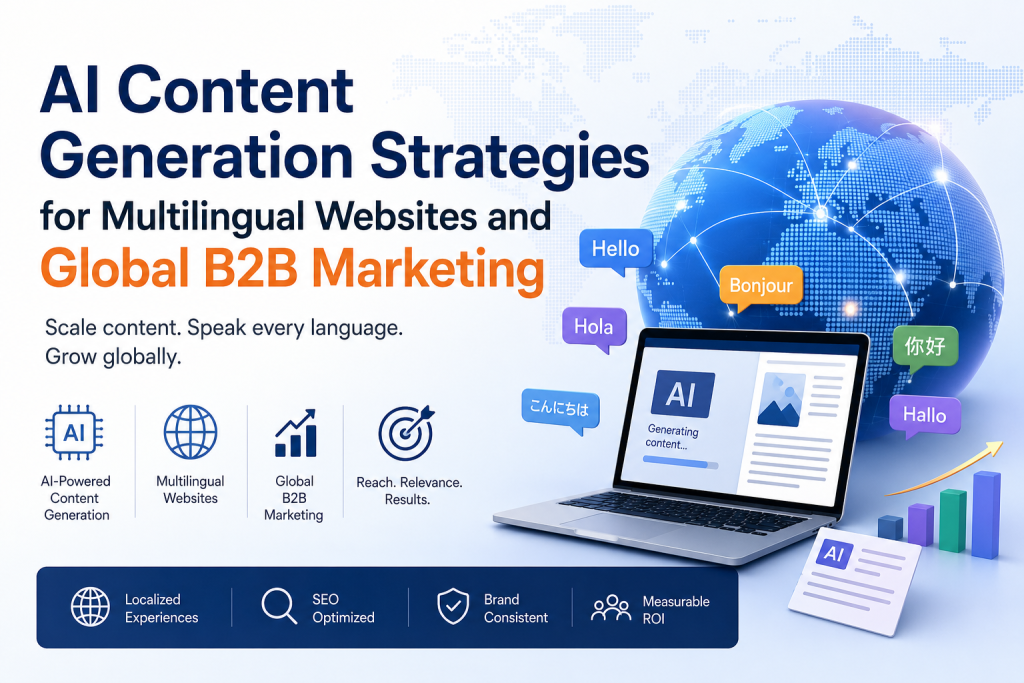
ToggleAI Content Generation Strategies for Multilingual Websites and Global B2B Marketing
Global business communication has entered a new era. As companies expand across borders, the demand for high-quality, locally relevant content in multiple languages has grown faster than most marketing teams can manually scale. This is exactly where AI content generation is rewriting the rules. Powered by large language models and sophisticated natural language processing, AI is giving B2B organizations the ability to produce, translate, and optimize content for international audiences at a speed and scale that was previously impossible.
For marketing leaders building a global marketing strategy, the challenge is no longer just about translation. It is about creating content that resonates culturally, ranks well in local search engines, and maintains the technical precision that B2B digital marketing demands. This article provides a comprehensive, practical guide to deploying AI content generation strategies that power multilingual website growth and global B2B marketing success.
The Growing Imperative for AI-Driven Global Content
The numbers are compelling. According to CSA Research, 76 percent of global online consumers prefer to buy products in their native language, and 40 percent will never purchase from websites available in English only, regardless of whether they speak English fluently. For B2B companies selling into multiple markets, this is not simply a preference signal. It is a revenue signal.
Source: CSA Research, “Can’t Read, Won’t Buy”
At the same time, producing quality content across 10, 20, or 30 languages through traditional agency and in-house methods is prohibitively expensive and slow. A single white paper localized into 15 languages through traditional processes can take weeks and cost tens of thousands of dollars. AI content generation compresses that timeline to hours and the cost to a fraction, without sacrificing technical accuracy when deployed correctly.
Why B2B Organizations Are Accelerating AI Adoption
A 2023 McKinsey Global Survey found that 50 percent of organizations had adopted AI in at least one business function, with marketing and sales among the top three areas of deployment. For B2B digital marketing specifically, AI content tools are being used to generate product documentation, thought leadership articles, email nurture sequences, landing page copy, and technical case studies across multiple languages simultaneously.
Source: McKinsey Global Survey on AI
The competitive advantage is clear. Organizations that build AI content generation capabilities into their global digital marketing workflows can enter new markets faster, test messaging at lower cost, and iterate based on performance data in near real time.
Building a Multilingual Website Strategy Powered by AI
A multilingual website is more than a translated version of your English content. It is a localized digital experience designed to meet the specific expectations, search behaviors, and cultural norms of each target market. AI content generation plays a central role in making this feasible at scale, but it requires a structured strategy to execute effectively.
Step 1: Define Your Localization Hierarchy
Not all markets deserve equal investment. Before deploying AI content generation tools, map your target markets by revenue potential, strategic priority, and competitive intensity. Tier 1 markets might receive fully localized content with native editorial review. Tier 2 markets might receive AI-generated content with light human proofreading. Tier 3 markets could be served primarily by AI with periodic quality audits. This hierarchy ensures your global marketing strategy allocates resources intelligently.
Step 2: Establish a Multilingual Content Architecture
Your multilingual website must be built on a technically sound structure. Use hreflang tags to signal language and regional targeting to search engines. Implement country-code top-level domains, subdirectories, or subdomains depending on your SEO and brand strategy. Ensure your CMS supports multilingual content management natively. Platforms such as Contentful, Sitecore, and Drupal are built for this, while headless CMS architectures offer the flexibility needed when AI content generation is integrated into publishing workflows through APIs.
Step 3: Train AI on Brand Voice and Technical Vocabulary
Generic AI content generation tools will produce generic content. To generate outputs that reflect your brand’s expertise and voice, you must invest in custom prompt engineering, model training or grounding using your existing content library, and clear brand voice guidelines. For B2B companies, this is especially critical. Technical accuracy in product descriptions, regulatory compliance language, and industry-specific terminology must be correct in every language, not merely approximated.
AI Content Generation Frameworks for Global B2B Marketing
Implementing AI content generation across a global digital marketing operation requires more than choosing the right software. It demands a repeatable framework that governs content quality, cultural appropriateness, SEO optimization, and brand consistency across every market.
The CALM Framework: Create, Adapt, Localize, Measure
Create
Use AI content generation to produce master content in your primary language, typically English. This master content becomes the strategic source of truth for all localized versions. Invest the most editorial attention here, as quality at this stage multiplies across every market you serve.
Adapt
Adaptation goes beyond word-for-word translation. AI models can be prompted to adjust tone, formality levels, and cultural references based on target market profiles. For example, B2B digital marketing content targeting Japanese enterprises requires a significantly more formal register than content targeting Australian SMBs. AI can handle these adjustments at scale when properly instructed.
Localize
True localization includes currency formatting, date conventions, regulatory references, local case studies, regional statistics, and country-specific calls to action. Your multilingual website should feel native to each market, not translated. AI can systematically apply localization rules when integrated with localization management platforms such as Phrase, Lokalise, or Smartling.
Measure
Every localized content piece should be tracked against market-specific KPIs, including organic search ranking in local search engines such as Google, Baidu, Yandex, and Naver, as well as time on page, conversion rate by language variant, and pipeline attribution. This data feeds back into your global marketing strategy to refine AI prompting strategies and editorial investment decisions.
Integrating AI into the B2B Content Supply Chain
For large B2B organizations, AI content generation should be integrated directly into the content supply chain, not treated as a standalone tool. This means connecting AI writing platforms with your CMS, DAM or Digital Asset Management system, translation memory, SEO tools, and marketing automation platform. When AI outputs feed directly into these systems, the speed advantage compounds significantly across your entire global digital marketing operation.
Workflow automation platforms such as Zapier, Make, or custom API integrations allow AI-generated content to be automatically routed for review, optimized for SEO, formatted for publishing, and scheduled without manual intervention at each stage. This is how enterprise-scale B2B digital marketing teams can achieve content velocity that was previously difficult to sustain.
SEO Considerations for AI-Generated Multilingual Content
Search engine optimization for a multilingual website involves a distinct set of challenges that must be addressed alongside AI content generation deployment. Search engines do not evaluate content quality based only on whether AI was involved. The content still needs to be useful, original, accurate, relevant, and aligned with search intent.
Keyword Research by Market, Not Just Language
A common mistake in global digital marketing is assuming that translated keywords carry the same search volume and intent in target markets. Spanish-speaking users in Mexico search differently from those in Spain or Argentina. Your AI content generation strategy must be informed by market-specific keyword research conducted using tools such as Ahrefs, Semrush, or Google Keyword Planner with geographic filters applied. AI can then generate content optimized for these market-specific keyword sets rather than simply translating English-optimized copy.
Avoiding Duplicate Content Across Language Variants
AI translation tools that produce near-identical content across language variants with only surface-level changes risk creating thin content that search engines may deprioritize. Genuine AI content generation, where AI creates distinct, market-specific content informed by local keyword research, cultural context, and buyer personas, produces content that can earn rankings independently in each market. This distinction is critical for any global marketing strategy that takes SEO seriously.
Technical SEO for Multilingual Architecture
Ensure your multilingual website implements correct hreflang annotation across all pages, canonical tags that prevent duplicate-content issues, and XML sitemaps segmented by language and region. Page-speed optimization must also be applied through appropriate regional CDN configurations so users in Southeast Asia or Latin America experience the same fast load times as users in Europe or North America.
Practical Use Cases: AI Content Generation in Global B2B Marketing
Understanding how AI content generation applies in real-world B2B digital marketing scenarios makes the strategy tangible. Below are high-impact use cases that global B2B organizations are deploying today.
Thought Leadership and Long-Form Content at Scale
B2B brands that publish regular thought leadership content, including industry reports, trend analyses, and strategic guides, in multiple languages are seen as authoritative voices in each market they serve. AI content generation allows a single research-backed master article to be adapted into multiple market-specific versions, each with local statistics, regional examples, and culturally appropriate framing, within hours rather than weeks.
Personalized Email Campaigns Across Markets
Email personalization is one of the highest-ROI tactics in B2B digital marketing. AI can generate hundreds of personalized email variants based on buyer persona, industry vertical, company size, and geographic market, all in the appropriate language and register. According to Salesforce’s State of Marketing report, high-performing marketing teams are 4.9 times more likely to use AI for content personalization.
Source: Salesforce State of Marketing Report
Product and Technical Documentation
For technology, manufacturing, and professional services companies, accurate AI-assisted generation of product documentation, API guides, and compliance materials across multiple languages reduces the costly cycle of sending every asset to external translation agencies. When AI is grounded in an approved technical glossary, the accuracy and consistency of terminology across languages can improve significantly.
Localized Landing Pages for Paid Campaigns
Paid advertising in global digital marketing requires landing pages that match the language, offer, and cultural context of the ad creative. AI content generation enables marketing teams to build fully localized landing pages for each campaign, market, and audience segment rapidly, while A/B testing headline and body-copy variants across languages to identify what converts best in each market.
Governance, Quality Control, and Ethical Considerations
Deploying AI content generation at global scale introduces governance responsibilities that marketing leaders must address proactively. AI outputs must be reviewed for factual accuracy, cultural sensitivity, regulatory compliance, and brand alignment before publication, particularly in markets where a mistranslation or culturally insensitive phrase can cause significant reputational damage.
Building a Human-in-the-Loop Review Process
The most effective global marketing strategy for AI content places human expertise at the editorial review stage, rather than relying on AI output without oversight. Native-speaking subject-matter experts should review content for cultural nuance, factual accuracy, and brand voice alignment. This hybrid model captures the speed advantages of AI content generation while maintaining the quality standards that B2B digital marketing audiences expect.
Data Privacy and Compliance Across Markets
When using AI content generation platforms, ensure that proprietary business information, customer data, and confidential market intelligence are not entered into public systems without appropriate safeguards. Enterprise-grade AI platforms may offer private deployment options and data-residency controls that help organizations meet requirements under regulations such as GDPR in Europe, PDPA in parts of Southeast Asia, and LGPD in Brazil.
Conclusion
AI content generation is not simply a future capability. It is a present competitive advantage that global B2B organizations are deploying to scale their multilingual website presence, accelerate B2B digital marketing execution, and build a more effective global marketing strategy. The organizations winning in international markets are not necessarily those with the largest content teams. They are the ones with the smartest AI-enabled workflows, the most culturally intelligent localization strategies, and the discipline to measure and iterate consistently.
As global digital marketing grows more competitive and complex, the ability to produce locally resonant, technically precise, and SEO-optimized content across multiple languages will separate market leaders from followers. Building that capability starts with a clear strategy, the right technology stack, and a commitment to quality that no shortcut, AI or otherwise, can replace.
FAQs
Ai content generation refers to the use of artificial intelligence specifically large language models to create written content automatically based on prompts, guidelines, or structured inputs. For multilingual marketing, AI can produce original content in multiple languages simultaneously, adapt brand messaging for different cultural contexts, and integrate market-specific keywords, all at a fraction of the time and cost of traditional content production methods.
Yes, when properly reviewed and edited. Google’s content policies focus on helpfulness and quality, not on whether content was AI-generated. A multilingual website that publishes AI-generated content reviewed by native-speaking subject matter experts can achieve strong organic search performance. The key is ensuring factual accuracy, cultural appropriateness, and technical correctness before publication.
For b2b digital marketing teams, ai content generation enables faster campaign execution, personalized content at scale, localized landing pages, and multilingual thought leadership programs all of which directly support pipeline generation, market penetration, and brand authority in new regions.
The primary risks include factual inaccuracies in technical content, culturally insensitive phrasing, inconsistent brand voice, and potential compliance issues in regulated industries. These risks are effectively mitigated through a structured human review process, fine-tuning AI on proprietary brand and product content, and implementing quality assurance protocols before any AI-generated content is published to your multilingual website.
Leading platforms for ai content generation in global digital marketing contexts include Jasper AI, Claude by Anthropic, OpenAI’s GPT-4, Writesonic, and DeepL Write for translation-adjacent tasks. For enterprise deployment, platforms with API access, custom training capabilities, and data privacy controls are preferable. The right tool depends on your content volume, languages required, integration needs, and governance requirements.
Keyword research for a multilingual website should be conducted market by market, not simply by translating English keywords. Each language market has distinct search behaviors, query volumes, and competitive landscapes. Use SEO tools with geographic filtering such as Ahrefs, SEMrush, or Google Keyword Planner to identify high-value keywords per language and market, then instruct your ai content generation tools to optimize content for these market-specific terms.
A practical workflow for b2b digital marketing teams typically involves: defining the content brief and market-specific requirements, using ai content generation to produce first drafts in all target languages, routing drafts to native-speaking reviewers for accuracy and cultural checks, applying SEO optimization per market, publishing through your CMS, and tracking performance by language variant. This cycle can be completed in 2 to 3 days for multi-language campaigns that would previously take 4 to 6 weeks.
ROI measurement for ai content generation in a global marketing strategy context should track both efficiency gains and revenue impact. Efficiency metrics include content production time reduction, cost per piece of content, and number of languages served. Revenue metrics include organic traffic growth by market, lead generation by language variant, pipeline attribution by region, and conversion rate improvements on localized landing pages. Most organizations deploying enterprise-grade AI content programs report content production cost reductions of 40 to 70 percent within the first 12 months.