Table of Contents
ToggleGrowth Marketing: Using Customer Analytics for SaaS Upgrades
Introduction
In today’s hyper-competitive SaaS landscape, companies can no longer rely on one-time acquisition tactics. Sustainable revenue growth depends on keeping users engaged and nudging them toward higher-tier plans. That’s where growth marketing becomes indispensable. Unlike traditional marketing that focuses purely on new customer acquisition, growth marketing combines data, experimentation, and personalization to maximize value at every stage of the customer journey. When paired with deep customer analytics, it creates a powerful engine for driving SaaS upgrades organically and at scale.
What Is Growth Marketing in a SaaS Context?
Growth marketing is a full-funnel, data-driven approach that focuses on acquiring, activating, retaining, and expanding customers. In SaaS, the real gold lies in expansion revenue getting existing users to upgrade their plans, add seats, or unlock premium features.
This differs from saas marketing in general, which often concentrates on top-of-funnel brand awareness. Growth marketing instead tests hypotheses across every touchpoint onboarding emails, in-app messages, pricing pages and scales what works.The Role of Customer Analytics in Driving Upgrades
You cannot grow what you cannot measure. Customer analytics gives SaaS teams the visibility they need to understand user behavior, identify upgrade triggers, and predict churn before it happens.
Key Metrics to Track
- Product Usage Frequency How often users log in and use core features
- Feature Adoption Rate Which premium features free users explore
- Session Depth How far users go before hitting a paywall or limit
- Support Ticket Volume A rise in tickets often signals friction and upgrade opportunity
- Net Revenue Retention (NRR) Measures expansion and contraction revenue combined
Tools like Mixpanel, Amplitude, and Segment are industry standards for customer analytics in SaaS.
Lifecycle Marketing Nurturing Users Toward Higher Plans
Lifecycle marketing maps specific messages and offers to where users are in their journey from first login to power user to upgrade candidate. It ensures the right message reaches the right person at the right time.
Stages of SaaS Lifecycle Marketing
- Onboarding: Guide new users to their first ‘aha moment’ using automated welcome sequences and tooltips.
- Activation: Push users to experience the core value proposition within the first 7 days.
- Engagement: Use in-app nudges to highlight premium features they haven’t tried yet.
- Upgrade Trigger: Send personalized emails when users hit usage limits or engage heavily with a gated feature.
- Loyalty & Expansion: Reward long-term users with exclusive offers or early access to new features.
Integrating lifecycle marketing with customer analytics ensures that upgrade nudges feel natural rather than pushy increasing conversion without damaging user trust.
Retention Marketing The Foundation of SaaS Revenue
Retention marketing is the backbone of any sustainable SaaS business. Acquiring a new customer costs 5–7x more than retaining an existing one by focusing on retention marketing, SaaS companies not only reduce churn but also build a base of loyal users who are far more likely to upgrade.
Retention Tactics That Drive Upgrades
- Personalized re-engagement campaigns triggered by inactivity
- Milestone-based rewards (e.g., congratulating users on 100 tasks completed)
- Proactive customer success check-ins for high-usage accounts
- Contextual upsell messages tied to real usage patterns from customer analytics
Building a Growth Marketing Funnel for SaaS Upgrades
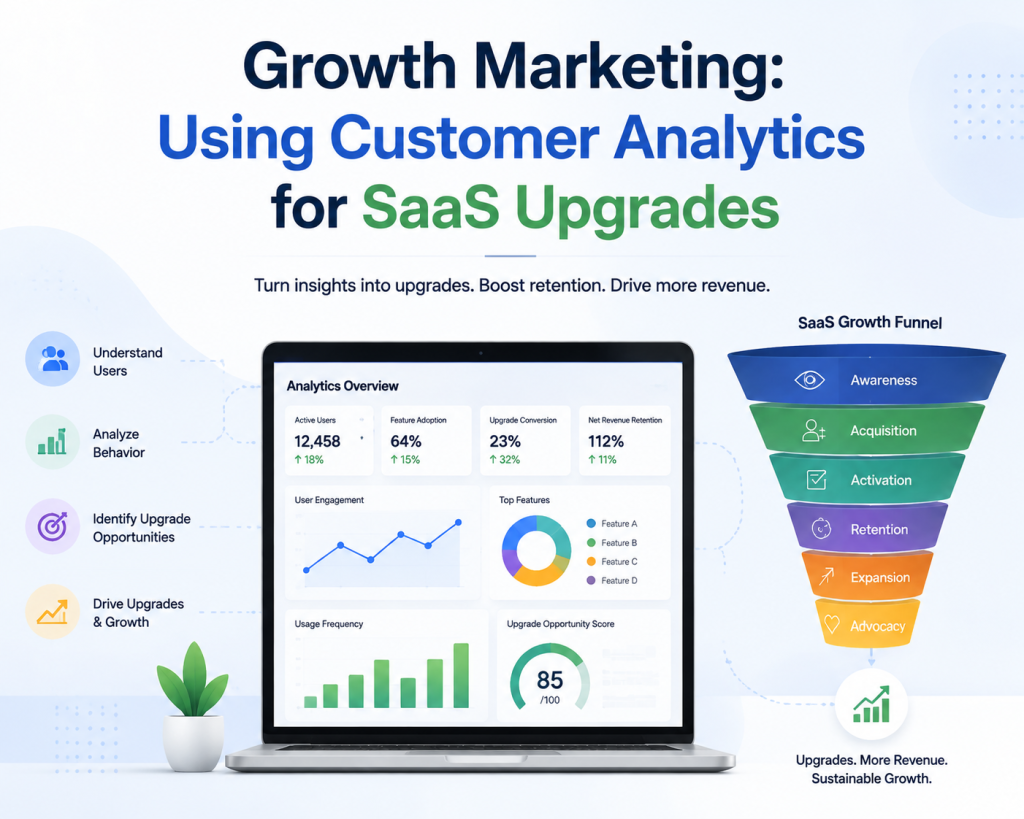
A structured funnel combines all the elements above into a repeatable system. Here’s how a growth marketing funnel for upgrades typically looks:
- Awareness: Content marketing and saas marketing campaigns attract the right audience.
- Acquisition: Free trials or freemium plans reduce friction to sign up.
- Activation: Guided onboarding ensures users reach value quickly.
- Retention: Behavioral emails and in-app messaging driven by customer analytics keep users engaged.
- Expansion: Drive upgrades through personalized offers and feature adoption.
- Advocacy: Happy, upgraded users become brand ambassadors fueling organic growth.
Frequently Asked Questions (FAQs)
Q1. What is growth marketing and how does it differ from traditional marketing?
Growth marketing is a data-driven, full-funnel approach that focuses on growing every stage of the customer journey from acquisition to retention and expansion. Unlike traditional marketing that mainly targets awareness and acquisition, growth marketing tests, iterates, and optimizes across all touchpoints using real user data.
Q2. How does customer analytics support SaaS upgrades?
Customer analytics identifies behavioral signals such as heavy feature usage, frequent logins, or hitting plan limits that indicate a user is ready to upgrade. These insights allow SaaS teams to send the right upgrade message at precisely the right moment.
Q3. What tools are best for customer analytics in SaaS?
Popular customer analytics tools include Amplitude, Mixpanel, Segment, Heap, and FullStory. For product-led growth marketing, Pendo and Appcues also provide powerful in-app analytics and messaging capabilities.
Q4. What is lifecycle marketing and why does it matter for SaaS?
Lifecycle marketing tailors communication to each stage of the user journey, ensuring users receive relevant, timely messages that guide them toward greater engagement and, ultimately, upgrades. It reduces churn and increases lifetime value.
Q5. How can retention marketing reduce SaaS churn?
Retention marketing uses personalized campaigns, proactive outreach, and behavioral triggers to keep users engaged. By addressing disengagement before it leads to cancellation, SaaS companies protect revenue and build a foundation for sustainable growth marketing.
Q6. What metrics should a SaaS growth marketer track?
Key metrics include Monthly Recurring Revenue (MRR), Net Revenue Retention (NRR), Customer Acquisition Cost (CAC), Lifetime Value (LTV), upgrade conversion rate, and churn rate. Customer analytics platforms can centralize all these metrics in real time.
Q7. What is the best way to trigger SaaS upgrade prompts?
The most effective approach combines lifecycle marketing logic with customer analytics data. Trigger upgrade prompts when users consistently hit usage limits, explore premium features, or show high product engagement scores rather than using arbitrary time-based schedules.
Q8. How does saas marketing differ from growth marketing?
SaaS marketing broadly refers to all marketing activities used to promote a software product, including brand building, content, and paid ads. Growth marketing is a subset (and evolution) that specifically focuses on data-driven experimentation and optimizing for long-term revenue growth across the entire funnel.
Q9. Can small SaaS startups implement growth marketing effectively?
Absolutely. Growth marketing doesn’t require a large budget it requires a structured approach to experimentation and a commitment to using customer analytics to make decisions. Even lightweight tools like Google Analytics, Mailchimp, and Intercom can power effective growth marketing for early-stage startups.
Q10. How long does it take to see results from a growth marketing strategy?
Most growth marketing experiments yield initial insights within 2–4 weeks. However, building a fully optimized retention marketing and upgrade funnel typically takes 3–6 months of continuous testing and iteration based on customer analytics feedback.