Table of Contents
ToggleDigital Transformation in Manufacturing: Best AI Automation & CRM Tools
Manufacturing sales is demanding long cycles, technical products, and multiple decision-makers. Yet many teams still run on manual follow-ups, spreadsheets, and gut instinct. The real question is: do you fully understand what are automation tools capable of, and are you using the right ones for your sales team?
Today’s sales automation tools are purpose-built for complex B2B environments. They integrate natively with your manufacturing CRM and manufacturing software, helping reps spend more time selling and less time on admin. If you are serious about digital transformation in manufacturing, your sales stack is the right place to start.
Why Manufacturing Sales Teams Need Automation Now
B2B sales reps spend less than 35% of their day actually selling. In manufacturing where quotes need engineering input and proposals require compliance checks that number is even lower. What are automation tools solving here? They remove the repetitive, rule-based work so your best people can focus on relationships, negotiations, and strategic accounts.
Industrial buyers now research 70–80% of their purchase online before they contact a supplier. Companies that have invested in sales automation tools are responding faster, converting more leads, and closing deals sooner. Your competitors who have adopted these tools are not just more efficient they are winning deals you should be winning.
What Are Automation Tools? A Quick Framework
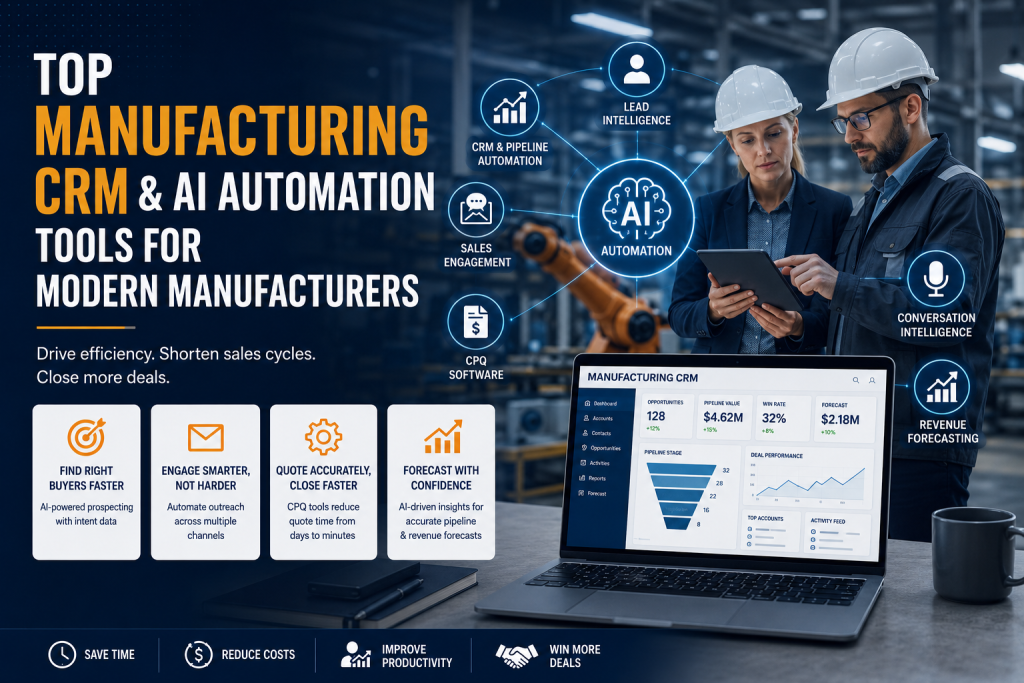
For manufacturing sales, automation tools fall into six categories:
- CRM & Pipeline Automation: Auto-captures deal data and surfaces at-risk opportunities
- Lead Intelligence: AI identifies and ranks ideal accounts using intent and firmographic data
- Sales Engagement: Automates multi-touch outreach across email, phone, and LinkedIn
- CPQ Software: Enables reps to configure products and generate quotes in minutes, not days
- Conversation Intelligence: Records and analyzes calls to surface coaching insights and deal risks
- Revenue Forecasting: Uses CRM activity data to produce accurate pipeline and forecast reports
The best automation strategy is not to deploy everything at once it is to identify the biggest time or revenue leak in your current process and fix that first.
Manufacturing CRM: The Foundation of Your Stack
Every automation investment depends on a solid manufacturing CRM. Without clean, structured account and deal data, every tool you layer on top will underperform.
Why Generic CRMs Often Fail
Most standard CRMs were not designed for manufacturing. They struggle with multi-level account hierarchies, complex deal stages, ERP integrations, and distributor relationships — leading to adoption rates below 30% and incomplete pipeline data.
What a Manufacturing CRM Must Include
- Multi-level account hierarchies — parent company, subsidiaries, plants, and sites
- ERP integration — live inventory, pricing, and order history without leaving the CRM
- Custom deal stages — quoting, engineering review, procurement approval, negotiation
- Distributor & partner management — channel and direct sales in one platform
- Mobile access — offline-capable for field reps visiting plants
Modern manufacturing CRM platforms also bring AI: automatic activity logging, deal scoring, next-best-action prompts, and anomaly detection for at-risk opportunities.
Sales Prospecting Tools: Find the Right Buyers Faster
Without intelligent sales prospecting tools, reps spend hours building contact lists manually — only to find stale data and wrong decision-makers.
AI-powered platforms like ZoomInfo, Apollo.io, and 6sense combine firmographic data, technographic signals, and behavioral intent data to surface the highest-fit accounts for your product category. For manufacturing teams, this means targeting ‘automotive tier-1 suppliers in the Midwest using SAP, currently researching quality management’ — automatically.
Intent data is the biggest unlock: when employees at a target company start researching topics related to your product, that signal is surfaced immediately. Teams using intent-based sales prospecting tools report 2–3× higher response rates and measurably shorter sales cycles.
Sales Automation Tools for Outreach & Follow-Up
Sales automation tools like Outreach, Salesloft, and Apollo orchestrate multi-touch sequences across email, calls, LinkedIn, and video so reps work from smart task queues instead of memory.
In manufacturing, where the average prospect needs 8–12 touchpoints before engaging, this is transformative. A rep who previously managed 40 active prospects manually can now manage 150–200 at the same quality level.
The best automation platforms also use AI to personalize emails at scale pulling in company-specific context like recent news, tech stack, and role relevance so messages feel crafted, not templated.
CPQ Software: Stop Losing Deals at the Quote Stage
In manufacturing, the quote is where deals most often stall. Complex configurations, margin approvals, and compliance documentation can take days or weeks. CPQ manufacturing software fixes this by letting reps generate accurate, professional quotes in minutes.
Top platforms for manufacturing contexts:
- Salesforce CPQ — deep CRM integration; ideal for complex product catalogs
- Oracle CPQ — enterprise-grade with strong ERP tie-ins
- Epicor CPQ — purpose-built for industrial use with 3D visualization
- Tacton CPQ — designed for complex discrete manufacturing engineering-to-sales workflows
Manufacturers implementing CPQ manufacturing software consistently report 30–50% faster quote turnaround and 20–30% improvement in quote accuracy and margin consistency.
Choosing the Right AI Automation Company
The ai automation company landscape is crowded. When evaluating vendors, ask: Does it support multi-level manufacturing account structures? Does it integrate with our ERP natively? Has it been deployed at manufacturers our size?
- ERP integration depth — native connectors to SAP, Oracle, Epicor, Infor, Dynamics
- Implementation track record — verifiable ROI data from comparable manufacturers
- Total cost of ownership — licensing + services + training + ongoing support
- Mobile & field readiness — offline-capable mobile app is non-negotiable
- AI roadmap — look for investment in predictive analytics and generative AI capabilities
Digital Transformation in Manufacturing: Start With Sales
Digital transformation in manufacturing is often framed around factory operations — IoT, predictive maintenance, smart scheduling. But the fastest ROI comes from transforming how you find, win, and retain customers.
Sales metrics are immediately measurable: leads generated, quotes produced, win rate, cycle length, revenue per rep. Every improvement maps directly to revenue, making the business case straightforward.
Phased Rollout Roadmap
- Phase 1 (Months 1–3): Manufacturing CRM implementation — clean data, baseline metrics
- Phase 2 (Months 3–6): Sales prospecting tools + intent data feeds + rep training
- Phase 3 (Months 6–9): CPQ manufacturing software — ERP and CRM integrated
- Phase 4 (Months 9–12): Conversation intelligence + AI deal scoring + continuous optimization
Recommended Tools by Category
CRM Platforms
- Salesforce Manufacturing Cloud — best for mid-large manufacturers; native ERP integrations and account-based selling
- Microsoft Dynamics 365 Sales — ideal for Microsoft ERP ecosystems
- HubSpot CRM — fastest deployment for smaller teams; excellent usability
Prospecting & Intelligence
- ZoomInfo — most comprehensive B2B data with strong intent signals
- Apollo.io — combines contact database + sales prospecting tools + sequencing
- 6sense — enterprise-grade account intelligence for ABM strategies
Sales Engagement
- Outreach — market leader for enterprise sales automation tools with deep analytics
- Salesloft — strong call coaching and engagement automation
Conversation Intelligence
- Gong — AI-powered call analysis; works with any manufacturing CRM
- Chorus by ZoomInfo — excellent for teams already using ZoomInfo
Measuring ROI From Sales Automation
Track these metrics to evaluate your automation investment:
- Revenue per rep — the clearest indicator of automation’s real-world impact
- Sales cycle length — 15–30% reductions are typical within 12 months
- Quote-to-close rate — improved by CPQ speed and accuracy
- Outreach-to-meeting rate — improved by intent-based sales prospecting tools
- Forecast accuracy — AI forecasting reduces variance quarter over quarter
- CRM adoption rate — the baseline; if reps don’t use the manufacturing CRM, nothing else works
FAQs
What are automation tools for manufacturing sales? They are AI platforms that eliminate manual tasks — auto-logging CRM data, identifying best-fit prospects, running multi-touch outreach, generating quotes, and analyzing sales calls. The result: more selling time, faster cycles, and stronger pipeline visibility.
Start with the manufacturing CRM. Without a clean system of record, every tool you add underperforms. Configure your CRM first, establish baseline metrics, then layer on sales prospecting tools, outreach automation, and CPQ in phases.
A manufacturing CRM handles multi-level account hierarchies, ERP integration, long deal pipelines with engineering stages, channel partner management, and offline-capable mobile access — none of which generic CRMs handle natively.
Platforms that combine firmographic data, technographic signals, and intent data — ZoomInfo, Apollo.io, and 6sense — consistently deliver the best results for manufacturing B2B. Intent data, specifically, lets you prioritize outreach to companies actively researching your category right now.
Sales automation tools handle the 8–12 touchpoints needed before a manufacturing prospect engages — without manual memory or missed follow-ups. Deal scoring surfaces opportunities going quiet, and behavioral email tracking alerts reps when a dormant prospect re-engages.
Digital transformation in manufacturing spans factory operations and commercial functions. Sales technology delivers the fastest, most measurable ROI — directly tied to leads, quotes, win rates, and revenue per rep.
Ask any ai automation company: Do you have ERP integration for our platform? Can you show ROI data from similar manufacturers? What is your AI roadmap? The best automation vendors are long-term partners, not just software licenses.
Priority order: (1) manufacturing CRM as the data foundation; (2) CPQ manufacturing software to fix the quote bottleneck; (3) sales prospecting tools for better top-of-funnel; (4) conversation intelligence for rep coaching. Understanding what are automation tools best suited for each stage guides your sequencing.
Sales automation tools and manufacturing CRM platforms typically offer native connectors for SAP, Oracle, Dynamics, Epicor, Infor, and Sage — enabling real-time data exchange without manual entry.
Productivity improvements appear within 60–90 days. Quote-to-close gains show within the first quarter after CPQ deployment. Revenue-level ROI becomes measurable at 6–12 months. Teams that invest in change management alongside the technology see results 40–50% faster.