Table of Contents
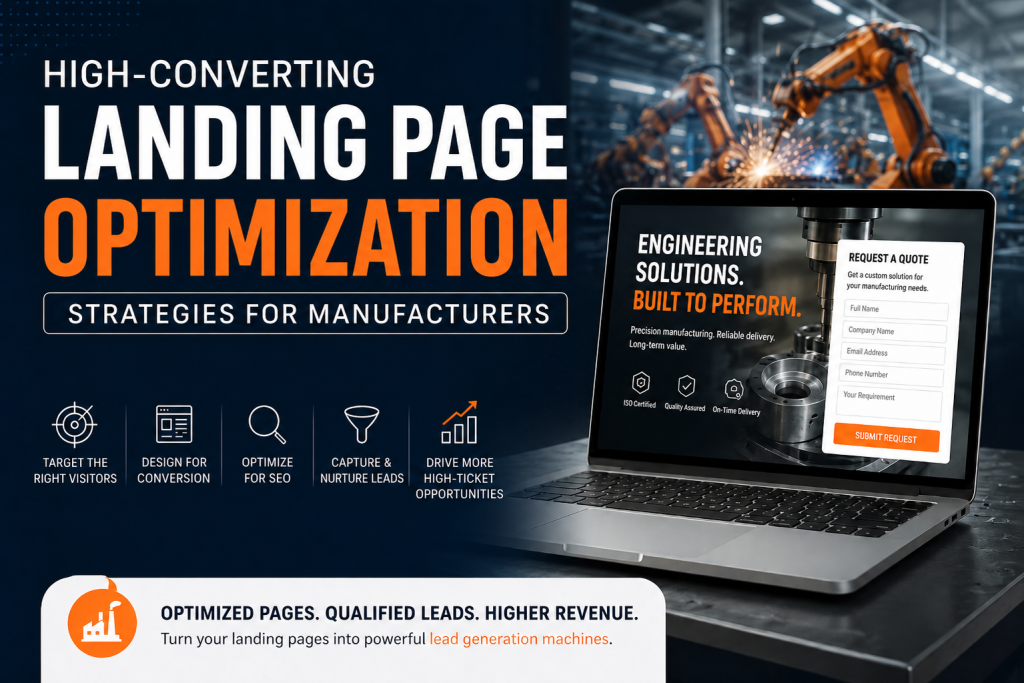
ToggleHigh-Converting Landing Page Optimization Strategies for Manufacturers
In the manufacturing sector, a single closed deal can be worth tens of thousands or even hundreds of thousands of dollars. That level of commercial value demands a digital presence that is not just visible but genuinely persuasive. Yet most manufacturing companies still rely on generic websites and poorly structured pages that fail to convert the high-value visitors they attract. This is where landing page optimization becomes a game-changer.
Landing page optimization is the disciplined process of designing, testing, and refining specific web pages to maximize the percentage of visitors who take a desired action whether that is requesting a quote, booking a consultation, or downloading a product specification sheet. For manufacturing businesses targeting high-ticket clients, this process is not a marketing luxury. It is a revenue-critical strategy.
This comprehensive guide explores exactly how landing page optimization can transform the digital lead generation performance of manufacturing companies. From the technical foundations of landing page SEO to the strategic nuances of manufacturing digital marketing and conversion-focused manufacturing website design, every section is packed with actionable insight designed to help your business capture more high-value opportunities.
Why Landing Page Optimization Matters in Manufacturing
Manufacturing is a sector historically slow to adopt digital best practices. Many manufacturers still generate leads through trade shows, direct sales teams, and long-standing industry relationships. While these channels remain valuable, the modern B2B buyer has fundamentally changed. Industry research consistently shows that the majority of B2B buyers complete more than half of their purchase research online before ever speaking to a sales representative.
This shift makes landing page optimization a strategic imperative. When a procurement officer, plant manager, or engineering director lands on your page after a targeted search, you have a narrow window to establish credibility, communicate value, and compel action. Every element of the page from headline to form placement either advances or undermines that goal.
For high-ticket manufacturing leads, the stakes are even higher. The decision cycle is longer, the scrutiny is greater, and the trust threshold is considerably higher than in consumer markets. Landing page optimization bridges the gap between attracting the right visitors and converting them into genuine business opportunities.
The Cost of Poor Conversion in High-Value Industries
Consider this scenario: your manufacturing digital marketing campaigns drive 500 highly targeted visitors to a landing page each month. If your current conversion rate is 1%, you are generating 5 leads per month. With effective landing page optimization, raising that rate to just 3% triples your lead volume without increasing your advertising budget by a single rupee or dollar. For high-ticket contracts, that difference could represent millions in revenue.
This is precisely why leading manufacturers are now investing seriously in landing page optimization not as a cosmetic exercise, but as a core component of their growth strategy.
Understanding the Lead Generation Landing Page
A lead generation landing page is a standalone web page created specifically to capture visitor information and move them toward a sales conversation. Unlike a homepage which serves multiple audiences and purposes a lead generation landing page has one singular goal: conversion.
In the manufacturing context, a well-built lead generation landing page typically captures leads by offering something of genuine value in exchange for contact details. This could be a custom quote, a product catalog, a technical specification document, a consultation call, or access to a manufacturing capability overview.
The most effective lead generation landing page designs in manufacturing share several characteristics:
- A compelling headline that speaks directly to the buyer’s pain point or objective
- A clear, concise value proposition that differentiates your capabilities
- High-quality imagery or video showcasing manufacturing facilities and product quality
- Social proof elements including certifications, client logos, and case studies
- A frictionless, mobile-optimized lead capture form with minimal required fields
- Prominent trust signals such as ISO certifications, industry affiliations, and quality standards
- A strong, specific call-to-action (CTA) that tells visitors exactly what to do next
Aligning the Lead Generation Landing Page With the Buyer's Journey
High-ticket manufacturing leads rarely convert on the first visit. Your lead generation landing page must align with where the visitor is in their buying journey. A procurement manager researching suppliers needs different content and CTAs than a plant director ready to request a detailed proposal.
Effective landing page optimization accounts for this by creating variants or tailored pages for different stages of the funnel. Top-of-funnel visitors might respond better to a downloadable capability guide, while bottom-of-funnel visitors those with specific requirements and budget approval respond to a “Request a Custom Quote” or “Schedule a Facility Tour” CTA.
The Technical Foundation: Landing Page SEO
Generating high-quality traffic to your landing page is the prerequisite for any conversion. This is where landing page SEO becomes foundational. Landing page SEO refers to the practice of optimizing your landing pages to rank organically in search engine results for relevant, high-intent queries.
For manufacturing companies, landing page SEO is particularly powerful because it captures buyers who are actively searching for solutions they have already identified a need and are evaluating providers. These are your highest-value visitors, and landing page SEO ensures they find you before they find your competitors.
Core Landing Page SEO Elements for Manufacturers
A technically sound landing page SEO strategy for manufacturing businesses must address each of the following:
- Keyword targeting: Identify the exact search terms your ideal buyers use when evaluating manufacturing partners. Go beyond generic terms and include product-specific, process-specific, and capability-specific keywords.
- Title tag and meta description: Craft compelling, keyword-rich title tags (under 60 characters) and meta descriptions (under 160 characters) that improve click-through rates from search results.
- Header tag hierarchy: Use a logical H1, H2, H3 structure that reflects the topical depth of the page and incorporates target keywords naturally.
- Page speed optimization: Manufacturing buyers are often on corporate networks or mobile devices. Slow pages destroy conversion rates and harm landing page SEO rankings simultaneously.
- Mobile responsiveness: With a growing number of B2B researchers using mobile devices at different stages of the buying process, mobile-first design is no longer optional.
- Structured data markup: Implement schema markup to help search engines understand your business type, location, and offerings enhancing your appearance in search results.
- Internal linking strategy: Connect your landing pages to relevant technical content, case studies, and product pages to build topical authority and guide visitors deeper into your site.
URL Structure and Landing Page SEO
Clean, descriptive URL structures contribute meaningfully to landing page SEO. For manufacturing companies, URLs like /cnc-machining-services-quote or /custom-metal-fabrication-inquiry communicate topical relevance to both search engines and human visitors, improving ranking potential and click-through confidence.
Manufacturing Website Design That Converts
No amount of landing page optimization or landing page SEO will overcome a website design that fails to convey credibility and professionalism. In manufacturing, your manufacturing website design is your digital first impression and in high-value B2B markets, first impressions directly influence whether a potential client chooses to engage or quietly navigates away.
Effective manufacturing website design for high-ticket lead generation balances visual impact, technical credibility, and frictionless user experience. Here is what separates the best from the rest:
Visual Hierarchy and Trust Engineering
Sophisticated manufacturing website design employs deliberate visual hierarchy to guide visitors through the page in a sequence that builds trust progressively. The design should lead with what the visitor cares about most typically their specific challenge or requirement before presenting capabilities, proof, and conversion opportunities.
High-quality photography and video content are non-negotiable in effective manufacturing website design for high-ticket markets. Potential clients want to see your facilities, your equipment, your quality control processes, and your finished products. Generic stock photography immediately diminishes credibility in a sector where operational proof matters enormously.
Form Design and Conversion Psychology
Your lead capture form is the final and most critical element in the landing page optimization chain. Manufacturing website design that features long, complex forms with dozens of required fields will dramatically suppress conversion rates, even among motivated visitors.
The optimal approach in manufacturing website design is to request only the information genuinely needed to initiate a meaningful conversation. Name, company, email, phone number, and a brief description of the requirement is often sufficient. Progressive profiling gathering additional information across subsequent interactions is far more effective than front-loading your form with every question your sales team eventually wants answered.
Manufacturing Digital Marketing: The Strategic Context
Landing page optimization does not exist in isolation. It is one critical component within a broader manufacturing digital marketing ecosystem. The most sophisticated manufacturing digital marketing strategies treat landing pages as the conversion hub of a multi-channel lead generation architecture.
When manufacturing digital marketing campaigns whether paid search, LinkedIn advertising, email nurture sequences, or content syndication drive targeted traffic to meticulously optimized landing pages, the commercial return on every marketing dollar invested multiplies significantly.
Paid Search and Landing Page Optimization
Google Ads and LinkedIn Sponsored Content are among the most effective paid channels in manufacturing digital marketing. However, their effectiveness is entirely dependent on the quality of the landing page they direct traffic to. A paid campaign sending visitors to a generic homepage or an unoptimized product page is a guaranteed way to drain budget with minimal return.
Within manufacturing digital marketing, the rule is clear: every paid campaign should direct traffic to a purpose-built, highly relevant landing page that reflects the specific message and offer of the advertisement. This alignment known as message match is one of the highest-impact principles in landing page optimization.
Content Marketing and Landing Page SEO Synergy
Content marketing and landing page SEO are natural partners in a sophisticated manufacturing digital marketing strategy. Informative, technically credible blog posts, whitepapers, and video content build organic search authority and nurture early-stage buyers. Strategic internal linking from this content to targeted lead generation landing pages creates a seamless funnel from awareness to conversion.
This content-to-landing-page architecture is one of the most cost-effective strategies in manufacturing digital marketing generating inbound leads organically while simultaneously strengthening the landing page SEO of your highest-value conversion pages.
Conversion Rate Optimization: The Ongoing Process
Landing page optimization is never a one-time exercise. The most successful manufacturing marketers treat it as an ongoing, data-driven discipline. Conversion rate optimization (CRO) is the systematic process of using real visitor behavior data to continuously improve landing page performance.
A/B Testing for Manufacturing Landing Pages
A/B testing involves creating two or more versions of a landing page element and exposing different segments of your traffic to each version to determine which performs better. In manufacturing markets with typically lower traffic volumes, even small improvements in conversion rate achieved through rigorous A/B testing can have significant commercial impact.
High-impact elements to test in a manufacturing landing page optimization program include:
- Headline copy and value proposition framing
- CTA button text, color, and placement
- Hero image or video content
- Social proof placement and format
- Form length and required field selection
- Page layout and visual hierarchy
- Trust signal types and positioning
- Above-the-fold versus below-the-fold content distribution
Heatmaps and Session Recording for Manufacturing Pages
Tools such as Hotjar, Microsoft Clarity, and Crazy Egg provide visual heatmaps and session recordings that reveal exactly how visitors interact with your landing pages. For manufacturing website design and landing page optimization, these tools are invaluable showing where visitors click, how far they scroll, where they hesitate, and at what point they abandon.
These behavioral insights allow manufacturers to make evidence-based optimization decisions rather than relying on assumption or aesthetic preference a critical distinction in competitive manufacturing digital marketing environments.
Trust Signals That Convert High-Ticket Manufacturing Buyers
High-ticket manufacturing decisions are almost never made on impulse. They involve extensive due diligence, internal approval processes, and risk assessment. Your landing page optimization strategy must account for this by embedding the right trust signals throughout every page.
The trust signals most effective for manufacturing lead generation landing pages include:
- ISO, AS9100, IATF, and other relevant quality certifications displayed prominently
- Named client logos from recognized brands in the target industry
- Detailed case studies with measurable outcomes (not vague testimonials)
- Machine and facility specifications that demonstrate genuine capability
- Awards, industry recognitions, and media mentions
- Years of operation and total projects delivered statistics
- Response time commitments and clear next-step timelines
- Team credentials and technical expertise profiles
These elements should be integrated thoughtfully into your manufacturing website design and positioned strategically throughout the lead generation landing page not relegated to a separate “About Us” page that most visitors never reach.
Mobile Optimization: A Non-Negotiable Priority
The proportion of B2B research conducted on mobile devices continues to grow year over year. Manufacturing digital marketing campaigns targeting procurement officers, operations managers, and engineers must account for the reality that these individuals are increasingly searching, comparing, and evaluating suppliers on smartphones and tablets.
Mobile landing page optimization requires more than a responsive grid. It demands a deliberate re-evaluation of content priority, form usability, CTA visibility, and page load speed for mobile contexts. A lead generation landing page that takes more than three seconds to load on a mobile connection will lose a significant percentage of its potential leads before they ever see your value proposition.
FAQs
Landing page optimization is the systematic process of improving a specific web page to maximize the percentage of visitors who complete a desired action such as requesting a quote, submitting an inquiry, or downloading a catalog. For manufacturing businesses pursuing high-ticket contracts, landing page optimization is particularly critical because even a small improvement in conversion rate can translate into a significant increase in qualified leads and revenue. Unlike general website improvements, landing page optimization focuses laser-sharp attention on the pages that matter most to your lead generation pipeline.
An effective lead generation landing page for manufacturing should open with a compelling, specific headline that speaks directly to the buyer’s challenge or objective. It should follow with a concise value proposition, supported by trust signals such as certifications and client logos. High-quality facility imagery or capability videos build visual credibility. A frictionless form requesting only essential information, paired with a specific and motivating CTA, completes the lead generation landing page structure. The entire design should guide the visitor through a logical, trust-building sequence that reduces friction and motivates action.
Effective landing page SEO for manufacturing businesses involves several interconnected elements. These include strategically placing target keywords in title tags, H1 and H2 headers, body content, image alt text, and meta descriptions. Technical landing page SEO factors are equally important: fast page load times, mobile responsiveness, clean URL structures, and schema markup for local and business entities. Building topical authority through internal linking from relevant content pages to your landing pages also strengthens landing page SEO performance over time.
Manufacturing website design has a direct and substantial impact on conversion rates. A professionally designed website signals credibility, competence, and attention to quality values that are critically important to B2B manufacturing buyers evaluating potential partners. Specific design elements that impact conversion include visual hierarchy, form placement and length, page load speed, mobile responsiveness, quality of imagery, and the strategic positioning of trust signals. Poor manufacturing website design can cause motivated, qualified visitors to lose confidence and abandon the page before converting.
Manufacturing digital marketing is the engine that drives targeted traffic to your landing pages. Without a coherent manufacturing digital marketing strategy encompassing paid search, LinkedIn advertising, email campaigns, and content marketing even the most perfectly optimized landing page will see insufficient traffic to generate meaningful leads. Conversely, strong manufacturing digital marketing campaigns that direct highly targeted traffic to poorly optimized landing pages will produce disappointing results. The most effective approach integrates both: precise manufacturing digital marketing targeting with meticulously optimized landing pages designed specifically for the audience being targeted.
For high-ticket manufacturing lead generation landing pages, the optimal number of form fields is typically four to six. Requesting more information than necessary to initiate a productive first conversation creates unnecessary friction and suppresses conversion rates. A good starting set includes: name, company name, business email, phone number, and a brief description of the requirement or project. More detailed qualification information can be gathered during the subsequent sales conversation. Remember, the primary goal of the lead generation landing page is to open the conversation not to replace it.
The timeline for landing page optimization to deliver measurable improvements varies based on traffic volume, current conversion rate, and the scope of changes implemented. For manufacturing websites with moderate traffic, initial A/B test results typically become statistically significant within 4 to 8 weeks. Landing page SEO improvements generally show meaningful organic ranking changes within 2 to 4 months. Businesses that approach landing page optimization as an ongoing, data-driven discipline rather than a one-time project consistently see the strongest long-term improvements in both conversion rate and lead quality.
The most effective content for a manufacturing lead generation landing page combines technical credibility with clear commercial value. High-performing content types include: capability overviews that demonstrate the breadth and precision of your manufacturing processes; case studies with specific, measurable outcomes from recognized clients; facility and equipment photography that establishes the quality of your operations; video walkthroughs of manufacturing processes; and clear specification sheets. The best lead generation landing page content answers the core questions a procurement decision-maker would have at the evaluation stage of their buying process.
Mobile optimization is an increasingly critical dimension of landing page optimization for manufacturing businesses. A growing proportion of B2B research including early-stage supplier evaluation takes place on mobile devices. A lead generation landing page or manufacturing website design that is not optimized for mobile will deliver a frustrating user experience, resulting in high bounce rates and lost leads. Key mobile optimization priorities for landing page optimization include: sub-three-second load times, thumb-friendly form fields and CTA buttons, content prioritization for smaller screens, and eliminating pop-up elements that disrupt mobile browsing.
Measuring landing page optimization success requires tracking a clear set of key performance indicators (KPIs) aligned with your lead generation objectives. The primary metric is conversion rate the percentage of visitors who complete the desired action on the lead generation landing page. Supporting metrics include: traffic volume by channel (to understand which manufacturing digital marketing sources perform best), bounce rate, time on page, form abandonment rate, lead quality score (based on sales team feedback), and cost-per-lead from paid channels. Setting up goal tracking in Google Analytics and integrating it with your CRM provides the clearest view of how landing page optimization efforts translate into real business outcomes.