Table of Contents
ToggleSaaS Growth Strategy: Combining SEO + CRO + Product-Led Growth
Introduction
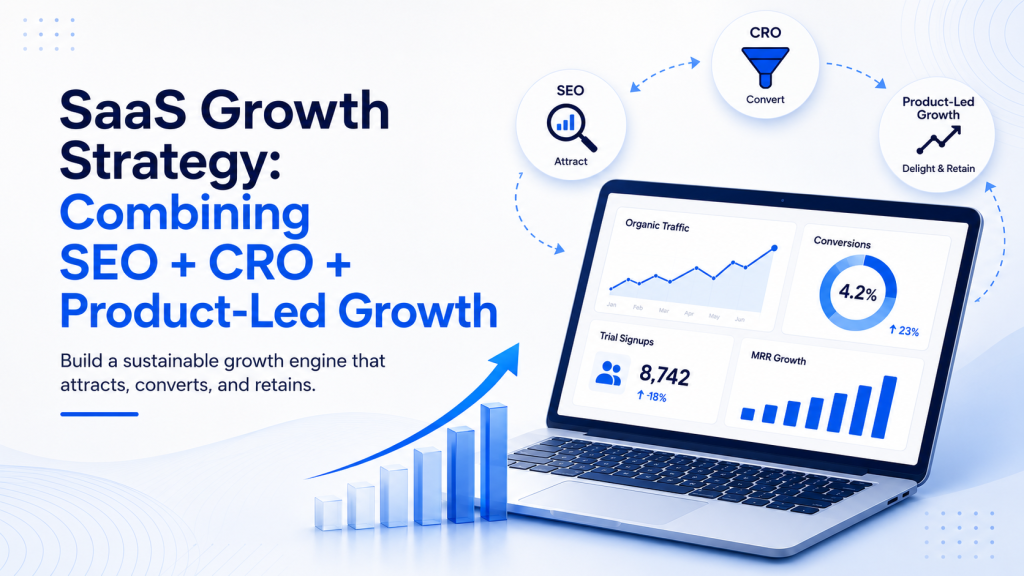
The SaaS industry has never been more competitive. With thousands of tools vying for the same buyer’s attention, sustainable growth no longer comes from simply building a great product it comes from building a great system around your product. For modern SaaS companies, that system is built on three interconnected pillars: SEO for SaaS, conversion rate optimization (CRO), and product-led growth (PLG).
Together, these three disciplines create a self-reinforcing growth engine. SEO for SaaS brings qualified organic traffic to your product. CRO turns that traffic into paying customers. And product-led growth ensures that the product itself becomes your most powerful acquisition and retention tool. When combined intelligently within a broader SaaS growth strategy, the result is compounding revenue growth that becomes increasingly difficult for competitors to replicate.
This guide is a comprehensive, practitioner-level breakdown of exactly how to integrate these three disciplines across your entire funnel. Whether you are an early-stage startup trying to achieve product-market fit or a scaling SaaS brand in a crowded vertical, the frameworks, examples, and tactical playbooks in this article will help you grow faster and more sustainably than you could through any single channel alone.
The Modern SaaS Growth Challenge
The playbook that worked for SaaS companies five years ago is increasingly broken. Paid acquisition costs have risen dramatically the average cost per lead in B2B SaaS grew over 40% between 2020 and 2024. Outbound SDR teams that once reliably filled pipelines are hitting reply rates below 2% on cold email. Meanwhile, buyer behavior has fundamentally shifted: according to Forrester, 74% of B2B buyers conduct more than half of their research online before engaging a vendor.
The result is that SaaS marketing teams are under enormous pressure to generate more pipeline with constrained budgets, while targeting buyers who are actively trying to avoid sales conversations. The companies winning in this environment are those that have shifted from outbound-heavy, paid-dependent acquisition models to integrated inbound approaches anchored by SEO for SaaS, CRO, and product-led growth.
Why Traditional Marketing Falls Short for SaaS
Traditional digital marketing was designed for transactional e-commerce: drive traffic, present an offer, capture a conversion. SaaS is categorically different. Buyers are evaluating software that may require team adoption, IT integration, procurement approval, and multi-year contract commitments. The decision is high-stakes, research-intensive, and rarely made in a single session.
This means your SaaS inbound marketing strategy must account for buying journeys that span weeks or months, involve multiple stakeholders across different job functions, and require demonstrating value not just claiming it. Generic content and landing page A/B tests are not enough. You need a tightly integrated system where SEO brings the right people in, CRO moves them efficiently toward commitment, and the product experience does the convincing.
SEO for SaaS: Building Organic Compounding Growth
B2B SaaS SEO is fundamentally different from SEO in other industries. Your buyers are not browsing they are researching. They have specific, often technical problems, and they are searching with high intent for solutions, comparisons, and validations. This makes SEO for SaaS simultaneously more complex and more rewarding than traditional search marketing.
The SaaS SEO Content Architecture
The most successful b2b saas seo strategies are built around a layered content architecture that maps to every stage of the buyer journey. This architecture typically consists of three content tiers:
- Tier 1 Problem-Aware Content:Top-of-funnel articles targeting broad informational queries. Examples: ‘how to reduce customer churn,’ ‘what is a sales pipeline,’ ‘how to automate payroll.’ This content reaches buyers before they have identified your category, building brand awareness and topical authority.
- Tier 2 Solution-Aware Content:Mid-funnel content targeting buyers who know the category but are evaluating approaches. Examples: ‘best CRM software for startups,’ ‘HubSpot vs Salesforce comparison,’ ‘how to choose a project management tool.’ This content directly competes for high-intent decision-stage queries.
- Tier 3 Brand-Aware Content:Bottom-of-funnel content targeting buyers researching your specific product or competitors. Examples: ‘[Competitor] alternatives,’ ‘[Your Brand] pricing,’ ‘[Your Brand] reviews.’ This content captures buyers moments before conversion and can be the difference between a trial signup and a lost deal.
Keyword Strategy: Jobs-to-Be-Done Mapping
Traditional keyword research focuses on search volume and difficulty. Advanced SEO for SaaS starts with jobs-to-be-done (JTBD) identifying the specific outcomes your users are trying to achieve and works backward to the search queries that reflect those outcomes. This approach consistently surfaces high-intent, lower-competition keywords that pure volume-driven research misses.
For example, a project management SaaS might find that their users’ core job is ‘making sure projects don’t miss deadlines.’ This surfaces keywords like ‘project deadline tracking software,’ ‘how to prevent project delays,’ and ‘automated project status updates’ all highly specific, moderately searched, and deeply intent-aligned queries that most competitors have overlooked.
Technical SEO for SaaS Platforms
SaaS websites have unique technical SEO challenges that can silently suppress organic performance:
- JavaScript-rendered content:Many SaaS platforms use React or Vue frameworks that render content client-side. Ensure critical content is server-side rendered or pre-rendered for reliable Googlebot indexation.
- App subdomain vs. marketing site:The separation between app.yourdomain.com and www.yourdomain.com creates link authority fragmentation. Consolidate marketing site authority carefully.
- Thin product pages:SaaS product and feature pages often have minimal unique content. Building out comprehensive feature pages with use-case context significantly improves organic visibility.
- Core Web Vitals:Page experience signals directly impact ranking. SaaS marketing sites frequently suffer from poor LCP and CLS scores due to heavy JavaScript bundles and dynamic content.
Link Building for SaaS: Authority Without Manipulation
Domain authority is the backbone of b2b saas seo competitive performance. The most durable link-building strategies for SaaS include: original data studies and industry benchmarks that journalists and bloggers naturally cite; free tools and calculators that attract backlinks for their utility; integration partnership pages with complementary SaaS platforms; and contributed editorial content in niche B2B publications where your buyers actually read.
Conversion Rate Optimization: Turning Traffic Into Trials and Trials Into Revenue
Most SaaS companies dramatically under-invest in CRO relative to traffic acquisition. The math makes this costly: if your SEO generates 10,000 monthly visitors and converts at 2%, you get 200 trials. Improving conversion to 4% without adding a single new visitor doubles your trial volume. This is why CRO is not a nice-to-have optimization exercise; it is a core pillar of any serious SaaS growth strategy.
The SaaS Conversion Funnel
CRO for SaaS operates across multiple conversion events, not just one. The primary stages requiring optimization are:
- Visitor Trial/Signup:Homepage, landing pages, and product pages converting organic and paid traffic into free trial or freemium signups
- Trial Activated User:Onboarding flows ensuring new users reach the ‘aha moment’ the point of genuine product value realization before the trial expires
- Activated User Paid Customer:In-app upgrade prompts, email nurture sequences, and sales-assist processes converting activated users to paid subscriptions
- Paid Customer Expanded Revenue:Upsell and cross-sell mechanisms that grow revenue from existing accounts over time
Homepage and Landing Page CRO
Your homepage is the highest-traffic page on your site and typically your lowest-converting one. The most impactful homepage CRO interventions for SaaS companies include:
- Value proposition clarity:Your headline should communicate the specific outcome you deliver not what your product is, but what your customer becomes. ‘The project management tool for product teams’ converts worse than ‘Ship features on time, every time.’
- Social proof specificity:Generic testimonials underperform. Specific, outcome-quantified social proof (‘Reduced onboarding time by 60% in the first month’) dramatically increases credibility and conversion.
- Friction audit:Analyze every micro-friction point in your signup flow required fields, email verification gates, credit card requirements and systematically test removing them.
- Personalization by segment:Dynamically adjust homepage messaging for different traffic sources (organic vs. paid), industries, or job roles to increase relevance and conversion intent.
Trial Onboarding CRO: Finding and Engineering the Aha Moment
The single most important conversion event in SaaS is the aha moment the specific in-product action that correlates most strongly with long-term retention. examples of saas companies that have systematically engineered their aha moment include Slack (sending a message to a team), Dropbox (uploading a file and accessing it from another device), and Zoom (completing a first successful video call). Identifying your aha moment requires cohort analysis connecting specific activation events to retention rates.
Once identified, your entire onboarding experience should be redesigned to guide users to that moment as quickly and frictionlessly as possible. Every onboarding step that does not contribute to reaching the aha moment is a conversion obstacle that should be removed or deferred.
Product-Led Growth: Making the Product Your Primary Growth Engine
Product-led growth (PLG) is a go-to-market strategy where the product itself drives acquisition, conversion, and expansion. In a PLG model, users experience product value before or instead of engaging with sales through freemium tiers, free trials, or viral product features. For SaaS lead generation, PLG is the most scalable and capital-efficient acquisition model available, and it fundamentally changes how SEO for SaaS and CRO need to be designed.
The PLG Flywheel
The PLG flywheel works as follows: a user discovers your product through SEO, a referral, or word-of-mouth; they sign up and experience immediate value without a sales conversation; that value creates genuine satisfaction; satisfied users invite colleagues and share the product; the expanded user base generates more data, improvements, and network effects; and the reinforced product experience attracts more organic discovery. Each rotation of the flywheel accelerates the next.
Free Trial vs. Freemium: Choosing Your PLG Model
The two dominant PLG acquisition models free trial and freemium each suit different saas marketing contexts:
- Free Trial:Users access the full product for a limited time (typically 7–30 days). Best suited for products with high complexity where time-limited full access converts better than permanently limited access. Works well when your aha moment can reliably be delivered within the trial window.
- Freemium:Users access a permanently limited version of the product for free, upgrading to unlock additional value. Best suited for products with strong network effects, where free users generate value for paid users (Slack, Notion), or where the free tier serves as a perpetual top-of-funnel motion.
Viral and Collaborative Growth Mechanics
The most powerful PLG SaaS companies build viral growth mechanics directly into the product:
- Collaboration invitations:Products that require team adoption naturally drive invitations. Figma, Notion, and Asana all grew primarily through invited collaborators becoming new users.
- Powered-by branding:Calendly, Typeform, and Mailchimp all grew through branded outputs scheduling links, embedded forms, and email footers that exposed the product to non-users at scale.
- Sharing and embedding:Products whose output is shared publicly (presentations, reports, dashboards) gain continuous organic distribution through usage.
Product Analytics: The Engine of PLG Optimization
PLG without rigorous product analytics is guesswork. Instrumentation should track: signup-to-activation rate by cohort and acquisition source; time-to-aha-moment; feature adoption breadth and depth; and revenue expansion from activated accounts. Tools like Mixpanel, Amplitude, and Heap provide the event-level tracking necessary to continuously optimize these metrics.
Integrating SEO + CRO + PLG Into a Unified SaaS Growth System
Individually, SEO for SaaS, CRO, and PLG deliver meaningful results. But the compounding power of these three disciplines emerges when they are integrated into a unified SaaS growth strategy. Here is how the integration works in practice:
SEO Feeds the PLG Funnel with Intent-Qualified Traffic
Organic lead generation powered by b2b saas seo brings the highest-quality traffic available people who have self-identified their need through a search query and are actively researching solutions. When this traffic enters a PLG funnel (freemium or free trial), signup conversion rates are consistently higher than paid traffic because the intent signal is stronger. The implication is strategic: every SEO content investment should be evaluated not just on organic traffic but on trial conversion rate and downstream activation.
CRO Connects SEO Traffic to Product Value
Even the most intent-qualified organic visitor will not convert if your landing pages create friction, your messaging is unclear, or your onboarding fails to deliver value quickly. CRO is the connective tissue that ensures your SEO investment is not wasted. For saas inbound marketing teams, this means applying CRO principles not just to marketing pages but to the entire product onboarding experience because in a PLG model, the product page and the trial experience are part of the same conversion funnel.
PLG Creates SEO Flywheel Effects
Product-led growth creates SEO advantages that traditional SaaS marketing cannot replicate. A large, active user base generates user-created content (profiles, templates, public dashboards, integrations) that accumulates organic search equity. Satisfied users write reviews on G2, Capterra, and Trustpilot driving branded search volume. Product virality generates natural backlinks as users share and blog about their experiences. And a growing brand footprint increases branded search volume, which signals authority to Google and improves rankings across all keyword categories.
Content Trial Activation Expansion: The Full Funnel Flow
The fully integrated SaaS growth funnel looks like this:
- Organic lead generation via SEO content that maps to problem-aware and solution-aware buyer queries
- Optimized landing pages with clear value propositions that convert organic visitors to trials or freemium signups
- Frictionless onboarding that rapidly delivers the aha moment and creates genuine product engagement
- Behavioral email sequences triggered by in-product actions to nurture activated users toward paid conversion
- In-app upgrade prompts and expansion mechanics that grow revenue from existing accounts
- Product virality features that turn satisfied users into organic acquisition channels
B2B SaaS Marketing: Adapting the Framework for Enterprise Buyers
B2B SaaS marketing adds a layer of complexity to the SEO + CRO + PLG framework because enterprise buying involves multiple stakeholders, longer evaluation cycles, and higher deal values. Here is how to adapt the integrated framework for B2B contexts:
Account-Based SEO: Ranking Where Your Target Accounts Search
Traditional SEO for SaaS focuses on volume ranking for queries that attract many visitors. Account-based SEO focuses on quality ranking for the specific queries that your ideal customer profile (ICP) is searching, even if those queries have low volume. For a b2b saas marketing team targeting enterprise CFOs, ranking for ‘financial close process automation for Fortune 500’ may generate only 20 monthly visitors but those 20 visitors are worth more than 20,000 SMB signups.
Sales-Assisted PLG: Bridging Self-Serve and Enterprise Sales
Pure PLG self-serve works excellently for SMB deals but often requires human assistance for enterprise. The sales-assisted PLG model uses product usage data as a signal for sales intervention: when a free user’s account shows expansion signals (team invitations, high feature adoption, power user behavior), an account executive is automatically notified to reach out with personalized context. This model delivers enterprise deal velocity without abandoning the saas lead generation efficiency of product-led acquisition.
Content for Multi-Stakeholder B2B Buying Committees
Enterprise b2b saas marketing must address multiple stakeholders simultaneously: the technical evaluator (IT / engineering), the business champion (end-user manager), and the executive sponsor (C-suite). Creating content tailored to each role’s specific concerns integration documentation for IT, ROI calculators for finance, executive briefing decks for leadership dramatically improves conversion rates across complex buying committees.
Examples of SaaS Companies That Mastered the SEO + CRO + PLG Combination
The most instructive way to understand how these three disciplines compound together is to examine real-world execution from SaaS companies that have built category-defining growth engines.
HubSpot: The SEO Flywheel That Built a Billion-Dollar Brand
HubSpot is one of the most cited examples of saas companies that built a dominant market position primarily through SEO and content marketing. Starting with a blog that now generates tens of millions of organic visitors monthly, HubSpot’s content strategy creates awareness at the top of funnel, captures mid-funnel consideration through comparison and use-case content, and converts at the bottom through free tool offers (Website Grader, Email Marketing Free). Each free tool is a PLG motion that generates saas lead generation at scale while simultaneously building links and brand authority for their SEO flywheel.
Notion: PLG Virality Meets SEO Scale
Notion’s growth story is one of the most instructive examples of saas companies combining PLG virality with organic search. Notion’s freemium model made the product free for individual users, seeding adoption within organizations one power user at a time. As teams were invited to collaborate, account expansion happened organically. Simultaneously, Notion’s user base created thousands of publicly-shared templates, workspace pages, and integration guides all generating long-tail organic search equity that the company did not have to produce itself.
Ahrefs: Educational SEO as the Primary Growth Engine
Ahrefs competes in the highly competitive SEO tools market against Semrush and Moz by investing more heavily in educational content than any competitor. Their blog, YouTube channel, and free SEO courses generate enormous organic awareness while simultaneously demonstrating product capability. The saas inbound marketing model works because every piece of educational content is simultaneously a product demonstration by learning about SEO from Ahrefs, readers experience the product’s value proposition in action.
Measuring What Matters: Metrics for the Integrated SaaS Growth System
An integrated SaaS growth strategy demands integrated measurement. Siloed metrics SEO traffic in one report, trial conversion in another, product activation in a third obscure the connections between your growth levers and prevent effective optimization. Build a unified growth dashboard that tracks:
- Organic Trial Conversion Rate:Not just organic traffic volume, but the rate at which organic visitors convert to trials or freemium signups, segmented by content type and keyword intent category
- Trial Activation Rate:The percentage of trial signups reaching your defined aha moment within the trial window, segmented by acquisition source to reveal which SEO content attracts the most activatable users
- Activation Paid Conversion Rate:The rate at which activated users convert to paid plans, and the average time from activation to first payment
- Marketing-Sourced ARR:Annual recurring revenue attributable to organic and content marketing efforts, tracked with multi-touch attribution across the full buyer journey
- Product-Qualified Lead (PQL) Conversion Rate:The rate at which users meeting your PQL criteria (usage-based signals indicating high purchase intent) convert when contacted by sales or targeted with upgrade campaigns
Common Mistakes SaaS Companies Make With This Framework
Treating SEO as a Traffic Channel Rather Than a Revenue Channel
The most damaging SEO for SaaS mistake is optimizing for traffic without connecting it to revenue outcomes. Ranking for high-volume informational keywords that your ICP never searches generates vanity metrics, not pipeline. Every b2b saas seo investment should be justified by its estimated contribution to qualified trial signups and downstream ARR, not raw visitor counts.
Ignoring Onboarding CRO While Investing Heavily in Acquisition
Many SaaS companies spend aggressively on organic lead generation and paid acquisition while leaving their trial-to-paid conversion rates unoptimized. A leaky onboarding funnel is an acquisition trap: every new user you acquire at cost exits without converting, creating a perpetual growth ceiling. Fix the funnel before you fill it.
Building PLG Without Measuring Activation
Launching a freemium tier or free trial without instrumenting product analytics to measure activation rates is like driving without a speedometer. You cannot optimize what you cannot measure. Before launching any PLG motion, define your aha moment, instrument the events required to measure it, and establish baseline activation rates that you actively work to improve.