Table of Contents
ToggleHow D2C Brands Use Social Commerce & SMM Automation to Drive Ecommerce Sales
The New Rules of Direct-to-Consumer Selling
The landscape of direct-to-consumer (D2C) retail has undergone a seismic shift. Consumers no longer wait to be advertised to they discover, evaluate, and purchase products entirely within the social media platforms they already spend hours on daily. This convergence of content and commerce is what defines social commerce, and it has become one of the most powerful growth levers available to modern D2C brands.
According to Statista, the global social commerce market was valued at approximately $1.3 trillion in 2023 and is projected to reach $8.5 trillion by 2030 a staggering growth trajectory that no D2C operator can afford to ignore.
For D2C brands, this is not simply a trend to observe from the sidelines. It is a fundamental shift in how sales happen, how customers are nurtured, and how brand loyalty is built. Add ecommerce automation and intelligent social media automation tools to this equation, and what you have is a scalable, data-driven growth engine that operates around the clock without requiring a proportionally larger team.
This article unpacks how forward-thinking D2C brands are using social commerce strategies combined with SMM automation to accelerate their ecommerce growth strategy and outpace traditional retail competitors.
What Is Social Commerce and Why It Matters for D2C Brands
Social commerce refers to the use of social media platforms Instagram, TikTok, Pinterest, Facebook, YouTube, and others as direct sales channels where consumers can discover products, engage with brand content, and complete a purchase without ever leaving the platform.
Unlike traditional ecommerce advertising, which redirects users to a separate website, social commerce closes the gap between discovery and conversion by embedding the full purchase journey within the social feed. This dramatically reduces friction, shortens purchase cycles, and increases impulse buying rates.
For D2C brands which by definition sell directly to consumers without third-party retail intermediaries this model is particularly powerful. It removes dependency on marketplace algorithms, allows brands to own the customer relationship from the first interaction, and creates the kind of immersive brand experiences that build lasting loyalty.
The Core Platforms Powering Social Commerce Today
Instagram Shops and Shoppable Reels have transformed how brands showcase products with in-feed purchase options. TikTok Shop has emerged as a disruptive force, especially for younger audiences, combining viral content with seamless in-app checkout. Pinterest remains a high-intent discovery platform where users actively search for products before buying. Facebook Shops continue to serve broad demographic segments, particularly for higher-ticket purchases.
According to eMarketer, 64% of social media users made a purchase on a social platform in 2023 a figure rising sharply year over year.
SMM Automation: The Operational Backbone of Scalable Social Commerce
Running social commerce at scale is operationally demanding. Publishing consistent content across platforms, responding to comments and direct messages, scheduling promotional posts, analyzing performance data, and managing ad campaigns simultaneously would overwhelm any small team. This is precisely where social media automation tools deliver their greatest value.
Tools such as Hootsuite, Buffer, Sprout Social, ManyChat, and Metricool allow D2C brands to automate repetitive workflows, centralize content management, and maintain a consistent publishing cadence without burning out their marketing teams.
Key Automation Workflows D2C Brands Are Using
Post scheduling and multi-platform publishing is among the most widely adopted use cases. Brands use social media automation tools to pre-schedule weeks of content across Instagram, TikTok, Facebook, and Pinterest simultaneously ensuring consistent brand presence even during weekends, holidays, and high-pressure product launch windows.
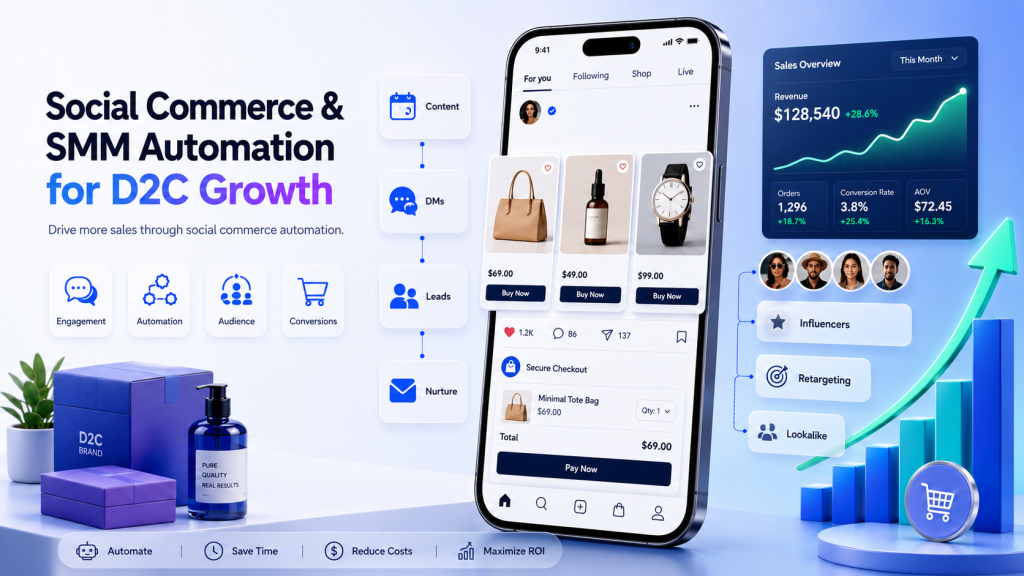
Automated DM sequences and chatbots represent another high-impact application. Platforms like ManyChat allow brands to create rule-based conversational flows triggered by comments or messages. A user who comments on a product post automatically receives a personalized message with product details and a purchase link turning passive engagement into active social media lead generation at scale.
Performance analytics and reporting automation pulls engagement metrics, click-through rates, conversion data, and audience growth numbers into unified dashboards. This gives marketing teams real-time intelligence without manual data collection, enabling faster strategic pivots and more confident budget decisions.
How Automation Amplifies Social Commerce Revenue
When automation handles operational tasks, human teams are freed to focus on strategy, creative direction, and community building the high-value activities that actually drive brand differentiation. The result is a compounding effect: automation maintains volume and consistency while human creativity elevates quality and emotional connection.
A 2023 HubSpot report found that marketers who use automation tools are twice as likely to report exceeding their revenue goals compared to those who manage everything manually.
Social Media Lead Generation: Building a Warm Audience Before the Sale
One of the most underappreciated aspects of D2C social strategy is how social commerce platforms serve as top-of-funnel lead generation engines. Unlike paid search, which captures existing demand, social platforms create demand by placing products in front of consumers who did not previously know they needed them.
Effective social media lead generation for D2C brands involves several interconnected tactics that work together to attract, warm, and convert audiences without relying purely on paid media budgets.
Organic Content Funnels
Content is the foundation. Brands that consistently publish educational, entertaining, and relatable content build audiences primed to buy. A skincare D2C brand that publishes daily ingredient-education Reels on Instagram builds trust and authority long before any purchase intent is expressed. By the time a follower sees a product recommendation, the conversion barrier has already been significantly reduced.
Lead Magnets and Social Giveaways
Strategically designed giveaways requiring participants to follow the brand account, tag friends, and engage with a post generate viral reach and rapid follower growth. When combined with automated follow-up sequences through DM tools, these campaigns become powerful social media lead generation systems that continuously feed a warm audience into the brand’s sales funnel.
Influencer and Creator Partnerships
Micro-influencer partnerships with creators having between 10,000 and 100,000 followers have proven particularly effective for D2C social commerce. Their audiences are highly engaged and niche-specific, meaning brands receive qualified traffic with strong purchase intent. According to a Linqia study, 71% of marketers believe micro-influencer content performs better than brand-created content for driving conversions.
Ecommerce Advertising Within the Social Commerce Ecosystem
Organic social commerce delivers compounding long-term results, but ecommerce advertising, specifically paid social ads, accelerates growth significantly when executed with precision. D2C brands that master the integration of paid and organic social can build self-funding advertising loops where revenue from conversions is continually reinvested into ads that generate new customers.
Performance-Driven Ad Formats for D2C Brands
Instagram and Facebook Dynamic Product Ads automatically display products a user has viewed or added to their cart, creating highly personalised retargeting experiences. TikTok Spark Ads amplify existing organic content, turning high-performing posts into paid placements that retain native-looking authenticity. Pinterest Shopping Ads target users based on interest and search behaviour, reaching consumers at the consideration stage. YouTube Shopping Ads combine long-form video storytelling with transactional intent, linking directly to product pages.
Scaling Ecommerce Advertising With Automation
Running ecommerce advertising at scale requires automated budget management, creative testing, and audience optimization. Smart bidding algorithms, automated A/B testing tools, and AI-powered creative recommendation engines now allow D2C brands to operate sophisticated multi-platform ad campaigns that would previously have required large dedicated advertising teams.
Meta’s Advantage+ Shopping Campaigns use machine learning to automatically optimize targeting, placement, and bidding strategies delivering meaningful improvements in return on ad spend for many D2C advertisers who adopt them.
Building a Holistic Ecommerce Growth Strategy Around Social Commerce
Social commerce and SMM automation do not work in isolation. The most successful D2C brands weave these capabilities into a coherent ecommerce growth strategy that spans the entire customer lifecycle from first discovery through to post-purchase advocacy.
The Four Pillars of a Social Commerce Growth Strategy
The first pillar is discovery and brand awareness. This involves using organic content, paid ads, and creator partnerships to maximise brand reach and product discovery among target audiences. Social media automation tools ensure consistent presence across all relevant platforms.
The second pillar is consideration and trust building. This is achieved through social proof in the form of user-generated content, verified reviews, and behind-the-scenes brand storytelling. Automated review request sequences, loyalty reminders, and personalised follow-ups strengthen this stage.
The third pillar is conversion and purchase. Reducing friction with in-app checkout, shoppable posts, automated DM purchase links, and retargeting ads is central here. This is where ecommerce advertising integration becomes most critical to revenue performance.
The fourth pillar is retention and advocacy. Post-purchase content, automated thank-you messages, loyalty program integrations, and referral campaigns turn customers into repeat buyers and brand advocates, driving organic social media lead generation through authentic word-of-mouth.
Ecommerce Automation Beyond Social: Integrating the Full Stack
Forward-looking D2C brands are extending ecommerce automation beyond social media to encompass their entire operational infrastructure. Order management automation, inventory synchronization, automated email sequences triggered by social ad clicks, and AI-powered customer service chatbots all work in concert to create seamless customer experiences that scale without linear headcount growth.
Platforms like Klaviyo, Shopify Flow, and Zapier enable D2C brands to connect their social commerce touchpoints with backend systems, creating automated workflows that span marketing, sales, fulfillment, and customer support.
According to McKinsey, companies that use advanced marketing automation see 15 to 20 percent reductions in customer acquisition costs alongside a 10 to 15 percent increase in sales revenue.
Real-World Examples: D2C Brands Winning With Social Commerce
Several D2C brands have built their entire growth model on social commerce and intelligent automation. Gymshark, the UK-based fitness apparel brand, grew from a garage startup to a billion-dollar brand almost entirely through social-first marketing. Their content-led approach on Instagram and TikTok, combined with strategic influencer partnerships and community engagement, created a powerful social media lead generation engine that sustained years of explosive growth.
Glossier, the D2C beauty brand, pioneered community-centric social commerce by turning customers into brand advocates through user-generated content campaigns and social-first product launches. Their use of ecommerce automation for community management and content curation allowed their small team to maintain a brand presence far larger than their headcount would conventionally support.
These examples demonstrate that social commerce success is not a function of budget size. It is a function of strategic clarity, consistent execution, and the intelligent use of ecommerce automation to scale what works.
Key Metrics D2C Brands Should Track for Social Commerce Performance
A data-driven ecommerce growth strategy requires the right performance indicators. Brands should track social conversion rate, purchases from social channels as a percentage of total social visitors, as the most direct measure of social commerce effectiveness. Cost per acquisition from paid social ads determines whether ecommerce advertising campaigns are profitable at scale.
Social media lead generation rate measures how effectively each campaign converts passive audience members into qualified leads. Average order value from social commerce buyers reveals whether social audiences are high-value customers. Return on ad spend for all ecommerce advertising campaigns determines budget allocation priorities. Finally, content engagement-to-purchase correlation identifies which content formats most reliably drive revenue, informing the ongoing creative strategy.
Regular performance audits using social media automation tools with integrated analytics dashboards ensure brands can identify what is working and double down with speed and confidence.
Conclusion:
The Competitive Advantage of Social Commerce Mastery
The D2C brands that will dominate the next decade are those that treat social commerce not as a marketing tactic but as a core business channel. When combined with intelligent social media automation tools, structured social media lead generation systems, performance-driven ecommerce advertising, and a well-architected ecommerce growth strategy, social commerce becomes a self-reinforcing growth engine that delivers compounding returns over time.
The barrier to entry in D2C retail is lower than ever but so is the margin for mediocrity. Brands that invest in building sophisticated social commerce infrastructure today, backed by robust ecommerce automation, are building competitive advantages that will be extremely difficult for slower-moving competitors to replicate. The window to establish first-mover advantages in this space is still open but it will not remain so indefinitely.
FAQs
Social commerce is the practice of selling products directly through social media platforms, allowing users to discover, evaluate, and purchase within the same app without being redirected to an external website. Traditional ecommerce requires users to visit a standalone store. Social commerce eliminates this friction by embedding the entire purchase journey from discovery to checkout within platforms like Instagram, TikTok, or Pinterest, resulting in faster conversions and higher impulse purchase rates.
Instagram remains a powerhouse for D2C brands due to its Shoppable Posts, Reels integration, and Instagram Shops feature. TikTok Shop has rapidly gained traction among younger demographics. Pinterest is highly effective for lifestyle, home, fashion, and beauty brands due to its high-intent search behaviour. Facebook Shops serve broader demographic groups. The best platform depends on where your target audience spends time and what product category you operate in.
The leading social media automation tools for D2C brands include Hootsuite and Buffer for multi-platform scheduling, Sprout Social for analytics and engagement automation, ManyChat for automated DM sequences and chatbot flows, and Metricool for performance tracking. For ad automation specifically, Meta Advantage+ and TikTok Smart Performance Campaigns offer powerful AI-driven targeting and bidding automation that significantly reduces manual management overhead.
Social media lead generation for D2C brands works by creating engaging content and interactive campaigns that attract target audience members and capture their contact information or brand engagement before a direct purchase occurs. This includes organic content funnels, giveaway campaigns requiring follows and tags, lead magnet offers delivered through automated DMs, and micro-influencer partnerships that drive highly qualified traffic. The goal is to build a warm, engaged audience primed for conversion when product offers are made.
D2C brands use ecommerce advertising on social platforms through a combination of prospecting ads to reach new audiences and retargeting ads to re-engage users who have already shown interest. Dynamic product ads on Facebook and Instagram automatically display products a user has viewed. TikTok Spark Ads amplify organic content. Pinterest Shopping Ads target high-intent users. These formats are often managed with automation tools that handle bid management, creative testing, and audience optimization to maximize return on ad spend.
Ecommerce automation refers to the use of technology to execute repetitive operational and marketing tasks without manual intervention. For D2C brands, this includes automated order management, inventory syncing, email and SMS follow-up sequences, chatbot-driven customer service, social media post scheduling, and ad campaign optimisation. Automation enables brands to scale operations, maintain consistent customer experiences, and reduce overhead costs without proportional headcount increases critical for resource-constrained D2C teams.
Building an ecommerce growth strategy around social commerce requires structuring your approach across four stages: awareness and discovery using organic content and paid ads; consideration and trust building using social proof and user-generated content; conversion using in-app purchasing and retargeting ads; and retention using automated post-purchase communications and loyalty programs. Each stage should be supported by appropriate social media automation tools and measured with clear KPIs to enable continuous optimisation.
The most important metrics for D2C social commerce performance include social conversion rate, cost per acquisition from social ads, return on ad spend, average order value from social buyers, follower-to-customer conversion rate, engagement rate, and social media lead generation rate. Brands should also track customer lifetime value from social-acquired customers versus other channels, as this reveals the long-term profitability of the social commerce channel beyond just first-purchase metrics.