Table of Contents
ToggleEmail Marketing Automation for D2C Brands: Using AI for Personalization at Scale
There was a time when sending a weekly newsletter to your entire list felt like a solid email strategy. Today, that approach is the fastest way to land in spam or worse, to bore customers into unsubscribing. Shoppers expect brands to know them. They expect relevance, timing, and messaging that feels like it was written just for them.
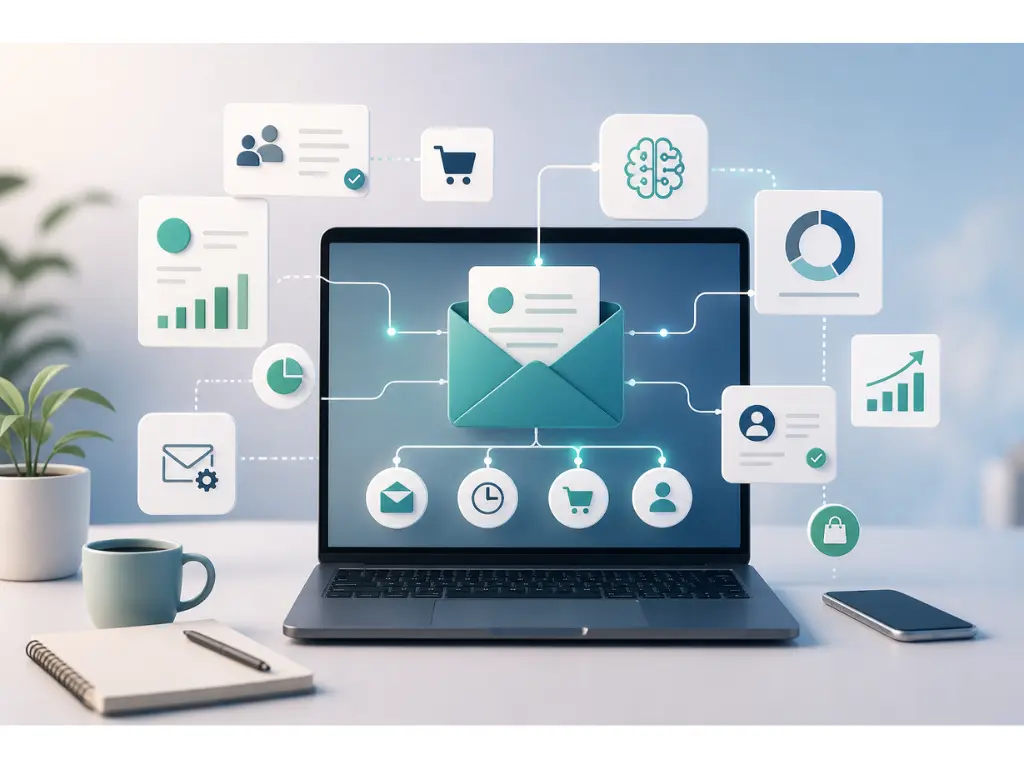
For direct-to-consumer brands, email marketing automation powered by AI is the answer to that expectation — not just in theory, but in measurable revenue. In this guide, we break down how D2C brands are using AI in email marketing to move beyond batch-and-blast, build intelligent customer journeys, and personalise at a scale no human team could manage alone.
Why Email Marketing Automation Is a D2C Growth Engine
Email remains the highest-ROI channel in ecommerce consistently returning between $36 and $42 for every dollar spent, according to industry benchmarks. But raw ROI numbers don’t tell the full story. The reason email outperforms paid social and display advertising for D2C brands isn’t just cost it’s ownership.
Unlike Instagram or Google, you own your email list. Algorithm changes don’t erase your reach overnight. Customer acquisition costs on paid channels continue to rise post-iOS 14, making email marketing automation not just efficient but essential for brands serious about sustainable D2C marketing automation.
But automation without intelligence is just noise at scale. That’s where AI changes the equation. Brands using AI in email marketing aren’t just sending emails faster they’re sending the right email, to the right person, at the exact moment it’s most likely to convert.
What AI Actually Does in Email Marketing Automation
Before we get into tactics, it’s worth being clear about what AI does and doesn’t do in an email marketing automation stack. It is not a magic content machine. It is a pattern-recognition and prediction engine that makes your campaigns smarter over time.
Predictive send-time optimisation
AI analyses each subscriber’s historical open and click behaviour to predict the exact time they’re most likely to engage. Instead of blasting your list at 10am Tuesday, every subscriber receives the email at their personal optimal send window. This alone can lift open rates by 15-25% for D2C brands with engaged lists.
AI-powered subject line generation
Modern AI in email marketing tools can generate and A/B test subject line variants at scale analysing emotional tone, length, personalisation tokens, and curiosity triggers to predict which variant will perform best for each audience segment. Tools like Phrasee, Persado, and Klaviyo’s built-in AI features make this accessible without a data science team.
Behavioural segmentation and dynamic content
AI-driven email marketing personalization goes beyond first-name tokens. It uses real-time behavioural signals what a customer browsed, bought, skipped, or returned to serve dynamically populated email content. A customer who just purchased a coffee grinder sees a follow-up featuring compatible filters and descaling kits. A subscriber who clicked on a sale but didn’t buy receives a gentle urgency nudge 24 hours later.
Churn prediction and win-back automation
AI can identify at-risk customers before they churn flagging subscribers whose engagement has dropped below a predictive threshold and triggering a tailored win-back sequence. For D2C brands with subscription models, this is one of the highest-value applications of D2C marketing automation available.
The Core Email Flows Every D2C Brand Should Automate
Before layering in AI sophistication, the foundation has to be solid. These are the non-negotiable automated flows for any D2C brand running serious marketing automation for ecommerce:
1. Welcome series (Days 0-7)
The moment someone joins your list is the peak of their curiosity about your brand. A strong welcome series typically three to five emails over the first week introduces your story, communicates your value proposition, offers social proof, and drives toward a first purchase. AI can personalise this series based on the source of sign-up (a quiz, a discount pop-up, a product page) to make it feel individually relevant from email one.
2. Abandoned cart sequence
Abandoned cart flows remain the single highest-converting email marketing automation for ecommerce. The standard three-part sequence reminder at one hour, value-add at 24 hours, incentive at 48-72 hours is well-established. AI elevates this by personalising the product imagery, copy, and incentive level based on cart value, customer lifetime value, and historical purchase behaviour. A first-time visitor shouldn’t receive the same email as a loyal repeat buyer.
3. Post-purchase flow
The post-purchase window is one of the most underused opportunities in marketing automation for ecommerce. Most brands send an order confirmation and stop there. A well-designed post-purchase flow includes a thank-you with brand story content, product usage tips, a cross-sell sequence timed to when the product is likely to run out or need a complement, and a review request at the optimal moment. AI timing models dramatically improve review collection rates by identifying the ideal ask window per product category.
4. Browse abandonment flow
Not everyone adds to cart. Browse abandonment flows trigger when a subscriber views a product page without taking action. These are lower-intent than cart abandonment, so the approach should be softer education-led, social-proof heavy, and without aggressive discounting. AI in email marketing can rank which browsed products are most worth following up on based on margin, browse depth, and category affinity.
5. Replenishment and subscription nudge flows
For consumable D2C products supplements, skincare, pet food, coffee AI-powered replenishment emails timed to each customer’s predicted usage rate are one of the most powerful D2C marketing automation plays available. Rather than guessing when a customer might run out, AI analyses purchase frequency and quantity to send the replenishment reminder at exactly the right moment, with a subscription upgrade CTA for high-LTV candidates.
Email Marketing Personalization at Scale: How AI Makes It Possible
The word personalisation is used so often in marketing that it has lost its edge. What most brands actually deliver is basic merge-field personalisation inserting a customer’s first name into a subject line. Real email marketing personalization the kind that moves revenue is something different entirely.
Genuine personalisation means that two subscribers on your list receive an email from the same campaign, but the product recommendations, the hero image, the offer, and sometimes even the tone of the copy are different. At any meaningful list size, this is impossible to do manually. It requires AI in email marketing to manage the logic, pull the data, and render the content dynamically.
Here’s what true AI-driven email marketing personalization looks like in practice for a D2C brand:
- Zero-party data collection: Quizzes, preference centres, and onboarding surveys feed AI models with self-reported customer intent, dramatically improving personalisation accuracy.
- Product affinity modelling: AI identifies which product categories each subscriber gravitates toward and weights recommendations accordingly.
- Dynamic offer logic: Rather than discounting everyone, AI determines which subscribers are price-sensitive versus brand-loyal, offering incentives only where they’re needed to convert.
- Personalised content blocks: Email templates contain modular content blocks that populate differently based on customer segment same campaign, radically different experience.
Choosing the Right Tools for D2C Marketing Automation
The marketing automation for ecommerce tool landscape has matured significantly. You don’t need enterprise-level investment to access AI-powered email capabilities. Here’s how the main platforms stack up for D2C brands:
Klaviyo
The dominant choice for D2C brands at the mid-to-growth stage. Klaviyo’s deep Shopify integration, predictive analytics, and AI-powered segmentation make it the default recommendation for brands doing $1M-$50M in revenue. Its predictive CLV modelling and churn-risk features are particularly strong for D2C marketing automation.
Attentive / Omnisend
Strong options for brands wanting SMS and email in one platform increasingly important as email marketing automation and SMS flows merge into unified customer journeys. Omnisend’s automation templates are particularly accessible for smaller D2C teams without a dedicated email specialist.
ActiveCampaign
Better suited for D2C brands with complex multi-product catalogues or education-heavy buying cycles. Its conditional logic for automation branching is among the most powerful available, making it a strong choice for brands where email marketing personalization needs to account for many customer journey paths.
Measuring What Matters in Email Marketing Automation
Vanity metrics like open rate and click rate have their place but for D2C brands, the only metrics that matter are tied to revenue. With privacy changes reducing the reliability of open rate data (Apple Mail Privacy Protection), smart brands are shifting focus to downstream metrics.
- Revenue per recipient (RPR): Total email revenue divided by emails sent. The cleanest measure of how your email marketing automation is performing.
- Flow revenue vs campaign revenue split: Healthy email programs typically see 30-50% of email revenue coming from automated flows. If your flows are underperforming campaigns, your automation needs work.
- List growth rate vs churn rate: Growing a list means nothing if churn is outpacing acquisition. AI-driven engagement scoring helps identify and re-engage at-risk subscribers before they unsubscribe.
- Attributed conversion rate by segment: Which customer segments convert best from email? AI segmentation should reveal which audiences respond to which flows, informing your broader D2C marketing automation strategy.
Common Mistakes D2C Brands Make with Email Automation
Even brands with good tools make avoidable mistakes. These are the most common:
Over-automating without a human voice
AI should power the logic humans should still write (or at least edit) the copy. Fully AI-generated emails that skip editorial review often feel flat and generic, undermining the brand voice that makes D2C brands compelling.
Ignoring email list hygiene
Sending to unengaged subscribers destroys deliverability. Regular list cleaning removing subscribers who haven’t engaged in 90-180 days protects your sender reputation and improves the performance metrics that actually matter.
Launching flows without testing
Automation should never be ‘set and forget.’ Even the best-designed email marketing automation sequences need regular performance reviews, copy refreshes, and A/B tests to stay effective.
Discounting too early
Many D2C brands default to offering a discount in the second or third email of a welcome or cart abandonment flow. AI personalisation allows you to reserve discounts for price-sensitive segments only protecting margin from customers who would have converted anyway.
Conclusion
The gap between D2C brands that treat email marketing automation as a channel and those that treat it as a growth system is widening. The brands winning on email today aren’t sending more they’re sending smarter. They’re using AI in email marketing to predict behaviour, personalise at the individual level, and turn every automated touchpoint into a revenue moment.
You don’t need a data science team to get started. You need the right platform, a solid set of foundational flows, a genuine commitment to email marketing personalization, and a willingness to let the data drive your decisions.
For D2C brands at any stage, marketing automation for ecommerce is no longer a competitive advantage it’s the baseline. The advantage comes from how intelligently you use it.