Best Email Marketing Strategies for Ecommerce & D2C
If you’re running an ecommerce or D2C brand in 2024, you already know that acquiring a new customer costs 5 to 7 times more than retaining an existing one. That’s exactly why smart brands are investing heavily in retention marketing — and email sits right at the heart of it. It’s direct, personal, cost-effective, and when done well, it genuinely drives repeat sales without burning your ad budget.
In this guide, we’ll walk through the best email marketing strategy frameworks for ecommerce and D2C brands — the kind that actually move the needle on customer loyalty and revenue.
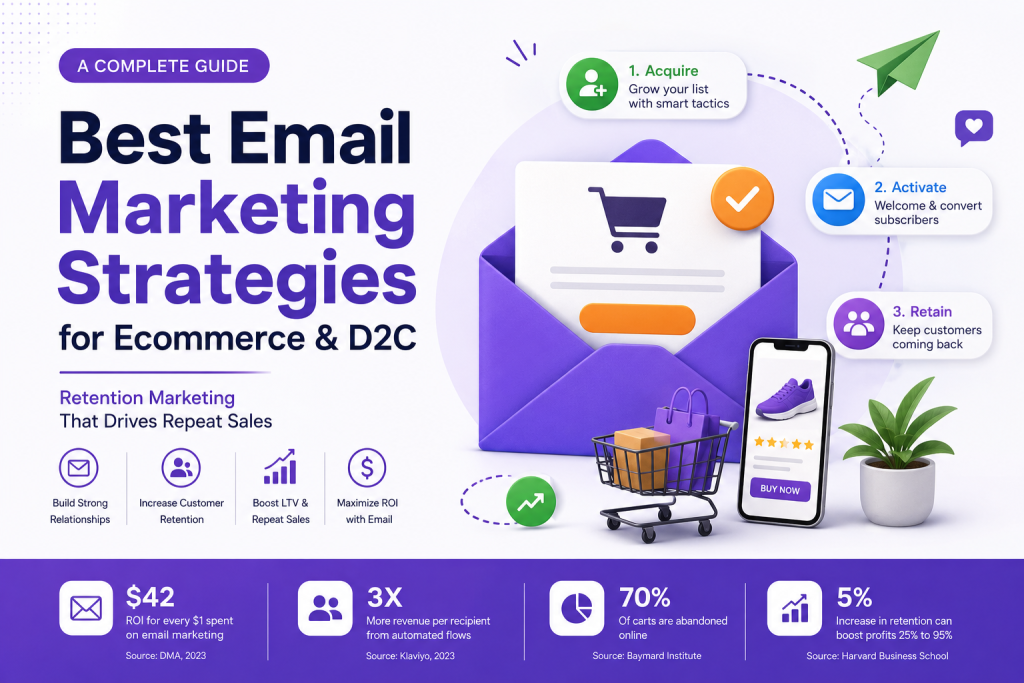
📊 According to Klaviyo’s 2023 Email Benchmark Report, ecommerce brands that use automated email flows generate 3x more revenue per recipient than broadcast campaigns alone.
Why Email is the Backbone of Retention Marketing
Let’s be real — social media algorithms change, ad costs go up, and paid traffic is never truly yours. Email is different. Your list belongs to you. For d2c marketing, this ownership is a massive competitive advantage.
Here’s why email consistently outperforms other channels for retention:
- ecommerce email marketing delivers an average ROI of $42 for every $1 spent (DMA, 2023)
- Email open rates for ecommerce average around 20–25% — far higher than social media organic reach
- Automated email sequences can run 24/7 without extra ad spend
- Highly personal: you can segment by purchase history, location, and behavior
Understanding the Ecommerce Email Funnel
Before diving into tactics, it’s worth mapping out how email fits into your ecommerce sales funnel. Think of it in three simple stages:
- Acquire — Grow your list through popups, lead magnets, checkout opt-ins
- Activate — Welcome new subscribers and convert them to first-time buyers
- Retain — Keep customers coming back with targeted, value-driven email sequences
Most brands focus only on the first two. The real money in retention marketing is in the third stage — retaining and reactivating customers who’ve already purchased.
📈 Data point: Increasing customer retention rates by just 5% can increase profits by 25% to 95% — Harvard Business School
Strategy 1: Build a Rock-Solid Welcome Series
Your welcome email series is your first impression — and it sets the tone for the entire customer relationship. For email marketing for ecommerce, a well-crafted welcome flow can generate up to 51% more revenue than a single welcome email (Omnisend Research).
A high-converting welcome series looks like this:
- Email 1 (Day 0): Warm welcome + brand story + what to expect
- Email 2 (Day 2): Highlight bestsellers or a ‘starter kit’ recommendation
- Email 3 (Day 4): Social proof — reviews, UGC, press mentions
- Email 4 (Day 7): Time-limited offer or exclusive discount to nudge first purchase
Keep the tone human. Write like you’re talking to a friend, not broadcasting to a database.
Strategy 2: Nail Your Abandoned Cart Emails
Abandoned cart emails are one of the highest-ROI flows in any ecommerce email marketing setup. On average, 70% of online shopping carts are abandoned (Baymard Institute). Recovering even a fraction of these is pure profit.
Your abandoned cart flow should include at least 3 emails:
- Email 1 (1 hour later): Gentle reminder — ‘Did you forget something?’
- Email 2 (24 hours later): Add urgency — limited stock or offer ending soon
- Email 3 (48–72 hours later): Final push — small discount or free shipping if needed
Pro tip: include the exact product image and name in every cart email. Personalization is the key to email marketing strategy that converts.
Strategy 3: Post-Purchase Emails that Build Loyalty
Most brands stop emailing once the order is shipped. That’s a huge missed opportunity. Post-purchase emails are the foundation of strong retention marketing — they reduce buyer’s remorse, encourage reviews, and plant the seed for repeat purchases.
Build a post-purchase flow like this:
- Order confirmation — Transactional but warm; add a personal note from the founder if you’re D2C
- Shipping update — Set expectations, reduce support tickets
- Delivery + How-to — Usage tips, care instructions, or tutorials
- Review request (Day 7–10) — Ask for feedback while the experience is fresh
- Cross-sell email (Day 14–21) — Suggest complementary products based on their purchase
This flow directly supports your ecommerce sales funnel by turning one-time buyers into loyal repeat customers.
Strategy 4: Segmentation — Stop Sending the Same Email to Everyone
This is where most brands leave money on the table. Sending the same email blast to your entire list is not an email marketing strategy — it’s noise. Segmented campaigns have been shown to drive up to 760% more revenue than generic ones (Campaign Monitor).
Key segments to build for your D2C brand:
- New subscribers (haven’t purchased yet)
- First-time buyers (purchased once in last 30 days)
- Repeat buyers (2+ purchases)
- VIP customers (top 10% by spend)
- Lapsed customers (no purchase in 90–180 days)
- Win-back segment (no purchase in 180+ days)
For d2c marketing, behavioral segmentation is especially powerful — trigger emails based on what people browse, buy, or skip.
Strategy 5: Win-Back Campaigns for Lapsed Customers
Even loyal customers go quiet. A smart win-back campaign is one of the most underused tools in email marketing for ecommerce. The goal: re-engage people who haven’t bought in 3–6 months before they forget you exist.
A simple but effective win-back flow:
- Email 1: ‘We miss you’ — acknowledge the silence, remind them of your value
- Email 2: Show what’s new — new products, improvements, or collections since they last visited
- Email 3: Make an irresistible offer — exclusive discount, free shipping, or gift
- Email 4: Last chance — ‘We’ll remove you from our list if we don’t hear back’ (this actually works)
Win-back campaigns also help you clean your list — keeping only engaged subscribers improves your sender reputation and overall ecommerce email marketing deliverability.
💡 Tool Reference: Platforms like Klaviyo, Omnisend, and Drip offer pre-built win-back automation flows for ecommerce brands.
Strategy 6: Personalization Beyond First Name
Inserting someone’s first name in the subject line is table stakes now. True personalization in retention marketing means using data to make every email feel like it was written specifically for that customer.
Powerful personalization levers to use:
- Purchase history — Recommend products based on what they’ve already bought
- Browsing behavior — Email about products they viewed but didn’t buy
- Replenishment timing — For consumables (skincare, supplements, coffee), email right before they run out
- Birthday or anniversary — A special email on their customer anniversary with your brand goes a long way
- Location-based offers — Seasonal or regional promotions based on where they are
Personalization directly impacts email marketing strategy performance — personalized emails deliver 6x higher transaction rates (Experian Marketing Services).
Key Metrics to Track in Your Ecommerce Email Program
No email marketing for ecommerce program is complete without measurement. Here’s what to watch:
- Open Rate — Benchmark: 20–25% (source: Mailchimp Industry Report)
- Click-Through Rate (CTR) — Benchmark: 2–5%
- Conversion Rate — Percentage of email recipients who made a purchase
- Revenue Per Recipient (RPR) — Total email revenue / emails sent
- Customer Lifetime Value (CLV) — The long-term metric that retention marketing directly impacts
- List Growth Rate — Are you growing your list faster than people are unsubscribing?
- Unsubscribe Rate — Keep below 0.5%; high rates signal irrelevant content
Email Marketing Tips Specific to D2C Brands
D2C brands have a unique advantage: you own the full customer relationship from first click to repeat purchase. Your d2c marketing emails can be more personal, more brand-forward, and more story-driven than a typical retailer.
- Lead with your brand story — Customers buy D2C brands for the ‘why’, not just the product
- Use founder voice — Emails from ‘Priya at [Brand]’ outperform generic ‘Team [Brand]’ sends
- Build community — Invite customers into your journey: product development, sustainability, behind the scenes
- Leverage UGC — Customer photos and reviews in emails build trust faster than polished ads
- Create a loyalty program email track — Reward frequent buyers with points, early access, or exclusive drops
Final Thoughts
Email marketing isn’t dying — it’s evolving. For ecommerce and D2C brands, it remains one of the most powerful tools in the retention marketing toolkit. The brands that win are those that treat email as a relationship channel, not just a promotional one.
Start with the fundamentals: build your welcome series, set up your abandoned cart flow, and create a solid post-purchase sequence. Then layer in segmentation, personalization, and win-back campaigns. Combine all of this with a clear understanding of your ecommerce sales funnel, and you’ll have a email marketing strategy that compounds over time — keeping customers longer, spending more, and telling others about your brand.
The goal isn’t just to sell. It’s to make every customer feel like they made the right choice — and keep coming back because of it.
FAQs
Retention marketing refers to strategies designed to keep existing customers engaged and coming back for repeat purchases. For ecommerce brands, it matters because retaining a customer is significantly cheaper than acquiring a new one, and loyal customers tend to spend more and refer others over time.
For most ecommerce brands, 2–4 emails per month for broadcast campaigns is a reasonable starting point. Automated flows (welcome, cart, post-purchase) should fire based on behavior — not a set schedule. Over-emailing is a leading cause of unsubscribes, so always prioritize relevance over frequency.
Common list-building tactics include: exit-intent popups offering a discount, checkout opt-in checkboxes, lead magnets (free guides, quizzes), spin-to-win gamification widgets, and social media lead ads. Always make the value exchange clear — what does the subscriber get in return?
According to Mailchimp’s industry benchmarks, the average open rate for ecommerce emails is around 20–22%. Anything above 25% is strong. Automated flows (like welcome and abandoned cart) typically see much higher open rates — often 40–60%
In d2c marketing, email operates across the entire funnel — from lead nurturing (top) to first purchase conversion (middle) to repeat buying and brand advocacy (bottom). Because D2C brands own the customer relationship directly, email is their most powerful owned channel
An email blast is a single email sent to your entire list (or a segment) at once — like a sale announcement. A drip campaign is a series of automated emails triggered by user behavior or time intervals — like a welcome sequence or post-purchase flow. For retention marketing, drip campaigns consistently outperform blasts in engagement and revenue.
The main causes of unsubscribes are too many emails, irrelevant content, and broken expectations. To reduce churn: segment your list properly, set clear expectations at signup, A/B test subject lines and send times, and regularly clean inactive subscribers from your list.
Yes — SMS and email are highly complementary. Email works well for longer content: product education, brand stories, newsletters. SMS excels for time-sensitive messages: flash sales, shipping alerts, and abandoned cart nudges. Brands using both channels together see significantly higher conversion rates than those using either alone.
Track these core KPIs for your email marketing strategy: open rate, click-through rate, conversion rate, revenue per email sent, and customer lifetime value (CLV). For retention marketing specifically, also monitor repeat purchase rate and customer retention rate month-over-month.