Table of Contents
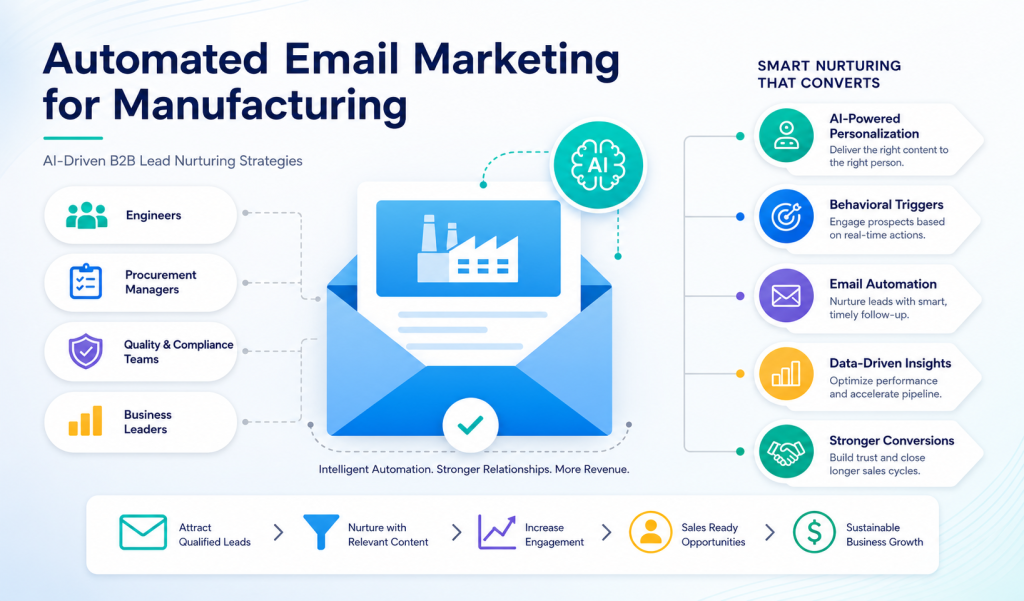
ToggleAutomated Email Marketing for Manufacturing: AI-Driven B2B Lead Nurturing Strategies
Manufacturing sales cycles are notoriously long. A procurement decision for industrial equipment, custom components, or contract manufacturing services can take six months to two years from first contact to signed purchase order. During that time, a prospect is researching alternatives, building internal business cases, navigating committee approvals, and revisiting their requirements as specifications evolve.
The majority of manufacturers address this reality by putting it in the hands of the field sales team — and hoping. The result is inconsistent follow-up, lost deals that went quiet, and sales pipelines that look full but move slowly. What most B2B manufacturing businesses are missing is a systematic, intelligent automated email marketing engine that keeps prospects engaged, educated, and moving forward through the buying cycle — without requiring a salesperson to manually chase every contact.
This guide explores how AI-powered email marketing and email marketing automation are transforming lead nurturing for manufacturers — turning slow, unpredictable pipelines into consistent, measurable revenue engines.
The Unique Email Marketing Challenge for B2B Manufacturers
Before diving into strategy, it is worth being honest about what makes B2B email marketing for manufacturers genuinely different from other sectors — and why most off-the-shelf email strategies fail when applied to industrial and manufacturing contexts.
Long, non-linear buying cycles
Unlike consumer purchases or even many B2B SaaS decisions, manufacturing purchases are rarely made quickly. Specifications change. Budgets shift. Internal champions move roles. A prospect who went cold six months ago may suddenly re-emerge with an urgent requirement — and if your business has not maintained any presence during that dormant period, a competitor who stayed in touch will be the one shortlisted.
Effective automated email marketing for manufacturing keeps your business visible and credible throughout the full duration of the buying cycle — even during the extended quiet periods where it can feel like nothing is happening.
Multiple stakeholders with different information needs
A single purchasing decision in B2B manufacturing typically involves three to seven stakeholders: an engineer specifying requirements, a procurement manager evaluating suppliers, a quality manager assessing compliance credentials, an operations director considering lead times, and a CFO or MD approving the budget. Each of these individuals needs different information to move forward.
Generic email blasts cannot address this complexity. AI-powered email marketing can — by identifying which stakeholder role a contact is most likely to hold, based on their job title, content engagement, and behaviour, and automatically serving them the information most relevant to their specific concerns.
Technical buyers with high skepticism
Engineers and procurement professionals in industrial sectors are trained to be skeptical of marketing claims. Vague benefit statements, unsubstantiated guarantees, and generic case studies are ignored or, worse, damage credibility. Effective B2B email marketing for manufacturers must lead with technical substance — precise specifications, documented performance data, and verifiable credentials — rather than marketing language.
This is where the content strategy underlying your automated email marketing programme becomes as important as the automation technology itself. The best email sequence in the world will not convert a skeptical engineer if the content it delivers does not demonstrate genuine technical depth.
How AI Transforms Email Marketing Automation for Manufacturing
Lead scoring is the process of assigning a numerical value to each prospect based on their characteristics and behaviour — indicating how sales-ready they are. Traditional lead scoring uses manually defined rules: if a contact downloads a datasheet, add ten points; if they open three emails in a row, add five points.
AI lead scoring replaces these rigid rules with machine learning models trained on your historical conversion data. The AI identifies which behavioural patterns, content engagement signals, and firmographic characteristics actually correlate with sales conversion for your specific business — often surfacing insights that human analysts would never identify. For B2B manufacturing businesses with long sales cycles, this predictive accuracy dramatically improves how automated email marketing resources are allocated — concentrating nurture intensity on prospects most likely to convert.
Behavioural email triggers
Rule-based email marketing automation triggers emails based on simple conditions: three days after sign-up, send email two; seven days after that, send email three. AI-powered triggers are fundamentally more sophisticated — firing email sequences based on the specific behaviour a prospect exhibits.
A prospect who downloads a technical specification sheet receives a follow-up email with a relevant application case study within hours. A contact who visits your pricing page but does not enquire triggers a personalised outreach from their assigned sales contact. A prospect whose engagement score drops below a threshold triggers a re-engagement sequence with fresh content. This kind of responsive, behaviour-driven automated email marketing feels like attentive account management — not mass communication.Additionally, these behavioural triggers become even more effective when integrated with LinkedIn outreach and retargeting campaigns, ensuring that high-intent prospects are engaged across multiple channels simultaneously.
Dynamic content personalisation
AI-powered dynamic content allows a single email template to render differently for different recipients — changing the hero image, the case study reference, the product focus, and even the tone of the copy based on what the system knows about each contact.
For manufacturing marketing, this means an aerospace engineer receives an email featuring aerospace-specific applications and precision tolerances, while a food processing procurement manager receives the same campaign with food-grade compliance credentials and hygiene standards at the centre. The infrastructure is the same; the experience is completely tailored. This is the core promise of AI-powered email marketing — personalisation at a scale that manual segmentation could never achieve.
Predictive send-time optimisation
When you send an email matters almost as much as what it contains. AI send-time optimisation analyses each individual contact’s historical engagement patterns — the days and times they most consistently open and click — and delivers each email at the predicted optimal window for that specific person.
For B2B email marketing targeting manufacturing professionals, this is particularly valuable because industrial buyers have highly variable schedules — some are on the shop floor at 8am, others are in planning meetings all morning and check email in the late afternoon. Predictive send-time optimisation ensures your carefully crafted nurture content is seen when it is most likely to be read.
The Core B2B Email Nurturing Sequences Every Manufacturer Needs
A complete automated email marketing programme for a manufacturer is built from several coordinated nurture sequences, each designed for a specific stage of the buyer journey or a specific audience segment. Here are the essential flows every B2B manufacturing business should have in place.
1. New lead welcome and qualification sequence
The moment a new prospect enters your database — whether from a website enquiry, a trade show contact, a content download, or an inbound call — they should enter an automated welcome sequence. This sequence serves two purposes: it introduces your business with credibility-building content, and it gathers information that enables smarter segmentation.
A well-designed welcome sequence for manufacturing marketing typically runs over two to three weeks and includes: an immediate introduction email with your most compelling proof points (key clients, certifications, production capabilities); a follow-up featuring a relevant case study; a content offer (technical guide, webinar recording, or specification tool) that provides genuine value while identifying the prospect’s area of interest; and a soft CTA inviting the prospect to book a discovery call or request a sample.
2. Persona-based educational nurture track
Once a prospect is segmented by role and interest area — through their content engagement, form data, or CRM fields — they should enter a persona-specific educational track. This is the heart of AI-driven B2B email marketing for manufacturers: extended nurture sequences that deliver progressively more detailed technical content aligned to each stakeholder’s specific concerns.
An engineering persona track might run for three to six months, delivering application guides, technical papers, comparison specifications, and innovation updates. A procurement persona track focuses on supply chain reliability, lead time performance data, quality certifications, and pricing transparency. Each track deepens the prospect’s understanding of your capability while continuously building the confidence and trust needed for a significant purchase decision.
3. Mid-funnel consideration sequence
Prospects who have moved past initial awareness — who have downloaded multiple resources, visited your website repeatedly, or requested a quote — need a different kind of automated email marketing treatment. The mid-funnel consideration sequence shifts from education to proof: detailed case studies with specific metrics, video testimonials from existing clients in the prospect’s industry, comparison content addressing the most common competitive objections, and clear articulations of your differentiation.
AI lead scoring identifies when a prospect has crossed the threshold from education to consideration — triggering the shift from the educational track to the consideration sequence automatically, without requiring manual intervention from the sales team.
At this stage, combining email marketing automation with LinkedIn touchpoints and targeted remarketing campaigns significantly increases the likelihood of conversion by reinforcing messaging across multiple platforms.
4. Long-cycle re-engagement sequencen
Manufacturing sales cycles frequently go quiet for extended periods — not because the prospect has lost interest, but because internal priorities have shifted, budgets are under review, or specifications are being refined. A re-engagement sequence maintains your presence during these dormant periods without the pushiness of repeated sales calls.This strategy becomes even more powerful when supported by LinkedIn engagement and retargeting ads, which help maintain brand visibility even when email interaction temporarily declines.
Effective re-engagement content for B2B manufacturing includes: industry news and trend analysis relevant to the prospect’s sector; notification of new case studies or capability additions; invitations to webinars, factory tours, or virtual demonstrations; and seasonal prompts aligned to procurement cycles (year-end budget spending, Q1 planning periods).
5. Post-quote and proposal nurture sequence
One of the most underused opportunities in email marketing automation for manufacturers is the post-proposal period. A prospect who has received your quotation is at peak consideration — and likely simultaneously evaluating two or three competitors. This is not the moment to go quiet and wait.
A post-quote nurture sequence keeps your business front of mind while the prospect deliberates: reinforcing key differentiators, addressing common objections proactively, sharing relevant client testimonials, and providing the sales team with engagement data that indicates when the prospect is actively reviewing the proposal and might be receptive to a follow-up call.
6. Customer onboarding and retention sequence
The nurture journey does not end when a prospect becomes a customer. A structured onboarding sequence — delivered through automated email marketing — confirms the purchase, introduces the account team, sets expectations for communication and delivery, and begins building the relationship that leads to repeat orders and referrals.
For manufacturers, customer retention is particularly high value because switching costs are significant and repeat purchase cycles can span years. An ongoing client communication programme — periodic capability updates, invitation to new product launches, annual review prompts — is one of the most cost-effective growth strategies available to any manufacturing marketing team.
Choosing the Right Email Marketing Automation Platform for Manufacturing
The email marketing automation platform you choose significantly impacts what is technically possible — and how quickly your team can implement and iterate. Here is how the main platforms serve B2B manufacturing businesses specifically.
HubSpot
The most complete all-in-one option for mid-market manufacturers. HubSpot combines AI-powered email marketing, CRM, lead scoring, sales pipeline management, and reporting in a single platform — eliminating the integration complexity that often undermines marketing automation investments. Its AI features include predictive lead scoring, smart content personalisation, and send-time optimisation. For manufacturers who want a single source of truth for marketing and sales activity, HubSpot is the strongest all-round choice.
Marketo Engage (Adobe)
The enterprise-grade choice for larger manufacturers with complex buying committee structures and multiple product lines. Marketo’s account-based marketing capabilities, advanced segmentation, and deep CRM integrations make it particularly well-suited to B2B email marketing programmes that need to coordinate engagement across multiple contacts within a single target account. The learning curve and investment are significant — but the capability ceiling is correspondingly high.
ActiveCampaign
A strong mid-market option for manufacturers who want sophisticated automated email marketing capabilities without enterprise pricing. ActiveCampaign’s automation builder is among the most flexible available — enabling complex conditional logic that can handle the branching nurture journeys that B2B manufacturing sales cycles require. Its AI features, including predictive sending and lead scoring, are accessible and well-implemented for teams without dedicated data science resources.
Salesforce Marketing Cloud
The natural choice for manufacturers already operating on Salesforce CRM. Marketing Cloud’s Einstein AI features — including engagement scoring, send-time optimisation, and content personalisation — integrate seamlessly with Salesforce data, giving marketing and sales teams a unified view of every prospect and customer interaction. For large-scale manufacturing marketing operations with established Salesforce infrastructure, this integration advantage is significant.
Building Your Manufacturing Email Content Strategy
The automation infrastructure is only as effective as the content it delivers. For B2B email marketing in manufacturing, content quality is the single biggest variable in nurture programme performance — and the area most frequently underinvested.
The content types that consistently outperform in manufacturing email nurture programmes include:
- Application-specific case studies: Not generic success stories, but detailed accounts of how your product or service solved a specific technical challenge in a specific industry application — with measurable outcomes (tolerance achieved, production volume, lead time, cost reduction).
- Technical deep-dives and white papers: Long-form content that demonstrates your engineering team’s expertise. These assets are particularly valuable as gated downloads that identify high-intent prospects while providing genuine value in return for contact information.
- Process and capability videos: Short videos (two to four minutes) showing your manufacturing process, quality control procedures, or equipment capability build credibility faster than any written content. AI-powered automated email marketing platforms can identify which contacts engage with video content and trigger appropriate follow-up sequences.
- Compliance and certification updates: For manufacturers in regulated sectors — aerospace, medical, food processing — proactive communication about certification renewals, audits passed, and new compliance achievements directly addresses a key procurement concern.
- Industry insight and trend analysis: Regular commentary on sector developments, regulatory changes, or technology trends positions your business as an industry authority rather than just another supplier. This type of content performs particularly well in re-engagement sequences for dormant prospects.
Combining Email Marketing with LinkedIn and Retargeting for Manufacturing Lead Generation
Automated email marketing is a powerful foundation for B2B manufacturing growth — but on its own, it is rarely sufficient to influence complex buying committees or sustain engagement across long sales cycles. The most effective manufacturing marketing strategies combine email marketing automation with LinkedIn network building, direct outreach, and retargeting campaigns to create a consistent multi-channel presence.
LinkedIn network building for manufacturing decision-makers
For B2B manufacturing businesses, LinkedIn is one of the most valuable channels for reaching engineers, procurement managers, operations heads, and senior decision-makers. While email marketing automation nurtures contacts over time, LinkedIn enables proactive relationship building at the individual level.
A structured LinkedIn network-building strategy should focus on connecting with ideal customer profiles (ICPs) based on industry, job role, and company size. Sales and marketing teams can collaborate to consistently expand their network with relevant prospects, ensuring that future email outreach is supported by existing familiarity and brand recognition.
Using LinkedIn InMail and messaging alongside email nurture
Not all prospects engage through the same channel. Some decision-makers rarely respond to emails but are active on LinkedIn, while others prefer email communication for detailed technical discussions.
Combining LinkedIn messaging with automated email marketing creates multiple engagement touchpoints. For example, after a prospect downloads a technical resource and enters an email nurture sequence, a personalised LinkedIn connection request followed by a value-driven message can reinforce the relationship. This coordinated approach increases response rates and builds trust faster than relying on a single channel.
Email and LinkedIn as a unified nurturing system
Rather than treating LinkedIn and email as separate channels, leading manufacturing marketers integrate them into a unified nurture strategy:
- LinkedIn content builds awareness and credibility
- Email marketing automation delivers in-depth technical and educational content
- LinkedIn engagement reinforces brand familiarity during inactive periods
- Sales outreach is triggered based on combined engagement signals
This multi-touch approach ensures that prospects continue to see and interact with your brand across different platforms throughout the buying journey.
The role of remarketing and retargeting in long sales cycles
Manufacturing buyers rarely convert after a single interaction. They research, compare suppliers, and revisit requirements over extended periods. Remarketing and retargeting campaigns play a critical role in maintaining visibility during this process.
By retargeting website visitors, email clickers, and content downloaders with relevant ads particularly on LinkedIn and Google manufacturers can stay top-of-mind even when prospects are not actively engaging with emails. For example, a prospect who visited a product page or reviewed a proposal can be retargeted with case studies, testimonials, or capability highlights that reinforce your value proposition.
When combined with automated email marketing, remarketing ensures that your brand remains consistently visible across channels increasing recall, trust, and ultimately conversion rates.
Measuring the ROI of Automated Email Marketing in Manufacturing
Proving the return on investment from automated email marketing in a long B2B sales cycle requires a measurement framework that goes beyond open rates and click rates. These are the metrics that connect email marketing activity to business outcomes for manufacturers.
- Pipeline influence: Track what percentage of active sales opportunities have had meaningful email marketing engagement — opened sequences, downloaded assets, attended webinars. This demonstrates the contribution of email marketing automation to pipeline health even before deals close.
- Lead-to-MQL conversion rate: What percentage of raw enquiries are being qualified to Marketing Qualified Lead status through nurture engagement? Improving this rate — through better content and smarter AI-powered email marketing — reduces the volume of unqualified leads passed to the sales team.
- Sales cycle length by nurture track: Compare the average sales cycle length for prospects who went through structured email nurture sequences versus those who did not. For B2B manufacturing businesses, even a 15-20% reduction in average cycle length represents significant revenue acceleration.
- Revenue attributed to email nurture: With CRM integration, it is possible to track which closed deals received email nurture touchpoints during the consideration phase — attributing a portion of that revenue to the automated email marketing programme.
- Reactivation rate from re-engagement sequences: Track the percentage of dormant prospects who re-engage and eventually convert following a re-engagement email sequence. This is often one of the highest-ROI metrics in manufacturing marketing because it recovers revenue from leads that would otherwise have been permanently lost.
Common Mistakes Manufacturers Make with Email Marketing Automation
Importing a cold list and calling it email marketing. Purchased contact lists and conference badge scans are not an email marketing list — they are cold outreach targets. Sending automated email marketing sequences to contacts who have not opted in destroys deliverability, triggers spam complaints, and can result in domain blacklisting. Always build your list through legitimate opt-in mechanisms and treat deliverability as a strategic asset.
Using a single linear sequence for all prospects. A welcome sequence that sends the same seven emails to every new contact regardless of their role, industry, or content engagement is not email marketing automation — it is batch-and-blast with a timer. True B2B email marketing sophistication requires branching logic that adapts the nurture path based on individual engagement behaviour.
Neglecting list hygiene. Inactive contacts degrade your sender reputation over time. Run regular list hygiene processes — suppressing contacts who have not engaged in 12 months, removing hard bounces immediately, and running re-engagement sequences before unsubscribing persistent non-openers. A smaller, engaged list consistently outperforms a large, stale one.
Disconnecting email marketing from sales. The most common failure mode in manufacturing marketing email programmes is a marketing team running automation in isolation from the sales team. Sales contacts should receive real-time notifications when their assigned prospects hit high engagement scores, download key assets, or revisit the pricing page — enabling timely, informed follow-up that converts marketing momentum into sales conversations.
Underestimating content investment. The technology platforms that power AI-powered email marketing are increasingly accessible and affordable. The content they deliver is not. Manufacturers that invest in the automation infrastructure but cut corners on content quality will consistently underperform against competitors who prioritise substance. Budget for content creation as generously as you budget for technology
conclusion
Manufacturing sales cycles will never be short. Complex products, high contract values, and multi-stakeholder buying committees are structural features of the industry not problems to be solved. But the gap between a manufacturer that nurtures prospects intelligently throughout that cycle and one that relies on sporadic sales follow-up is enormous measured in pipeline velocity, win rates, and annual revenue.
A well-built automated email marketing programme, powered by AI and integrated with LinkedIn network building, direct outreach, and remarketing campaigns, is not just a marketing tool. It is a complete, multi-channel system for building trust, maintaining visibility, and influencing buying decisions over time.
The manufacturers that combine email marketing automation with LinkedIn engagement and retargeting strategies are creating a consistent, always-on presence across the buyer journey. This approach ensures that when decision-makers are ready to move forward, your business is not just one of the options — it is the most familiar and trusted choice.
Start with one channel, build a strong foundation, and then layer LinkedIn and retargeting into your strategy. That integrated approach is what separates high-performing manufacturing marketing teams in 2026 from those still relying on disconnected tactics.
FAQs
Automated email marketing is a system that sends targeted, pre-built email sequences to prospects based on their behaviour, interests, and stage in the buying journey. In B2B manufacturing, it helps nurture long sales cycles by keeping engineers, procurement teams, and decision-makers engaged with relevant technical and business content.
AI enhances email marketing automation by enabling predictive lead scoring, behavioural triggers, dynamic content personalisation, and send-time optimisation. Platforms like HubSpot, Marketo Engage, ActiveCampaign, and Salesforce Marketing Cloud use AI to help manufacturers deliver highly relevant emails at scale.
Email marketing is critical for B2B manufacturing because sales cycles are long and involve multiple stakeholders. Automated email marketing ensures consistent engagement, builds trust over time, and keeps manufacturers top-of-mind during complex procurement decisions.
B2B email marketing automation is the use of software to automatically send segmented and personalised emails to business prospects. It helps manufacturers nurture leads, educate technical buyers, and move prospects through the sales funnel without manual follow-ups.
Some of the most effective tools for manufacturing marketing include:
- HubSpot for integrated CRM + marketing automation
- Marketo Engage for complex, large-scale campaigns
- ActiveCampaign for flexible workflows
- Salesforce Marketing Cloud for CRM-driven automation
The most effective automated email marketing campaigns include:
- Welcome and onboarding sequences
- Technical educational nurture tracks
- Mid-funnel consideration campaigns
- Re-engagement sequences for dormant leads
- Post-quote and proposal follow-ups
- Customer onboarding and retention emails
Email marketing automation keeps prospects engaged throughout long decision-making cycles by delivering consistent, relevant content. It ensures that even when prospects go inactive, your brand continues to build trust and influence future purchase decisions.
Key metrics include:
- Pipeline influenced by email engagement
- Lead-to-MQL conversion rate
- Sales cycle reduction
- Revenue attributed to email nurture campaigns
- Reactivation rate of dormant leads
Email marketing refers to sending campaigns manually or in bulk, while email marketing automation uses AI and workflows to send personalised, behaviour-based emails automatically based on user actions and data.