Ecommerce Product Page Design & AI Product Description Strategies for D2C Brands
The ecommerce landscape has never been more competitive. With millions of online stores competing for the same consumer attention, the brands that win are those that invest strategically in ecommerce branding, design excellence, and intelligent content creation. For direct-to-consumer (D2C) businesses especially, every touchpoint from the first scroll on a product page to the final purchase confirmation is an opportunity to build trust, communicate value, and create memorable experiences.
This article breaks down the most effective strategies for designing high-converting ecommerce product pages, writing compelling product descriptions, and leveraging AI to scale content operations without sacrificing quality. Whether you are launching a new brand or optimizing an existing store, this guide offers actionable insights rooted in current industry best practices.
Why Ecommerce Branding Is the Foundation of D2C Success
Strong ecommerce branding is not just about a logo or a colour palette. It is the complete emotional and visual identity that customers experience across every interaction with your brand. For D2C businesses, branding is even more critical because there is no retail partner or physical shelf presence to supplement perception; the brand itself must do all the heavy lifting.
According to a 2023 Lucidpress report, consistent brand presentation across all platforms increases revenue by up to 33%. This means that every element on your ecommerce product pages fonts, imagery, tone of voice, colour choices must align with a unified brand identity.
Building a Brand Identity That Converts
Effective ecommerce branding is built on four core pillars: visual consistency, a distinct brand voice, emotional storytelling, and trust signals. D2C brands that master these pillars see significantly higher customer lifetime value, stronger repeat purchase rates, and lower customer acquisition costs over time.
Visual consistency means that your product photography, typography, and layout language feel cohesive whether a shopper lands on your homepage, a category page, or a specific product page. A fragmented visual experience creates friction and reduces purchase confidence.
Your brand voice the personality behind your written content must remain consistent across product descriptions, email sequences, and social media. This is where d2c marketing intersects directly with brand strategy. When your words feel authentic and aligned with what your ideal customer values, you build rapport at scale.
Ecommerce Product Page Design: Principles That Drive Sales
A well-designed product page is one of the highest-leverage assets in your entire ecommerce branding strategy. Research by Nielsen Norman Group shows that users spend an average of just 5.94 seconds looking at a website’s main content area before deciding whether to stay or leave. Your ecommerce product page design must therefore be immediately compelling, intuitive, and persuasive.
Core Elements of High-Converting Product Pages
1. Hero Imagery and Visual Storytelling
Product photography is arguably the single most powerful conversion driver on any product page. Shoppers cannot physically touch or try a product before buying online, so high-resolution images from multiple angles, lifestyle photography that places the product in a real-world context, and 360-degree or video views dramatically reduce purchase hesitation. D2C brands that invest in professional-grade product photography regularly see conversion rate improvements of 30 to 40 per cent.
2. Above-the-Fold Layout Hierarchy
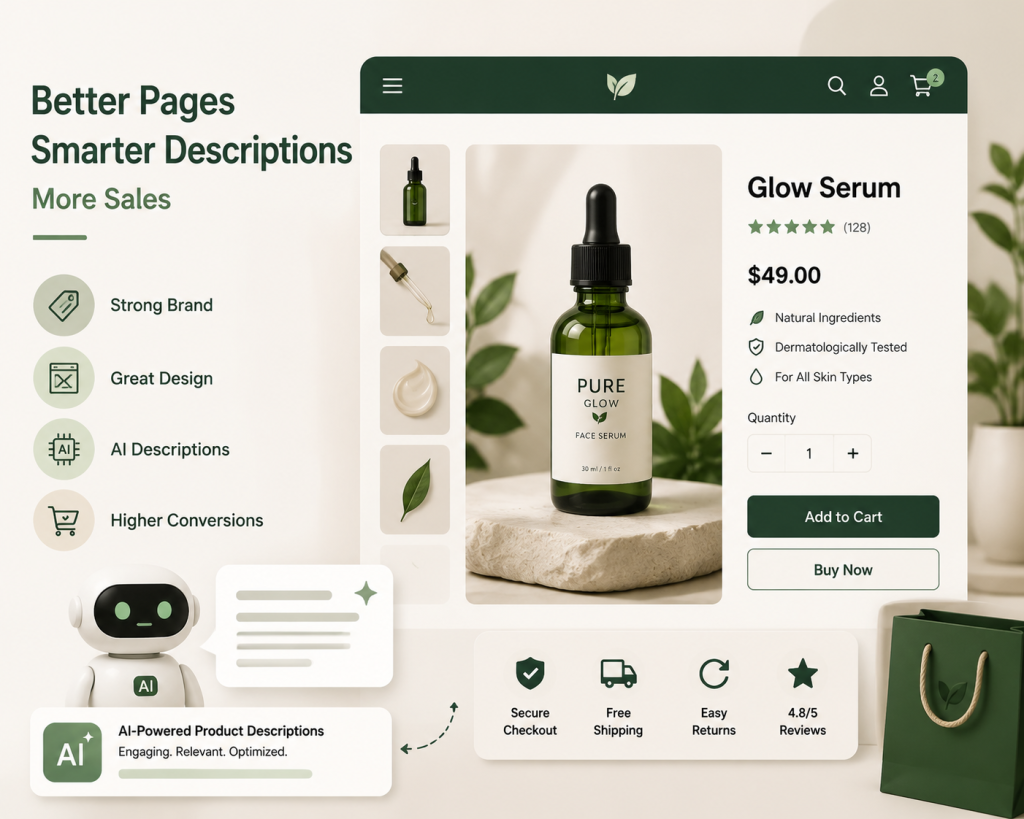
Premium ecommerce product page design places the most critical decision-making elements above the fold: product name, primary image, price, key benefit statement, and a clear call-to-action button. Below the fold, you expand with secondary images, detailed descriptions, size guides, reviews, and FAQs. This hierarchy mirrors the natural decision-making process of an online shopper.
3. Trust Signals and Social Proof
Trust signals are non-negotiable in modern ecommerce. Verified customer reviews, star ratings, user-generated content, media mentions, certifications, and return policy highlights all serve to reduce purchase anxiety. According to BrightLocal’s 2023 Consumer Review Survey, 91 per cent of consumers read online reviews before making a purchase decision.
4. Mobile-First Design Thinking
With over 60 per cent of ecommerce traffic now coming from mobile devices (Statista, 2023), your ecommerce product pages must be designed with mobile as the primary experience, not as an afterthought. This means thumb-friendly CTAs, fast image loading, collapsible content sections, and sticky add-to-cart buttons that remain accessible as users scroll.
Page Speed as a Design Element
Page speed is not simply a technical concern; it is a core component of ecommerce product page design. Google’s research shows that a one-second delay in mobile load time can reduce conversion rates by up to 20 per cent. Compress images, use next-gen formats like WebP, enable lazy loading, and minimise JavaScript execution to keep load times under two seconds.
Product Description Writing: The Science and Art of Persuasion
Even the most beautifully designed product page will underperform without compelling copy. Product description writing is the bridge between what your product does technically and why a customer should care deeply about it. Great product descriptions sell outcomes, not features.
The AIDA Framework Applied to Product Descriptions
The AIDA model Attention, Interest, Desire, Action is one of the most effective frameworks for product description writing. Start with a headline or opening sentence that grabs attention. Build interest by describing the core benefit in relatable language. Create desire by painting a picture of transformation or lifestyle improvement. Close with a clear action prompt that reduces friction to purchase.
For example, rather than writing ‘This moisturizer contains hyaluronic acid,’ a D2C skincare brand using AIDA might write: ‘Wake up to visibly plumper, deeply hydrated skin our clinically tested hyaluronic acid formula delivers 72-hour moisture from the very first application.’ The latter connects to the customer’s desire for results, not just ingredients.
SEO-Optimized Product Descriptions
From an e-commerce branding and search visibility standpoint, your product descriptions must serve two masters: the human reader and the search engine. Integrate target keywords naturally within the first 100 words of each description. Use structured formatting, short paragraphs, benefit-led bullet points, and descriptive subheadings to improve readability and crawlability simultaneously.
Avoid manufacturer-supplied descriptions entirely. Duplicate content across multiple retailers is a known SEO penalty trigger. Unique, brand-voice-aligned product description writing also reinforces your brand’s distinct positioning in a crowded market.
AI Product Description Generators: Scaling Content for D2C Growth
As D2C brands grow their product catalogues, the challenge of producing high-quality, unique descriptions at scale becomes significant. This is where an ai product description generator becomes a strategic asset. AI-powered content tools have evolved dramatically in the past two years, moving from producing generic, robotic text to generating contextually rich, brand-aligned content that requires only light editorial refinement.
How AI Product Description Generators Work
Modern ai product description generator tools are built on large language models trained on vast libraries of ecommerce copy, consumer psychology research, and persuasion frameworks. You input product attributes name, category, key features, target customer profile, and tone and the AI generates multiple description variants. The best tools also allow brand voice training, meaning the AI learns your specific tone and vocabulary over time.
Popular platforms in this space include Jasper AI, Copy.ai, Writesonic, and Anthropic’s Claude, all of which support ecommerce branding use cases with customizable tone settings, bulk generation capabilities, and SEO optimisation features.
Integrating AI into Your D2C Content Workflow
The most effective D2C marketing teams use AI as a first-draft accelerator, not a replacement for human strategy. A recommended workflow involves:
- Defining your brand voice guidelines and target customer persona clearly.
- Using an ai product description generator to produce initial drafts.
- Having a human editor refine for tone, accuracy, and emotional resonance
Publishing with SEO metadata fully completed.
This hybrid approach allows a lean D2C marketing team to produce descriptions for hundreds of SKUs in a fraction of the time traditional product description writing would require, while maintaining the quality standards that premium ecommerce branding demands.
Measuring AI Content Performance
Once AI-generated descriptions are published, track performance at the product level. Monitor conversion rate by product page, organic search ranking for targeted keywords, average session duration on ecommerce product pages, and bounce rate changes. Use A/B testing to compare AI-generated copy against human-written variants to continuously refine your approach.
D2C Marketing Strategies That Amplify Product Page Performance
Great ecommerce product page design and compelling descriptions mean little if the right audience never finds your pages. Effective D2C marketing drives qualified traffic to your best product pages while reinforcing brand identity at every stage of the customer journey.
Retargeting and Personalisation
D2C brands that use dynamic retargeting ads showing potential customers the exact products they viewed see significantly higher return on ad spend compared to generic campaigns. Combined with personalised ecommerce product pages that adapt content based on user behaviour (e.g., surfacing recently viewed items, recommending complementary products), retargeting becomes a powerful revenue recovery mechanism.
Email Marketing as a Product Page Driver
Email remains one of the highest-ROI channels in D2C marketing. Well-crafted product launch emails, back-in-stock alerts, and personalised recommendation sequences drive repeat traffic to your ecommerce product pages with buyers who already have a relationship with your brand. According to Campaign Monitor, email marketing delivers an average ROI of $44 for every $1 spent.
User-Generated Content as Brand Fuel
Encourage customers to share photos, videos, and reviews of your products on social media. Repurposing UGC directly on your ecommerce product pages creates authenticity that branded photography alone cannot replicate. This tactic simultaneously strengthens ecommerce branding and provides fresh, regularly updated content that search engines reward.
Conclusion:
Winning in the modern D2C ecommerce environment requires an integrated approach. Exceptional ecommerce branding sets the tone. Thoughtful ecommerce product page design converts attention into intent. Persuasive product description writing transforms intent into purchase decisions. And smart use of an ai product description generator allows you to scale these advantages across your entire catalogue without compromising quality.
The D2C brands that invest in these interconnected pillars and measure performance rigorously are the ones building sustainable competitive advantages in 2024 and beyond. Start with your highest-traffic product pages, apply the principles in this guide, and use data to continuously refine your approach. Your product page is not just a listing it is your most powerful salesperson.
FAQs
Ecommerce branding is the complete identity strategy a business uses to shape how customers perceive and experience its online store. For D2C businesses, branding is especially critical because there are no intermediary retailers to supplement brand perception. A strong, consistent brand identity builds trust, commands premium pricing, and drives repeat purchases all of which are essential for sustainable D2C growth.
The most impactful elements include high-resolution product imagery from multiple angles, a clear above-the-fold layout with a prominent CTA, social proof (reviews and ratings), detailed product descriptions, size or specification guides, and trust signals such as return policies and secure payment badges. Mobile-first design and fast page load speed are equally non-negotiable in 2024.
Yes, modern AI product description generator tools offer brand voice customisation features. You can provide tone guidelines, sample copy, vocabulary preferences, and target audience personas to train the AI on your specific style. The best results come from combining AI-generated drafts with light human editing to ensure accuracy and emotional authenticity.
A/B testing is the gold standard for product page optimisation. Test one variable at a time headline copy, hero image, CTA button color, price presentation, or description format. Use tools like Google Optimize, VWO, or Shopify’s built-in A/B testing functionality. Run tests for a statistically significant sample size before drawing conclusions, and document findings to build a compounding optimization strategy.
Focus on writing for the human reader first. Integrate your primary keyword naturally within the opening sentence or paragraph, use related secondary keywords in subheadings and body copy, and ensure the overall content answers the questions a potential buyer would have. Avoid forcing keywords into sentences where they sound unnatural. Google’s algorithms are sophisticated enough to reward genuinely helpful, well-written content.
Most businesses begin to see measurable improvements in rankings and visibility from local seo services within 3 to 6 months of consistent effort. Google Business Profile optimisations can produce faster results, sometimes within weeks, while on-page SEO improvements and link building typically take longer to fully influence rankings. The most important factor is consistency: local SEO rewards sustained, ongoing effort far more than short-term bursts of activity.
User-generated content (UGC) customer photos, reviews, and video testimonials serves as authentic social proof that builds trust far more effectively than branded content alone. Featuring UGC directly on product pages reduces purchase anxiety, increases time-on-page, and provides regularly updated content that search engines reward. D2C brands that actively cultivate and showcase UGC see measurable improvements in conversion rate and brand affinity.