Table of Contents
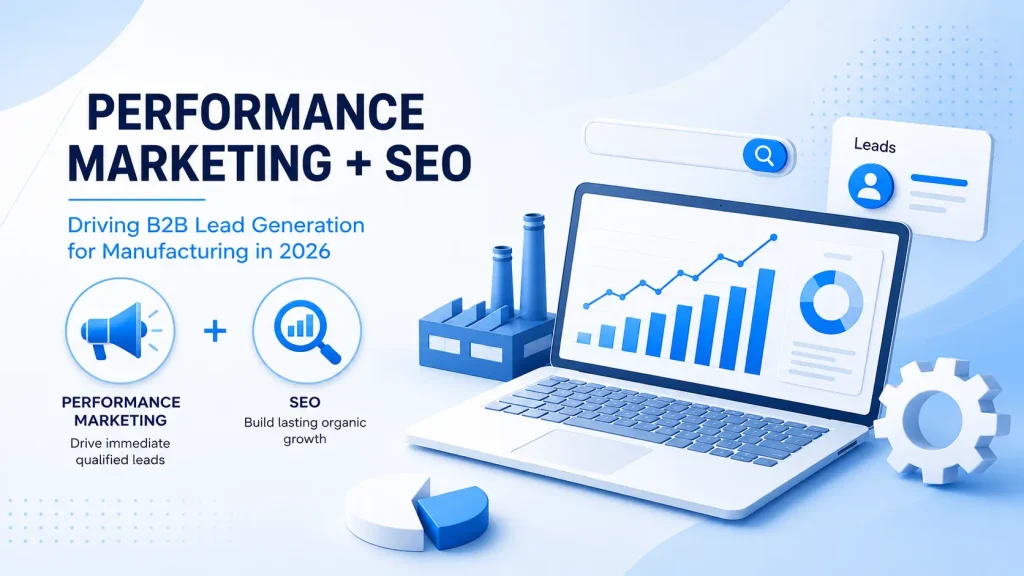
TogglePerformance Marketing + SEO for Manufacturing: AI-Powered Ad Optimization and Organic Strategy for B2B Lead Generation in 2026
Manufacturing has traditionally been a relationship-driven industry. Deals closed at trade shows, through referrals, and across handshakes that took years to earn. That world has not disappeared but it has changed dramatically. Today, the buyers doing the shortlisting, specifying the requirements, and influencing purchase decisions are doing their research online, long before they ever speak to a salesperson.
For manufacturers, this shift creates both a challenge and an extraordinary opportunity. The challenge is that digital marketing for manufacturing is unfamiliar territory for many businesses that have relied on field sales and distributor networks for decades. The opportunity is that most competitors are equally behind meaning the manufacturers that invest in intelligent B2B manufacturing marketing today are building pipeline advantages that compound over time.
This guide explores how the combination of AI-powered performance marketing and SEO is transforming lead generation services for manufacturers delivering short-term pipeline through paid ads while simultaneously building the organic visibility that lowers ad costs and creates durable competitive advantage. Because the smartest manufacturers are not choosing between paid and organic. They are running both and letting each one make the other more efficient.
Why Traditional Lead Generation No Longer Works for Manufacturers
The manufacturing sales cycle is long, the purchase decisions are complex, and the buyer committee is large. A single capital equipment purchase might involve an operations director, a procurement manager, a CFO, and a technical engineer each researching independently, each with different questions, and each needing different information before they are confident enough to engage a vendor.
Traditional lead generation services for manufacturers trade directories, print advertising, trade shows, cold outbound are expensive, slow, and increasingly ineffective at reaching this dispersed buying committee. More critically, they are almost impossible to measure. You cannot tell which trade show appearance drove which enquiry, or which print ad contributed to which quote request.
Performance marketing changes this completely. Every pound or dollar spent on digital marketing for manufacturing is trackable. Every click, every form fill, every phone call can be attributed to a specific campaign, a specific ad, a specific keyword. And when you combine that paid visibility with a strong SEO foundation, you create a system where organic search traffic reduces your dependence on ad spend — while paid ads accelerate results while your SEO rankings are still building.
Short-Term Wins vs Long-Term Advantage: Why Manufacturers Need Both
This is the core strategic insight that separates manufacturers building durable growth from those caught in a cycle of expensive, short-term ad dependency:
Performance Marketing: The Short-Term Engine
Paid performance marketing Google Search Ads, LinkedIn Ads, programmatic display — delivers results quickly. A well-configured campaign can generate qualified enquiries within days of launch. For manufacturers with immediate pipeline pressure, a new product launch to support, or a trade show approaching, ad optimization through paid channels is the fastest path to visible pipeline.
The limitation is cost dependency. The moment you stop paying, the traffic stops. And in competitive industrial sectors, cost-per-click on high-intent manufacturing keywords can be significant meaning every lead carries a direct, ongoing cost.
SEO: The Long-Term Compounding Asset
SEO for manufacturing marketing works differently. Unlike paid ads, organic search rankings are not switched off the moment your budget runs out. A well-optimised technical page, a detailed application guide, or a comprehensive case study that earns a first-page Google ranking continues to generate traffic and enquiries for months and years at zero incremental cost per click.
The limitation is time. Meaningful SEO results in competitive manufacturing sectors typically take three to six months to appear and six to twelve months to reach full performance. SEO is not a short-term tactic it is a long-term investment that requires patience and consistency.
The Combined Strategy: How Each Makes the Other More Efficient
Here is where the real advantage lies. When manufacturers run performance marketing and SEO together as an integrated strategy, each channel actively supports the other:
- Paid ads reveal what converts. Performance marketing generates conversion data fast which keywords drive enquiries, which ad messages resonate with which buyer personas, which product categories attract the highest-intent traffic. This data directly informs SEO content and keyword prioritization, making your organic strategy smarter from day one rather than relying on estimates.
- SEO reduces your ad costs over time. As organic rankings build for your target keywords, you can reduce paid spend on those terms redirecting budget to keywords where you do not yet rank organically. Manufacturers who run this strategy consistently find their blended cost per lead declining quarter over quarter, even as total lead volume grows.
- Organic content improves paid ad quality scores. Google rewards ads that link to genuinely relevant, high-quality landing pages with lower CPCs and higher ad positions. A strong SEO content foundation detailed product pages, technical guides, case studies directly improves the quality scores of your paid campaigns, making every ad pound work harder.
- Retargeting amplifies organic content reach. Visitors who found your site through organic search are your warmest audience. Retargeting them with paid ads featuring case studies, specific product offers, or consultation invitations converts the awareness built by SEO into active pipeline in a way that organic alone cannot achieve.
Understanding the B2B Manufacturing Buyer Journey
Effective B2B manufacturing marketing starts with a clear understanding of how industrial buyers actually behave because they behave very differently from B2C consumers, and even from buyers in less technical B2B sectors.
The Research Phase is Long and Independent
Gartner research consistently shows that B2B buyers spend only 17 percent of their purchase journey in conversations with potential vendors. The rest of the time, they are researching independently reading specification documents, watching product demos, comparing technical datasheets, and seeking peer recommendations.
For lead generation services targeting manufacturers, this means that marketing must reach buyers during this independent research phase not just when they are ready to request a quote. This is precisely where SEO plays its most critical role: ensuring your technical content, product pages, and application guides appear at the top of organic search results when buyers are researching solutions, long before they identify themselves to your sales team.
Multiple Decision-Makers, Multiple Channels
Different members of the buying committee use different channels. Technical engineers search Google for specifications and comparisons this is where SEO delivers its most targeted organic traffic. Procurement teams use LinkedIn and industry directories this is where LinkedIn Ads and ABM excel. C-suite decision-makers respond to peer recommendations and thought leadership this is where content marketing and retargeting build the brand familiarity that influences final decisions.
A sophisticated digital marketing for manufacturing strategy runs coordinated campaigns across multiple channels simultaneously reaching each stakeholder with the right message in the right environment. AI-powered campaign management automates this coordination and continuously optimises performance across all channels.
The AI-Powered Performance Marketing Stack for Manufacturers
Google Search Ads: Capturing Active Demand
Google Search Ads remain the highest-intent paid channel for lead generation services in the manufacturing sector. When a procurement manager searches for a specific type of industrial equipment, a custom fabrication service, or a component supplier, they are actively in the market and a well-optimized search ad positions your business at exactly that moment of need.
AI-powered ad optimization within Google Ads through Smart Bidding, Responsive Search Ads, and Performance Max campaigns uses machine learning to analyse millions of signals and automatically adjust bids and creative combinations to maximise conversion value. For manufacturers running complex campaigns across dozens of product categories, this automation is far more effective than manual bid management.
- Long-tail keyword targeting: Manufacturing buyers search with technical specificity. Targeting precise queries like ‘CNC machining services aluminium aerospace tolerances’ delivers far better cost-per-lead than broad category terms and these long-tail terms are also prime SEO targets where organic rankings are achievable within six to nine months.
- Negative keyword management: Industrial keywords attract significant irrelevant traffic. Rigorous negative keyword lists prevent budget waste on consumer searches that share vocabulary with your industry terms.
- Ad extensions for credibility: Callout extensions highlighting certifications (ISO, AS9100), case study snippets, and lead time guarantees build trust signals directly in the ad critical for B2B manufacturing marketing where credibility drives shortlisting decisions.
LinkedIn Advertising: Reaching the Full Buying Committee
LinkedIn is the most powerful paid channel for digital marketing for manufacturing when the goal is reaching specific job titles, seniority levels, and industries. No other platform allows you to target ‘Senior Procurement Manager at Aerospace Manufacturing companies with 500+ employees’ with this level of precision.
LinkedIn’s AI-powered campaign tools have matured significantly. Predictive audiences use LinkedIn’s behavioural data to identify users who resemble your existing customers. Document Ads allow manufacturers to promote technical whitepapers and case studies directly in the feed. Conversation Ads deliver personalised message sequences directly to a prospect’s LinkedIn inbox, opening direct dialogue with decision-makers who might never see your email outreach.
Account-Based Marketing (ABM) Powered by AI
For manufacturers targeting a defined list of high-value enterprise accounts, Account-Based Marketing represents the most efficient form of lead generation services available. AI platforms identify which target accounts are currently showing buying intent signals and automatically trigger coordinated ad campaigns, content sequences, and sales alerts. For B2B manufacturing marketing teams with limited headcount, AI-powered ABM delivers enterprise-level targeting precision without requiring an enterprise-level team.
SEO Strategy for Manufacturers: Building the Organic Foundation
While performance marketing fills the pipeline today, SEO builds the organic visibility that reduces your long-term cost per lead and creates competitive moats that paid advertising cannot replicate. Here is how manufacturers should approach SEO in 2026.
Technical SEO: Getting the Foundation Right
Before any content investment pays off, the technical foundation of your website must be sound. For manufacturing marketing SEO, this means fast page load speeds (Google’s Core Web Vitals), mobile responsiveness, clean URL structures for product and service pages, schema markup for products and services, and clear internal linking between related product categories and application areas.
Many manufacturing websites are built around internal product nomenclature and catalogue structures that make sense internally but bear no relationship to how buyers actually search. A technical SEO audit mapping your site architecture to real buyer search behaviour is typically the most immediately impactful investment for manufacturers starting their SEO journey.
Keyword Strategy: Technical Long-Tail First
The keyword strategy for digital marketing for manufacturing SEO is fundamentally different from consumer SEO. Manufacturing buyers search with extreme technical specificity. Broad terms like ‘manufacturing services’ are dominated by aggregators and directories and carry low commercial intent. The SEO opportunity for manufacturers lies in the long-tail specific, technically precise queries with clear commercial intent and achievable competition levels.
The same long-tail keywords that drive your most cost-efficient paid search conversions the specific application queries, material specifications, and industry certifications that attract genuinely qualified traffic are your highest-priority SEO targets. The performance marketing data you are already collecting tells you exactly where to focus your organic content investment.
Content That Converts: Technical Depth Wins in Manufacturing SEO
In manufacturing SEO, the content that ranks and converts is genuinely technical. Google’s quality assessment for industrial and engineering content rewards depth, specificity, and demonstrable expertise. Thin product pages and generic ‘About Us’ content do not rank for competitive manufacturing queries.
The content assets that consistently drive both organic rankings and lead generation in the manufacturing sector:
- Application-specific landing pages: Pages targeting ‘aluminium CNC machining for aerospace components’ or ‘custom gasket fabrication for oil and gas’ outrank generic service pages and convert at dramatically higher rates because they match the exact language and intent of qualified buyers.
- Technical whitepapers and application guides: Deep-dive content that addresses specific engineering challenges generates high-quality leads and earns backlinks from industry publications — both of which strengthen overall organic rankings.
- Case studies with specific metrics: Manufacturing buyers are persuaded by evidence, not promises. Case studies with production volumes, tolerance achievements, lead time improvements, and cost savings outperform generic testimonials for both SEO and conversion.
- Product specification sheets and technical resources: Making technical resources freely available creates genuine value for engineers in the research phase, generates organic search traffic, and produces contact information for lead nurturing sequences.
Link Building for Manufacturing Websites
Organic authority — the quality and quantity of backlinks from relevant external websites — is a critical determinant of SEO ranking performance. For manufacturers, link building opportunities include:
- Contributing technical articles to industry trade publications and engineering journals
- Industry association memberships and directory listings that carry genuine domain authority
- Supplier and partnership pages on customer and partner websites
- Local business directories and chamber of commerce listings for location-specific manufacturing SEO
AI-Powered Ad Optimization: How It Works in Practice
Automated Bid Management and Budget Allocation
AI-powered ad optimization platforms process thousands of signals per auction, adjusting bids in real time based on predicted conversion probability. For manufacturers running lead generation services campaigns across multiple product lines and geographies, AI bid management ensures budget flows toward the highest-converting combinations automatically no analyst intervention required.
Dynamic Creative Optimization (DCO)
AI creative optimisation continuously tests different combinations of headlines, descriptions, images, and CTAs — identifying which creative elements perform best for different audience segments. For digital marketing for manufacturing, this is particularly valuable because different members of the buying committee respond to different creative messages. An engineer responds to technical precision. A procurement manager responds to delivery reliability and cost transparency. AI creative testing identifies these preferences at scale and personalises creative delivery accordingly.
Conversion Rate Optimisation for Landing Pages
AI-powered landing page optimisation tools including multivariate testing platforms like VWO and Optimizely continuously test page variants to identify the layouts, copy angles, and trust signals that maximise form completion rates. For manufacturers, AI testing often reveals that detailed case studies, specific client logos, precise specification language, and clear next-step descriptions outperform generic benefit statements.
Measuring ROI Across Both Channels: The Full-Funnel Framework
One of the most persistent challenges in B2B manufacturing marketing is attribution — connecting marketing activity to revenue in a sales cycle that might span 6 to 18 months. A complete measurement framework tracks the full funnel across both paid and organic channels.
- Cost per qualified lead (CPQL) by channel: Track cost per qualified lead separately for paid and organic channels. As SEO matures, you will typically see organic CPQL declining while paid CPQL stabilises or improves due to better quality scores — evidence that the combined strategy is working.
- Organic vs paid traffic mix over time: Track what percentage of your total website traffic and lead volume comes from organic search vs paid channels. A growing organic share is direct evidence that SEO investment is reducing your dependence on paid ad spend.
- Pipeline contribution by channel: Track the total value of sales opportunities in your CRM that originated from each marketing channel. This connects both ad optimization investment and SEO effort directly to revenue potential.
- Multi-touch attribution: B2B buyers interact with multiple touchpoints before converting — often discovering you through organic search, being retargeted by paid ads, and converting via a LinkedIn Message Ad. Multi-touch attribution models distribute conversion credit across all contributing interactions, giving an accurate picture of how paid and organic channels are working together.
- Return on ad spend (ROAS) trend over time: As SEO compounds and organic traffic grows, your blended ROAS should improve even if paid ROAS stays constant because you are generating more total pipeline with the same or lower total spend.
Common Pitfalls in Manufacturing Performance Marketing and SEO
Running paid and organic in silos.
The most common and most expensive mistake manufacturers make is treating performance marketing and SEO as separate initiatives managed by separate teams with separate budgets and separate goals. The compounding advantage comes from integration shared keyword data, shared content assets, shared conversion insights. Build one unified strategy with two execution tracks.
Targeting too broadly on paid.
Generic terms like ‘manufacturing services’ or ‘industrial equipment’ attract enormous volumes of irrelevant searches. Effective lead generation services for manufacturers requires precise, technical keyword targeting the same long-tail specificity that makes your SEO content rank for qualified traffic.
Abandoning SEO before it compounds.
SEO for manufacturing marketing requires sustained investment before results are visible. Manufacturers who start an SEO programme and abandon it after three months never reach the compounding phase where organic traffic meaningfully reduces paid ad dependency. Commit to a twelve-month SEO roadmap alongside your performance marketing campaigns.
Measuring leads instead of pipeline.
Volume of leads is a vanity metric without quality context. A campaign generating 50 highly qualified leads from target accounts is worth far more than one generating 500 unqualified form fills. Align both your paid ad optimization goals and your SEO content strategy with pipeline value, not lead count.
Conclusion
The manufacturers winning new business in 2026 are not necessarily the ones with the biggest factories or the longest track records. They are the ones showing up consistently in the digital spaces where their buyers are researching with the right message, at the right moment, supported by intelligent ad optimization that continuously improves performance and an SEO foundation that makes each new organic ranking a permanent, compounding asset.
Effective lead generation services for manufacturers is not about choosing between paid and organic. It is about building a coordinated digital marketing for manufacturing engine where performance marketing fills the pipeline today while SEO reduces your cost of that pipeline over time — creating a system that gets more efficient with every month that passes.
Start with one paid channel. Build a rigorous measurement framework. Run your SEO programme in parallel, targeting the same long-tail keywords your paid campaigns have already proven convert. Let the data and AI ad optimization guide your paid investment, and let the organic content compound into rankings that no competitor can buy their way to the top of. That is how manufacturers build marketing advantages that last.